


Drone-Based Digital Dog Nose Sensor Developed at URI Could Put Bomb Sniffing Dogs Out of Work
GoLocal LIVE
Drone-Based Digital Dog Nose Sensor Developed at URI Could Put Bomb Sniffing Dogs Out of Work
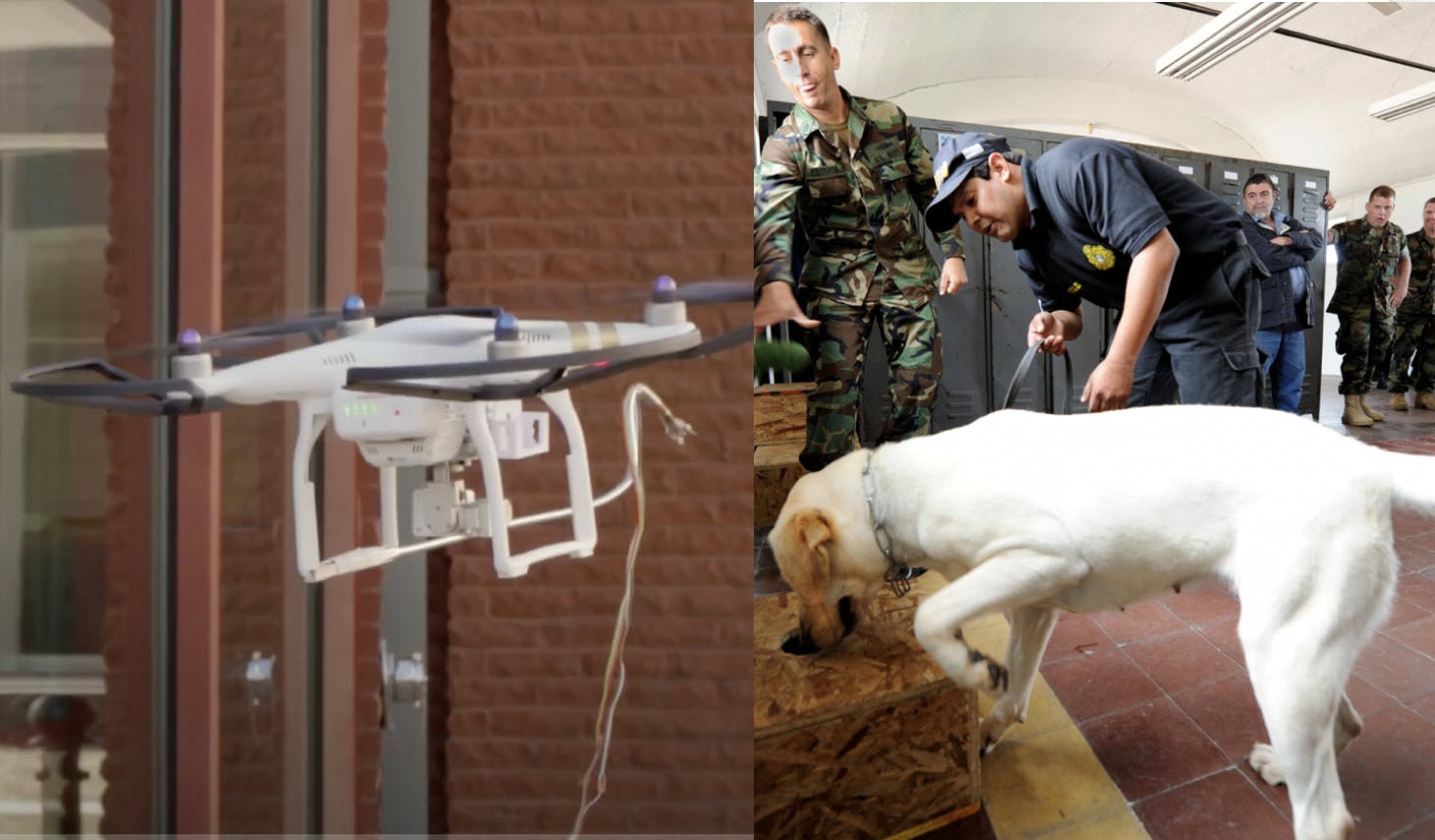
"This is potentially life-saving technology," said Gregory. "We have detected things at the part-per-quadrillion level. That's really single-molecule detection."
GET THE LATEST BREAKING NEWS HERE -- SIGN UP FOR GOLOCAL FREE DAILY EBLASTGregory appeared on GoLocal LIVE and discussed the flexibility and range of application for the micro-sensors.
"The platform is broad-based, so you can apply it to lots of different venues, with lots of different end-users," said Gregory.
While his research is largely funded by the Department of Homeland Security, other government agencies have provided funding and taken notice of Gregory's sensors and their potential applications.
"This project started as a DARPA funded project mainly to look at toxic gases -- threats that would be used in gas warfare, and when I say gases, chemical weapons,” said Gregory on GoLocal LIVE. DARPA is Defense Advanced Research Projects Agency -- the agency that has provided funding to private sector development of some of the country's super military tools.
Real Threats on the Battlefield in the Airport of Stadium
Gregory said the directive from the federal funding agencies was to look at “threats that could be put on airplanes, put in public transportation venues subways trains -- all those venues that were targets."
"Can you sniff out threats in those venues for these potentials really deadly explosives, that some of them can be made really easily by going to the local drug store right or hardware store and you have some very nasty material?” he said.

If a soldier or first responder suffered an open wound from shrapnel, Gregory's sensors could help determine if the wound became infected.
"Hydrogen peroxide generated by the human body for wounds is an indication of how good or how bad antibiotics are working to fight the wound," said chemical engineering doctoral student Peter Ricci. "Our sensor could be used as a wearable device to sniff out peroxide coming from the wound at the part-per-billion level."
Ricci has been working on the sensor with Gregory for five years.
According to Gregory, the U.S. Coast Guard has shown an interest in using the technology to "sniff out" illegal drugs being smuggled into the United State aboard ships.
"By decreasing the thermal mass of the sensor, we've decreased the amount of power required to run the sensor," said Gregory. "We started with a thermal mass on the order of grams. Now the thermal mass of our sensor is on the order of micrograms."
He says one of the keys to making a device as small and powerful as Gregory's is to find the right battery.
"We have partnered with a company that makes very thin, low-mass batteries in Colorado called ITN Energy Systems," Gregory said. "They make lithium batteries that are no thicker than a piece of paper. The process has been about finding the right partners, which helps us improve our catalysts and improve our sensor platform."