


Trader Joe’s: Great Market, Lost Opportunity–Architecture Critic Morgan
Will Morgan, Architecture Critic
Trader Joe’s: Great Market, Lost Opportunity–Architecture Critic Morgan

The arrival of Trader Joe’s on South Main Street is being heralded with much fanfare that one might think it was a real city-saving event. A place to buy food for Fox Point residents, college students, and the denizens of all the new apartment buildings in the 195 Commission’s remittance area, is a welcome addition to the area.
GET THE LATEST BREAKING NEWS HERE -- SIGN UP FOR GOLOCAL FREE DAILY EBLAST
With the exception of the Wexford building, and the pedestrian bridge, every new piece of construction in the so-called Innovation District is mediocre. Trader Joe’s proclaims that each of its nearly 600 stores are “designed to represent the surrounding neighborhood.” Those hoping for a neighborhood-enriching landmark–forget adventurous or innovative–were bound to be disappointed, as well as challenged to reach a store on a traffic island.

No one would even contemplate Trader Joe’s without parking, and it has plenty. Despite a sensible one-way route through the lot, there is only a single entrance/exit, which could be a bottleneck. The spaces are kindly hidden, jammed in behind a couple of apartment blocks.

Are there some positive things about Trader Joe’s? After all, the upscale California-based grocery has been around for more than half a century, earning a progressive reputation for its private labels and iconic red shopping carts, plus environmentally friendly policies, such as cage-free eggs and biodegradable shopping bags.
The market’s only distinguishing exterior feature is the roof along its front facade. The diagonal beams supporting the giant protective overhang, with their bolt pattern securing the steel sandwiched between the wood, are handsome and industrially decorative.

The large front windows flood the 9,400-square-feet store with natural light (the Fox Point store is slightly smaller than the typical Trader Joe’s). That, plus wide aisles unencumbered by the usual supermarket sales kiosks, make for a very pleasant and calming shopping experience. Murals, featuring local landmarks, and painted like giant postcards, are the corporation’s nod to the city’s assets.

Given the company’s policy of embracing local history, might Providence’s newest market have reflected its Fox Point neighborhood better? One might look to the 1924 South Brooklyn Savings Bank in the Cobble Hill section of Brooklyn that was transformed into a hugely popular Trader Joe’s. Rather than being razed, the century-old mercantile temple remains a landmark, its monumental banking hall intact.
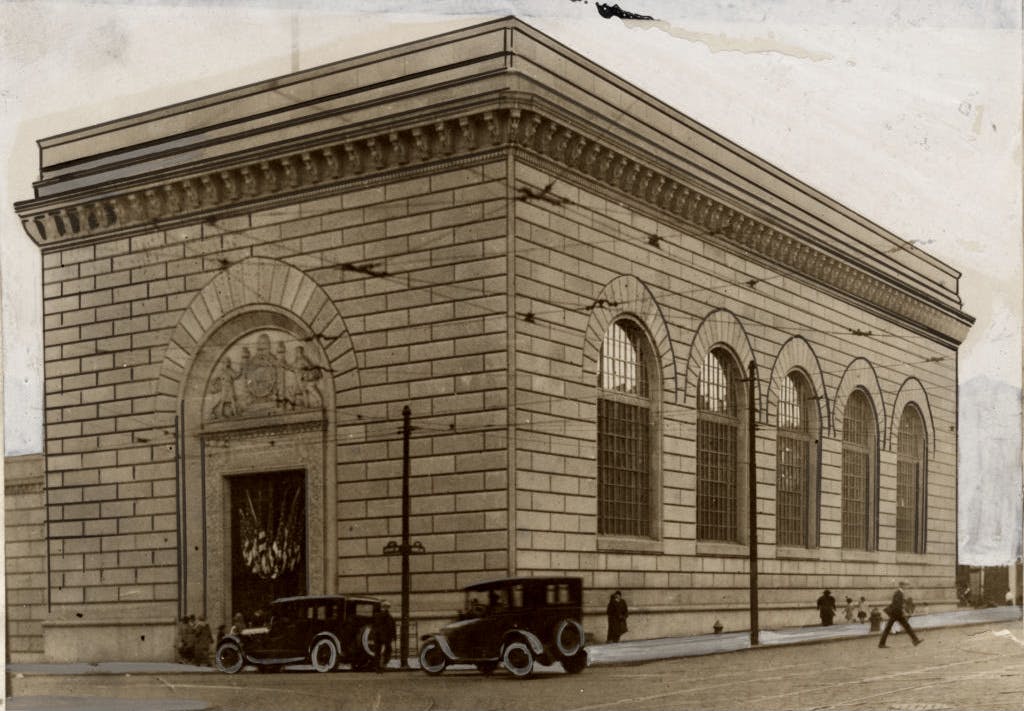
How innovative it could have been if Trader Joe’s had been placed behind the First Federal Bank on Weybosset Street. This skeletal façade has waited for fifteen years to be brought back to life. Instead of placing the store downtown (and close to future residents of the Industrial Trust), it is nestled onto an exit ramp off I-195.

After the announced move of a major bank from the Turk’s Head Building to taxpayer-subsidized new construction just behind Trader Joe’s, former Mayor Joseph Paolino called for the resignation of the 195 Commission. Let’s hope that Governor Dan McKee takes action.
