


Keeping Up With The Kindle
Maggie Lange, GoLocalProv Correspondent
Keeping Up With The Kindle
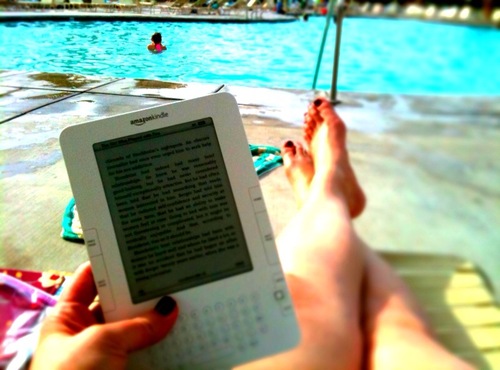
Its portability and pleasant aesthetics are Amazon’s strongest selling points for their e-book reader. Ann Hood, a novelist and West Warwick native who now lives in Providence, grew up with books surrounding her, but is a devoted convert. “I travel a lot," she says, "and sometimes have to pack a bag of books to be certain I won't run out of reading while I'm away." On a recent trip to China and Tibet, Hood says she "filled my Kindle and read my way happily from Shanghai to Tibet to Hong Kong. Call me living in the 21st century, I guess.”
The Kindle is sleekly attractive, a delicate blend of nostalgia into technological mastery. Like many e-Readers, the Kindle strives to straddle the divide between old and new. The Kindle has book-like proportions, ink-technology, margin-mimicking white frame set in a white, Apple-like simplicity. The newest e-reader on the scene, the Kobo, offers a cloth-like book cover to imitate the feel of the real thing.
GET THE LATEST BREAKING NEWS HERE -- SIGN UP FOR GOLOCAL FREE DAILY EBLAST
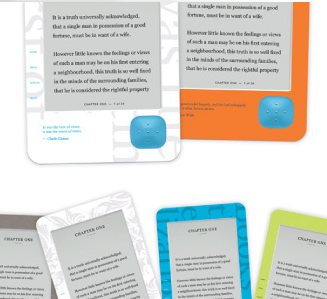
It appears that market domination is not in the Kindle’s future, it won’t change the dialogue of “new, new, new” in gadgetry – but will book replacement devices change the way we read? For one, e-readers like the Kindle prevent “book-sharing” in the same way that the Apple Store prevented music sharing. Sharing, lending, re-selling, buying used is intensely part of the print book culture. When finished with a book, people are just as likely to share, or resell their book rather than re-shelve it, a practice that can justify the cost of a $30 hard-cover.
In addition to being a convenient experience, purveyors of e-readers claim a less expensive reading experience. After the initial investment, books are sold to Kindle readers at $9.99, a misleadingly low price as Amazon actually sells Kindle books at a loss to encourage sales of the device. Books Kobo, the Nook, the i-Pad and Sony-Reader can be upwards of $15. However, with used books available on Amazon for pennies, any price seems high.
But even $9.99 can seem pricy for something that should potentially cost nothing more than bandwidth. E-Books cost nothing to print, bind, mail, shelve, or organize – and are made out of a whole lot of nothing – no paper or binding or cloth covering. However, most of the costs of books go to sources other than the materials. The New York Times broke down the costs: if a hardcover is $26, about $13 goes to the publisher – who will pay about $3 to print and ship, $1 for marketing, $1 for design and copy-editing, $4 to the author, which leaves about $4 for the publishing house. The remaining $13 go to the bookseller.
Local Impact
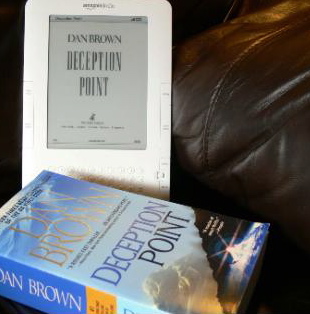
That’s because, Amato believes, for many avid readers, there is nothing like the real thing. Amato said he couldn’t imagine a time when people won’t want a hardcover book, “I enjoy having books on my bookshelves. I enjoy flipping through the pages on books, browsing in bookstores, being able to see my books displayed. I can't do any of that with a Kindle.” Amato then presciently compared books to vinyl records; obsolete technologically, but trendy and nostalgic.
Anne Robinson, the Executive Director of Providence Community Library, says, “I think people still love the printed word and the feel of a book. When parents read to their children, I can’t imagine them reading from a Kindle – it’s the actual book and the feel about it – the tactile part is very important.”
However, an e-reader can offer many options a book cannot. At 10.3 ounces, the Kindle is thinner and lighter than many paperbacks. In addition to hundreds of thousands of books, it offers print and web-based magazines that download with prompting. A Kindle user can switch seamlessly from the latest memoir to front-page news without rustling pages or rolling over in bed. Also, the Kindle is accompanied by Amazon’s seamless, 1-click shopping experience, a bookstore that compares reviews and prices.
Despite these new features, Kindle might always play second fiddle to actual books. “At home, I read real books. Kindle stays in my suitcase for travel,” says Hood, “I love the ease of it, but nothing can replace the heft and smell of the real thing.”
For traveling e-books certainly seem absolutely logical. As the plane headed down the runway, I envied the compact modernity of this man’s device. Before my trip, I deliberated for ages and settled on four books (one hardcover) for four days, and felt like an out of touch, over laden, packrat. However, when the man was asked to stow his Kindle for take-off and landing, I flipped the pages of my three and half pound hardcover happily.