


Quirky Destination: Narragansett Indian Head
Christopher Scott Martin, GoLocalProv Contributor
Quirky Destination: Narragansett Indian Head
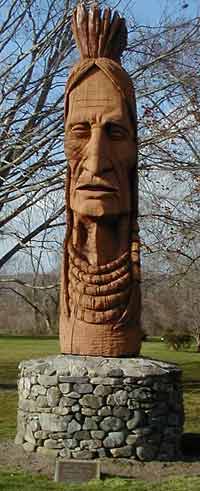
If you've ever seen the huge Indian head that stands at the corner of Route 1A and Strathmore Street in Narragansett, you may have wondered where it came from, and what it was for.
What if we told you that the statue in Narragansett was only one of 67 erected in Canada and every state of the Union? What if we told you they were all the work, completed over the span of 30 years, of a single dedicated man?
GET THE LATEST BREAKING NEWS HERE -- SIGN UP FOR GOLOCAL FREE DAILY EBLAST
I will make one sculpture of an Indian in each of the fifty states to honor them!
Traveling the United States in his "Ghost Ship" (a modified Dodge maxi-van), the self-taught artist spent summers in the north and winters in the south, stopping wherever local officials would allow or invite him to carve one of his "Whispering Giants." He accepted no money for his labors—the Hungarian immigrant considered the monumental sculptures to be a gift to his adopted country—but subsisted on whatever he could earn from odd jobs and the sale of small carved objects. By the time he rolled into Rhode Island in June 1982, he had 41 silent sentinels under his belt. Rhode Island's would be his 42nd.
Toth's path to Narragansett was hardly direct. He turned down an offer to carve at Charlestown's Ninigret Park (too isolated) and became mired in South Kingstown bureaucracy. Meanwhile, he began work on a massive Douglas fir, donated by Jim Thompson of Thompson's Sawmill in Hopkinton.
Finally the town of Narragansett stepped up. No red tape here; approval was soon given to place the monument in Sprague Park, at the entrance to Canonchet Farm. Although the statue was given for free, Narragansett promised $900 to erect the carving and coat it with preservative. Charlestown felt they had been snubbed, and some members of the Narragansett Tribe protested that they had not been consulted.
Sometime around the second week in July, the 23-foot sculpture was transported from Hopkinton to Narragansett so that Toth could complete his work on site. The artist often found himself performing for crowds of people who stopped to watch him patiently chip away at the wood. Proving that not all Narragansetts were cheesed off at Toth, two Indian stonemasons, Craig "Little Fox" Champlin and Ellison "Sonny" Brown, donated their time and skills to construct a solid base of beach stone and fieldstone.
Wendi-Starr Brown, Narragansett tribal historian, feels that Toth's depiction of a Narragansett Indian is pretty generic. While the sculpture's look—facial features, hairstyle, jewelry, and headdress—are not incompatible with Narragansett culture and traditions, neither are they particularly specific to them. However, Brown acknowledged that the addition of the stonework base, crafted by Narragansett tribe members, sets this statue apart from Toth's other creations.
Paulla Dove Jennings, curator of the Tomaquag Indian Memorial Museum in Exeter, remembers when Toth first came to Rhode Island and her father (Ferris Dove, the last traditional war chief of the Narragansett Tribe) introduced him at tribal council, where he explained his mission. He met and spoke with many Narragansetts, gaining a sense of the culture that he would use in crafting his sculpture. For her, it embodies the good will and effort of its creator, as well as the message he was trying to get across.
Toth named the sculpture "Enishkeetompauog Narragansett." The first word, according to Brown, translates roughly as all human beings. Narragansett means at the small, narrow point. So the full title means, essentially, the people of the small, narrow point—a part of all humanity. This echoes another of Toth's themes, that the statues represent all humanity and stand against injustice to all people.
Sprague Park, Kingstown Rd. (Rte. 1A) and Strathmore St., Narragansett.
Christopher Scott Martin is a founding editor of www.quahog.org, and a passionate archivist of all things historic and local.