


The Urban Gardener: Rise and Shine
Leonard Moorehead, GoLocalProv Gardening Expert
The Urban Gardener: Rise and Shine
Take the long view. Not for us the temporary transient. We view each planting as if the alpha and the omega. Don’t you sense relief from busy schedules? The garden pulls us aside from crosswalks. Stop, breath deep and exhale. Ah, the present and the future are one. Our needs appear and rewards beyond conception are ours. Let’s take a look at those perennials that anchor the garden. They are legion. Every gardener relies upon the stalwart vegetables, flowers and herbs that appear to skip cultivation, germination, or annual choice. Savvy gardeners understand perennials require familiar techniques far from benign neglect.
Asparagus officinalis is the premier perennial spring vegetable. Considered a delicacy since ancient times it is native to the shorelines and estuaries of North West Europe. Succulent spears so close to the heart whisper of their secret bounty of vitamins, roughage, taste and flavor. They are a sure investment during times of great change. Gardeners achieve their best results when emulating natural conditions native to each plant.
GET THE LATEST BREAKING NEWS HERE -- SIGN UP FOR GOLOCAL FREE DAILY EBLASTAsparagus thrives in sunny rich well drained loams. As predictable as high tide asparagus spears ascend through thick layers of manure, chopped leaves and goodness. Choose your site with an eye to plenty of sunshine. Consider each stage of the plant. Prepare a bed by double digging the site, turning the topsoil under and burying plenty of organic materials. Leaves are abundant, free or cheap and just right for urban gardeners. Push under each spade full of soil garden detritus such as leaves, stalks, shredded paper and other slow to decay organic materials. We are in for the long haul here. Asparagus has a long life and needs to start off on the right foot.
Virtually everyone buys asparagus roots to plant. They are ordinary clusters of string bean like roots with apparent tops and bottoms. Martha Washington is the prevailing cultivated variety only a step away from the wild. Indeed, asparagus forms bright red seeds late in the summer and often colonize roadsides. Gardeners achieve success with 2 year old roots. I tend to plant closely. Give your asparagus room. Soak the roots overnight. I dust all transplants with Rootone, a rooting hormone long accustomed to gardeners. Harmless and effective, the impetus to form thick clusters of roots is our goal. Mix a generous portion of bone meal into the top six inches of soil, especially near the future plants.
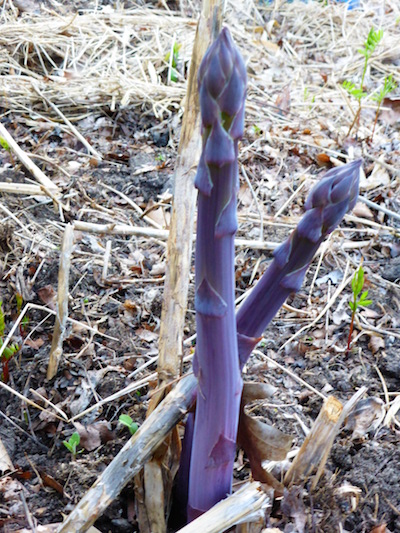
Plant the roots in a permanent location. Asparagus roots form dense subsurface root systems. The mature plants may grow to four or five feet tall and are prone to falling over. I re-cycle old picket fences around beds which allow growth and support the mature plants. You’ll want the fully grown asparagus to flourish and form extensive root systems. The ferny mature plants offer green softness and depth to the garden. They are an excellent foil to other plants. The contrasting foliage emphasizes bloom on other plants. There are purple stemmed varieties of asparagus which offer an otherwise humble plant some color. Cooking changes the stems to green.
OK, you’ve prepared a sunny humus rich loam bed and gently placed the soaked root clusters just below the soil line. Cover and tamp the soil down. Never leave soil exposed to the elements. Rather, spread a thin layer of mulch over the soil and add as the plants establish themselves. This is when gardeners accept the long view. Pundits advise a two year wait for the roots to become settled. Asparagus eventually forms a dense colony. Character enters the fray. Patience and hope are the main ingredients to success here. During this probationary period, location determines so much. Failure is quickly apparent and the main culprit is lack of sunshine. Asparagus has no tolerance for shade.
Be abundant. Give yourself a good head start with careful soil preparation. Allow the first couple years of shoots to grow un-harvested. Every ounce of greed urges one to break off a few asparagus spears after a visit to the expensive gourmet produce department. Don’t. Take a look around and see just how much money this nearly carefree vegetable costs. Consider the pencil thin spears that masquerade as asparagus. Go home and be grateful. Your home grown asparagus will surpass those transported immense distances from places free from environmental protections. Insecticides are only one of a stew of chemical mixtures poured onto our mother earth. Patience now rewards latter. No chemicals for you nor your patch of earth.
Do mulch heavily over the winter. Asparagus does very well under a permanent mulch. The delicious spears begin to emerge just around the last frost date. Keep an eagle eye on the asparagus bed. The shoots pop out of the soil and grow very quickly. Reward yourself for the two year wait, it is worth it. Grasp the shoots below the mulch and break off. Be vigilant, the now established roots send up new shoots. You’ll relish the thick spears for dinner and leave the pencil sized shoots to grow and nourish the root systems. A dozen asparagus plants will provide an abundant harvest of spears for weeks. Do consider the future and allow the smaller shoots to mature. They will quickly grow. Don’t bother harvesting these lesser shoots or cut down taller shoots. For a very short time the entire stem of asparagus is edible, soon however the shoot forms tough fibrous stalks.
Asparagus is rich in nutrients. It is best cooked much like it’s harvested, quickly. Gardener’s possess the secret to happiness in the asparagus bed. Hope, patience, kindness are all aspects of cultivating the asparagus. Don’t dismiss this tasty vegetable as being too slow for you. Some things take time. Plant asparagus as soon as possible in new gardens, their two year formation of root systems discourages some. Foster hope and persist. The wait is forgotten as the first bite melts in the mouth. Never pay high prices again for asparagus. Your friends will love you more as you visit the garden and break off thick new spears during May. Ask around, find the best recipe for Hollandaise sauce and enjoy the penultimate spring vegetable.
Spring and Summer Music Festivals
Boston Calling Music Festival
May 23-25
City Hall Plaza
Boston, MA
Boston Calling Music Festival is a three-day, two-stage festival featuring some of the biggest and best acts in live music. The event will be one big party with easy access to both stages, food, services and more. All ages are welcome and children under 10 are free.
Lineup Features:
Jack Johnson
Modest Mouse
Edward Sharpe and the Magnetic Zeros
The Decembrists
Bastille
Death Cab for Cutie
Tegan & Sara
Brand New
The Neighborhood
Built to Spill
Magic Man
Maximo Park
Walk Off The Earth
The Districts
Warpaint
Kurt Vile and the Violators
Jenny Lewis
Plus More...
Strange Creek Campout
May 23-26
Camp Kee-Wanee
Greenfield, MA
Presented by the Wormtown Trading Company, the Strange Creek Campout features live music, on-site camping, disc golf, yoga, a holistic village, and the Strangers Helping Strangers Food Drive.
Lineup Features:
Rusted Root
Max Creek (2 Shows)
Zach Deputy (2 Shows)
Donna the Buffalo
Ryan Montbleau
Turkuaz
Goosepimp
Yo Mama's Big Fat Booty Band
Fungus Amungus
Consider the Source
Plus more…
Roots on the River
June 5-8
Bellows Falls, VT
Roots on the River is an annual roots music festival featuring 23 sets, 7 shows, 6 venues over 4 days.
Lineup Features:
James McMurtry
Curtis McMurtry
Mary Gauthier
Carolyn Wonderland
JD McPherson
Sean Rowe
Poor Old Shine
Heather Maloney Band
Caitlyn Canty
Hayley Reardon
The Meadows Brothers
Leominster Starburst Festival
June 14 (Rain Date June 15)
Various Locations
Leominster, MA
For a free music festival in Central Massachusetts, check out Leominster’s Starburst, hosted by the Leominster Cultural Council. Everyone in your family will enjoy this day of music and fun, topped off with a firework show in the evening.
Paulie's New Orleans Jazz & Blues Festival
June 20-22
Canal District
Worcester, MA
Now entering its seventh year, the mission of Paulie's New Orleans Jazz & Blues Festival is to provide quality New Orleans & Louisiana jazz, blues, country, funk & zydeco music & food within an urban setting.
Lineup Features:
Roomful of Blues
Honey Island Swamp Band
Marcia Ball
Little Freddie King
Mem Shannon & The Membership
Bobby Patlauf Band
Big Al Carson & The Blues Masters
Eric Lindell & The Sunliners
Plus more…
New Bedford Folk Festival
July 5-6
New Bedford Whaling National Park
New Bedford, MA
The New Bedford Folk Festival brings together over 70 renowned and emerging folk performers and 90 juried arts and crafts vendors in New Bedford's authentic historic district during the first weekend in July.
Lineup Features:
Chris Smither
Christine Lavin with Don White
John Gorka
Poor Old Shine
Jonathan Edwards
RUNA
Vance Gilbert
Bill Harley
Green River Festival
July 12-13
Greenfield Community College
Greenfield, MA
The Green River Festival is a premier Pioneer Valley Music event that takes place every July. The event attracts national talent, the great local food and fine crafts, and even hot air balloons.
Lineup Features:
Puss'N'Boots Featuring Norah Jones
Trombone Shorty & Orleans Avenue
Hurray for the Riff Raff
Trampled by Turtles
Lucius
Dave Alvin & Phil Alvin & The Guilty Ones
The Lone Bellow
Ana Tijoux
James Hunter Six
The Iguanas
Poor Old Shine
Barnstar!
The Dirty Dozen Brass Band
Plus More...
North Atlantic Blues Festival
July 12-13
Public Landing
Rockland, ME
The North Atlantic Blues Festival is an annual two-day blues music festival featuring national blues performers and considered one of the most prestigious on the East Coast.
Lineup Features:
Mr. Sipp
Joe Louis Walker
Jarkeus Singleton
Teeny Tucker
Joanna Connor
Victor Wainwright
Melvin Taylor
C.J. Chener
Jimmy Thackery
In Layman Terms
The Mannish Boys
The Golden State lone Star Review
Lowell Folk Festival
July 25-27
Various Locations
Lowell, MA
One of the largest free folk festivals in the country, the Lowell Folk Festival attracts thousands of people over three days. The event features traditional music, food, crafts and good vibes.
The Pine Leaf Boys – Cajun
Bud Hundenski & the Corsairs – Polka
James Kelly, Donna Long, & Sean Keane – Irish
Kevin Doyle – Irish Step Dance
Marquise Knox – Blues
Seichi Tanaka & the San Francisco Taiko Dojo – Taiko Dojo Drums
Nikki D & the Browns – Sacred Steel Gospel
Sonny Burgess & the Legendary Pacers – Rockabilly
Joe Mullins & the Radio Ramblers – Bluegrass
Samba Mapangala & Orchestre Virunga – East African Rumba
E.U. – Go Go
Hassan Hakmoun – Moroccan Gnawa
Seizmos Band – Greek
Thomas Maupin, Daniel Rothwell, & Overall Creek with Kory Posey – Appalchian Buck
Plus More...
Gathering of the Vibes
July 31 - August 3
Seaside Park
Bridgeport, CT
Gathering of the Vibes is an annual music, arts and camping festival now in its 19th year. Vibes has grown into a four-day festival that has featured such world-class talent as Crosby, Stills and Nash; all original members of the Grateful Dead; the Allman Brothers Band; Jane's Addiction; James Brown; the Black Crowes; Buddy Guy; Elvis Costello; George Clinton and P-Funk; Bruce Hornsby; Les Claypool; and many, many more big names, while continuing to showcase extraordinarily talented, young, up-and-coming bands to the 20 thousand people who attend each year.
Lineup Features:
John Fogerty
Rodrigo y Gabriela
Rusted Root
Widespread Panic
Edward Sharp and the Magnetic Zeros
moe.
Slightly Stoopid
Maceo Parker
Deep Banana Blackout
Plus more…
Newport Folk Festival
July 25- 27
Fort Adams State Park
Newport, RI
Folk music has been a presence in Newport since 1959, when the Newport Folk Festival was founded by George Wein. Backed by board members Pete Seeger, Theodore Bikel, Oscar Brand, and Albert Grossman, the Festival became renowned for introducing a number of performers who went on to become major stars, most notably Joan Baez (who appeared as an unannounced guest of Bob Gibson in 1959), and Bob Dylan, whose first Newport appearance, as a guest of Joan Baez in 1963, is generally regarded as his premiere national performance.
Lineup Features:
Deer Tick
Ryan Adams
Nickel Creek
Rodrigo y Gabriela
Jimmy Cliff
Mavis Staples
Band of Horses
Jeff Tweedy
Kurt Vile and the Violators
Conor Oberst
Sun Kill Moon
The Devil Makes Three
Puss N Boots
Plus more...
Newport Jazz Festival
August 1-3
Fort Adams State Park
Newport, RI
Established in 1954, the Newport Jazz Festival begins its 60th year this August, one week after its sister event, the Newport Folk Festival, takes place. The first event was originally billed as "First Annual American Jazz Festival" and featured many notable jazz musicians, including Billie Holiday.
Lineup Features:
Bobby McFerrin
Jazz at Lincoln Center Orchestra with Wynton Marsalis
Trombone Shorty & Orleans Avenue
David Sanborn & Joey DeFrancesco
George Wein & Newport All-Stars
Dee Dee Bridgewater - To Billie With Love
Dave Holland
Dr. John
Gregory Porter
Gary Burton
Robert Glasper
Vijay Iyer
SFJAZZ Collective
Danilo Pérez
Ravi Coltrane
Plus more...
Peacham Acoustic Music Festival
August 15-16
Various Locations
Peacham, VT
The Peacham Acoustic Music Festival is also a blend of the old and the new - roots music from the Celtic traditions, old time fiddle tunes, and a touch of blues and bluegrass - not to mention The Dance. Smoke and alcohol free.
Lineup Features:
Jonathan Edwards
Bob Amos & Catamount Crossing
Carl Jones
Alan Greenleaf & The Doctor
The Bayley-Hazen Boys
Plus many more to be announced…
The White Mountain Boogie & Blues Festival
August 15-17
Sugar Shack Campground
Thornton, NH
Entering it's 18th year, the Boogie and Blues Festival features award-winning blues artists, food vendors, craft vendors, a climbing wall, and many fun activities for children --including Saturday night fireworks.
Lineup Features:
Brandon Santini
Moreland & Arbuckle
Southern Hospitality
Samantha Fish
Jeremiah Johnson
Gracie Curran
Plus many more to be announced…
Rhythm&Roots Festival
August 29-31
Ninigret Park
Charlestown, RI
The 17th Annual Rythym&Roots Festival features award-winning roots music artists on the Main Stage and at two big tented dance floors, plus intimate one-of-a-kind workshops and kids activities.
Featuring The Duhks as the featured host band
2014 Artist Lineup Announcements Coming Soon