


$2 Billion at Stake in Binding Arbitration Battle
Stephen Beale, GoLocalProv News Editor
$2 Billion at Stake in Binding Arbitration Battle

Last night, the state Senate passed a binding arbitration bill for teachers, shifting the battle over to the House, which could move on the measure today.
Under current state law—which has been in place for about four decades—local fire and police contracts are subject to binding arbitration. That means that $375 million in public safety costs across the 39 cities and towns in Rhode Island are already affected by binding arbitration. But if binding arbitration is extended to teachers, an additional $1.8 billion in local spending would potentially fall under the authority of arbitrators.
GET THE LATEST BREAKING NEWS HERE -- SIGN UP FOR GOLOCAL FREE DAILY EBLAST

In all, Rhode Island cities and towns spent $2.1 billion on police, fire, and schools in 2010, using data obtained from the Division of Municipal Finance.
“If you look at it from the perspective of who will be deciding how this money is spent … we basically would be turning over the purse strings to unelected, unaccountable arbitrators from Massachusetts, Connecticut, New Hampshire, Maine,” said Vincent Ragosta, an attorney who has represented city management in labor disputes, including Providence.
‘A new government of the unions’
Ragosta said arbitrators tend to favor unions over city and town administrations. Government leaders may come and go with elections, he said, while labor leaders last longer in office. As a result, he said arbitrators have an incentive to support unions in contract disputes for the simple fact that their leaders are in power longer and therefore might hire them back. “Traditionally labor arbitrators tend to be more favorable to those who employ them on a continuous basis,” Ragosta said.
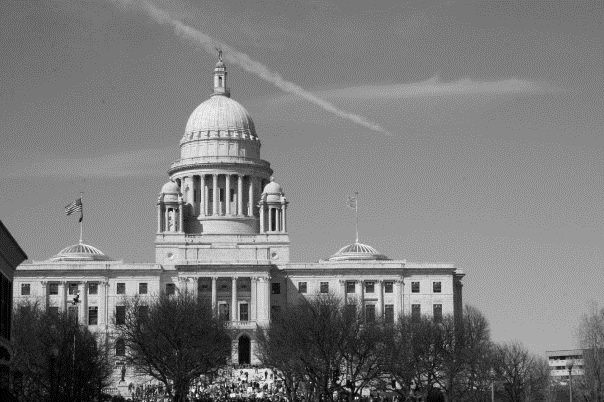
Taxpayer advocates are warning that the consequence is generous arbitration awards that benefit unions, causing tax hikes across the state.
“You create a new government of the unions, by the unions, and for the unions,” Kinder said. “That is what you do when you grant binding arbitration to the unions.”
Unions: Arbitrators have to be neutral
But arbitrators aren’t the only unelected officials who have a major say in contracts, said Marc Gursky, a labor attorney who has represented fire, police, and teacher unions. He said unelected officials “routinely make decisions” in collective bargaining agreements, such as the members of the Board of Regents and the Board of Governors for Higher Education. Sometimes contract disputes are kicked into court as well, where another unelected official—a judge—makes the final call, said Paul Doughty, head of the firefighter union in Providence.
Gursky questioned the data provided by Kinder, saying he was not aware of any study that proved arbitrators are biased in favor of unions.
Both Gursky and Doughty said the selection process for an arbitrator—which is spelled out in state law—ensures fairness and neutrality.

“It really forces them to walk the middle because if they’re all management or all union the opposition strikes them,” Doughty said. “Self interest rules the world and the arbitrator’s self-interest is to be in the middle so no one strikes you.”
So just why is binding arbitration so important to unions? Without it, Gursky says there would be no end to contract disputes. With it, he said there will be more of an incentive to bargain and reach agreements. “With arbitration as least there is an end result and making it a process where it has to be relatively quick and relatively fair will result in more deals being negotiated,” he said.
Impact: RI number 1 state for fire costs
But taxpayer advocates and municipal leaders say the evidence is on their side, blaming binding arbitration for increasing costs in public safety budgets across the state.
Yesterday, Dan Beardsley, the Executive Director of the R.I. League of Cities and Towns, said binding arbitration is the reason the Rhode Island to have the highest per capita cost of fire protection and rank 14th in per capita spending on police, according to a recent study by the Rhode Island Public Expenditure Council. (Click here to read the RIPEC study.)
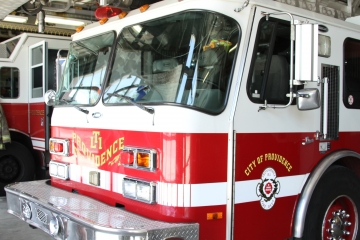
The reason firefighter costs are so high is not necessarily because they are paid more than others or receive more benefits, said Ashley Denault, Director of Research for RIPEC. Instead, she said it’s because Rhode Island simply has a greater number of fighters. It even has more than New Jersey, she noted, which is more densely populated than the Ocean State.
The high number of firefighters is due to the sheer number of fire departments spread throughout the state as well as minimum manning requirements, according to Denault. To the extent minimum manning has been determined by binding arbitration, she said binding arbitration has indeed been a factor in the high costs of fire protection.
Doughty disputed the RIPEC study, saying the data for Rhode Island includes staff for firefighters and EMS together, unlike other states.
“It’s apples and oranges because you need to look at both of these areas,” Doughty said. “It screws the numbers up and it makes the fire service look more expensive when it’s miscalculated as compared to other states.” (Denault countered that a National Fire Protection Association study found that a majority of calls for firefighters in other states are still for medical reasons. Doughty said that still does not justify the comparison.)
Kinder pointed to 3 percent compounded cost of living adjustments and 20-year retirements as commonplace contract provisions that originated out of binding arbitration decisions. As he described it, binding arbitration set up a kind of reverse domino effect: as one union won certain benefits in the 1970s and 1980s, other communities followed suit and granted them to avoid the costs and time-consuming process of binding arbitration.
“They say, ‘Why give it away in binding arbitration? If we have to give it away, we’ll give it away,’” Kinder said. “That’s the hidden cost.”
In Cranston, binding arbitration decisions resulted in free health care for retired police and fire, annual longevity bonuses, and minimum manning requirements, according to Steve Frias, an attorney and a local historian who is writing a book about the history of the city. He said $50 million of the unfunded liability for retiree benefits can be attributed to health care. (A recent study shows the full amount of the unfunded liability to be about $81.9 million.)
“If I had to tell you the most significant development in postwar Rhode Island, it is the rise and influence of public employee unions at the local level,” Frias said.
If you valued this article, please LIKE GoLocalProv.com on Facebook by clicking HERE.