


Booze, Bribes, and Conspiracy: RI Attorneys Disciplined by State Supreme Court
Stephen Beale, GoLocalProv News Contributor
Booze, Bribes, and Conspiracy: RI Attorneys Disciplined by State Supreme Court
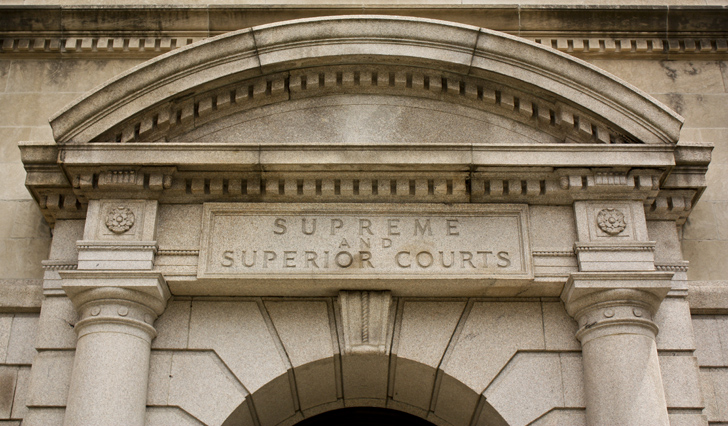
The cases include a number of notable public figures, including former House Speaker Gordon Fox, who was disbarred in April after he entered a guilty plea in a bribery and public corruption case. There’s also Joseph Caramadre, whose elaborate insurance fraud scheme made national headlines.
An attorney who has committed a crime, violated the ethical rules of their profession, or has committed some other misdeed that calls into question whether they should continue to practice law could be brought before the state Supreme Court for discipline, which can range from a simple public censure to formal disbarment. GoLocalProv poured over all cases of attorney misconduct for approximately the past year and a half. The top ten egregious cases are listed in the below slides.
GET THE LATEST BREAKING NEWS HERE -- SIGN UP FOR GOLOCAL FREE DAILY EBLASTThe high court also reviews applications from formerly disciplined attorneys who are asking to be readmitted to the law. The most prominent case in the past year was John M. Cicilline, the older brother of Congressman David Cicilline and son of a prominent local attorney. The elder Cicilline was disbarred after conviction in a corruption case, but was readmitted to the bar last year—but not without objection from one justice, who dissented.
Money the greatest temptation
One of the biggest temptations for attorneys is client money. David Logan, who teaches an ethics course at Roger Williams University School of Law, said he tells his students to never treat client money as their own. “Even for a second,” Logan said.

More recently, Elisa Pollard was under investigation for the personal use of funds from a real estate closing. The matter came before state authorities after the title insurance company filed a complaint, according to Craig Berke, spokesman for the state judiciary. He did not disclose the amount of money at stake.
The money has been repaid, but Pollard was disbarred April 21.
Client funds were again at the center of another case involved attorney Leonard Bergensen, who took $20,000 out of an escrow fund from one client, and then used money from another client’s escrow fund to pay it back, according to an October 14, 2014 Supreme Court order suspending him from law for a year and a half.
Economic pressures, especially in a time of downturn, can drive attorneys to take liberties with client money, Craven said. The problem is particularly acute in Rhode Island where roughly one hundred new attorneys enter the field each year. “The economy has not grown fast enough to absorb all those attorneys,” Craven said.
“It’s one more ladle in the well. Eventually, the well runs dry,” he added.

You can’t take money you don’t have, Craven wryly noted in an interview yesterday.
Personal indiscretions, public reputation
Besides the lure of illicit cash, another common problem is personal indiscretions that affect one’s public reputation.
“I tell my students 24 and 7, 365 they’re under scrutiny,” Logan said.
Private misdeeds, which sometimes become criminal matters, can call into question an attorney’s integrity and reputation, undermining their credibility and viability as attorneys, according to Logan.
Such was the case of Steven A. Murray, a local attorney who was arrested in July 2012 by Coventry police on four felony charges, according to a court record and police log. Murray pled no contest to an assault charge while the others were dismissed. Much of the alleged criminal activity occurred while he was ‘seriously intoxicated,’ according to the February 24 Supreme Court order suspending him.

“Lawyers are not exempt from being human beings,” Craven added. “Maybe by reputation they are.”
Sometimes the professional drives the personal. The stress generated by economic pressures and the struggle to make a viable living, Craven said, can cause someone to drink more or pursue other outlets.
Deception across state lines
Besides public corruption and personal crimes, the past year and a half worth of cases also include some notable instances of extraordinary deception.
One case involves a letter from an attorney in Georgia to Rhode Island residents warning them their homes were about to be sold at an auction. Although the attorney, Daniel J. Saxton, was based out of state, he claimed to have an office at 20 Weybosset Street. That proved to be fake. Coincidentally, the next closest real address is 24 Weybosset, where the office of the state disciplinary counsel for attorneys is located.
When confronted, the attorney gave another false address.

Can the Supreme Court impose discipline on an out-of-state attorney? In its order, the court said that by sending the letters to Rhode Island residents Saxton had submitted himself to its jurisdiction. And, just to make sure its order was taken seriously, state officials also contacted their counterparts in Georgia, according to Berke, the judiciary spokesman.
Another case also involved deception across state lines, though over a shorter distance.
When attorney Layne Savage had her license taken by the Traffic Tribunal, after her second DUI arrest, she simply drove over to the Massachusetts DMV office in Fall River, and, four hours later that same day applied for Bay State driver’s license, listing as her address an apartment in that state that she had begun leasing the day before.
The ploy worked for a few months before authorities in both states caught on and she had to surrender her Massachusetts license. Her right to practice law in Rhode Island also was suspended for three months.
Note: Bill Murphy, a local attorney and former House Speaker who has represented attorneys on matters of discipline, did not respond to a message seeking comment.
Attorneys Disciplined by the State Supreme Court

Disbarred over Bar Bribe
Gordon Fox
April 2, 2015
Case Description: Once Rhode Island’s most powerful politician, Gordon Fox in March pled guilty to receiving more than $52,000 in bribes from Shark Bar and Grille on Thayer in exchange for voting in favor of a liquor license. Fox had also filed false campaign finance reports to cover up his personal use of those funds. One month after his guilty plea, Fox voluntarily consented to disbarment before the Rhode Island Supreme Court but he can apply for his law license in five years.

Cashing in on the Elderly
Thomas J. Howard
February 24, 2015
Case Description: When an elderly woman hired Thomas J. Howard to handle her financial affairs, he treated her funds ‘as his private ATM,’ according to a state Supreme Court order. At the time of his hiring she had assets worth $60,827. But that shrunk down to $35,977 by the time Howard was done with it, thanks to exorbitant fees. When pressed to explain how he justified those charges, Howard could not produce contemporaneous billing records, which had either been ‘lost or inadvertently destroyed.’
The court also concluded that, “The respondent [Howard] wrote checks from [the elderly woman’s] account payable to ‘cash,’ which he then cashed for his own use. He also wrote checks to third parties from [her] account to make payments of his own expenses.” But some of her funds were left untouched, literally: her pension checks, which amounted to a paltry $123.42 a month. Howard failed to deposit the checks, which were returned to the sender.

Booze-Fueled Felonies
Steven A. Murray
February 24, 2015
Case Description: In July 2012, Steven A. Murphy was arrested by Coventry police on four felony charges including second degree sexual assault and assault with a weapon, according to a state Supreme Court order and locally published police logs. Murphy later pled no contest to the assault charge while the other three were dismissed, according to the court. He also pled no contest to a misdemeanor DUI charge on the same day, the court noted. Because Murphy was ‘seriously intoxicated’ during the first incident, the court opted for leniency, suspending his license to practice law for 18 months.

Fishy Funding
Leonard L. Bergersen
October 14, 2014
Case Description: When attorney Leonard L. Bergersen was entrusted with holding $28,000 in escrow for a client couple, he took out more than two thirds of the funds for himself, according to the state Supreme Court. When those clients later requested that Bergensen make payments from the escrow account to a bank, no money was left. That was no problem for Bergensen: he just took out $20,000 from another escrow account he held for a business, Jennifer Fisheries, to cover the payments requested by the other clients. The shortfall was not discovered until Jennifer Fisheries hired another attorney to represent it in federal litigation. Bergensen later paid back the money and revealed that a battle with depression had compromised his judgment. Still, the state Supreme Court suspended him for 18 months.

Two Bills Double Trouble
Jose Luis Serpa
June 11, 2014
Case Description: Jose Serpa charged an ‘illegal fee’ to an ‘indigent client’ who had been charged with a DUI, driving without a license, and leaving the scene of property damage in Massachusetts, according to the state Supreme Court. That may not be the worst part of it. Serpa was actually double billing: he charged his client after already being promised compensation from a state agency that provides public defenders. And, Serpa charged his poor client four times as much as the compensation to which he was officially titled, a difference of about $2,000 to $450, according to the court record. After Massachusetts officials suspended his license in May 2014, the Rhode Island Supreme did the same. His client meanwhile got a new trial and later had the charges dismissed.

Behind Bars to the Bar
John M. Cicilline
May 1, 2014
Case Description: This case stands out because the attorney in question was readmitted to the bar. John M. Cicilline, the brother of Congressman David Cicilline and son of famed local lawyer John F. Cicilline, lost his license to practice law in late 2008 after pleading guilty to conspiracy, obstruction of justice, and making false statements. The charges stemmed from a case in which Cicilline promised to help a client get a reduced sentence after an arrest for possessing a large amount of marijuana. The idea was that the client would provide federal authorities with information on another drug dealer. The problem? The client had no such information.
“The petitioner coached his client about how to present that false information to federal authorities,” the state Supreme Court said. Meanwhile, his client had found a better way to secure a reduced sentence: by helping federal authorities build a case against him and his law partner, Joseph A. Bevilacqua Jr., the son of the former state Supreme Court justice Joseph A. Bevilacqua. Cicilline would later go on to serve 18 months in federal prison.
Cicilline’s return to the bar was narrowly approved with three justices voting in favor. One justice, Gilbert V. Indeglia, had to recuse himself because his nephew, Vincent Indeglia, was representing Cicilline. The fifth justice, William P. Robinson III, dissented. “After much soul-searching and after meticulously reviewing the petition submitted by Mr. Cicilline and the accompanying supporting materials, I am unable to conclude that the petitioner has successfully borne ‘the burden of demonstrating by clear and convincing evidence’ that, at this point in time, he has satisfied the demanding criteria for readmission,” Robinson wrote.

Over the Line
Layne Savage
May 1, 2014
Case Description: What do you do when your driver’s license has been suspended in one New England state? For local attorney Layne Savage, the solution was simple: just go for a short drive to a neighboring state and get a new one.
When Savage was arrested in East Providence on a DUI charge and refusal to submit to a chemical test, she had her license suspended in January 2013. On the very same day, four hours later, Savage was at the DMV office in Fall River, Massachusetts, applying for a driver’s license using the Massachusetts address of an apartment she had just started leasing—the day before. When filling out her application form, Savage was asked if her right to drive had been suspended anywhere else. She wrote ‘no’—a statement she had to affirm was correct under penalties of perjury. Savage got away with her caper for just a few months. In May 2013 she had to surrender her Massachusetts license too.

Phantom Law Office
Daniel J. Saxton
April 4, 2014
Case Description: Tired of unsolicited junk mail? Usually a simple toss to the trash bin and problem solved. But this case was so egregious that the Rhode Island Supreme Court decided to get involved.
It began when Providence residents started getting letters from a law firm warning that their homes were at risk of being auctioned off. The letters were from a law firm named Freeman Saxton, P.C., which is in Atlanta, Georgia, but claimed to have an office at 20 Weybosset Street in downtown Providence. Except that address does not exist. The closest address is 24 Weybosset Street, which happens to house the offices of the state judiciary’s Disciplinary Counsel for attorneys. Oops.
The letters also had a local telephone number. But when state officials dialed it, it went to an Atlanta office, which told the official to visit the Providence office—but only by appointment. When confronted directly the attorney gave another fake address to state authorities. Even though Saxton is not a member of the Rhode Island bar and does not have an office here, the state Supreme Court ruled that he had submitted himself to its jurisdiction by his activities and ruled that he owed pro bono legal services to a dozen George residents—matching the number of Rhode Island residents whose business he had solicited. The work would be monitored by a foundation in Georgia.

Insurance Scheme
Joseph Caramadre
February 20, 2014
Case Description: Local attorney Joseph Caramadre made national headlines four years ago for his indictment in an insurance scheme in which he paid terminally ill individuals $2,000 in order to set up annuities and bonds in their names, in which associates of Caramadre invested. When the terminally ill individuals died, the investors received payouts from the bonds, according to media reports describing the arrangement. Caramadre reportedly said he was simply profiting off a loophole the small print of annuity rules. Federal prosecutors saw it differently: in 2011, he was charged with several felony counts of violating federal law. Two years later, he pled guilty to wire fraud and conspiracy and was sentenced to six years in prison in 2013. But it was not until about a year ago that his license to practice law was suspended, pending the outcome of the appeal he has filed.

License to Steal
Benjamin Wyzansky
November 14, 2013
Case Description: Benjamin Wyzansky, a Pawtucket-based real estate attorney, was sentenced to prison and order to make restitution, for over $350,000 he took from money that was meant to pay off a home loan for a client. He ended up getting three years in prison—approximately one for each $100,000 that he stole. At his sentencing Superior Court Judge Netti Vogel said that Wyzansky had “used his license to practice law to steal.” He lost that license on November 14, 2013.


