


Children Born During Pandemic Have Reduced Cognitive Skills, Finds New Study Led by Brown Professor
GoLocalProv News Team
Children Born During Pandemic Have Reduced Cognitive Skills, Finds New Study Led by Brown Professor
Researchers have found that children born during the coronavirus pandemic have lower cognitive skills than those born before the pandemic -- because of reduced interactions during lockdowns.
Led by Brown University Associate Professor of Pediatrics Dr. Sean Deoni, the new study found the babies born since March 2020 had worse cognitive, verbal and motor skills than children who entered the world before coronavirus.
GET THE LATEST BREAKING NEWS HERE -- SIGN UP FOR GOLOCAL FREE DAILY EBLAST“It’s a big deficit — it’s shockingly large,” Deoni told GoLocal in an interview. “Compared to some of the work done at Harvard [looking at the cognitive skills of] Romanian orphans — we’re almost at that level.”
According to the longitudinal study — which has yet to be peer-reviewed — mean early cognitive skill levels for children aged three months to three years old dropped from around 100 in the decade before the pandemic to below 80 during it.
The drop-off was worse in boys and those from poorer backgrounds, researchers said.
“While there is no past example of non-conflict related wide-spread and prolonged lock-downs from which to draw information from, concern for child development stemmed principally from the known impact that family and home stress, parent and child anxiety, lack of stimulating environments, and other economic and environmental adversities can have on the developing infant and child brain,” wrote the researchers.
“The study has been submitted to a journal and is going through the peer review process — we think it’s rigorous,” said Deoni. “We don’t foresee challenges there. We want to delve into some additional information and work with groups from other states and countries. We want to continue to follow our families and do what we can from a research standpoint.”
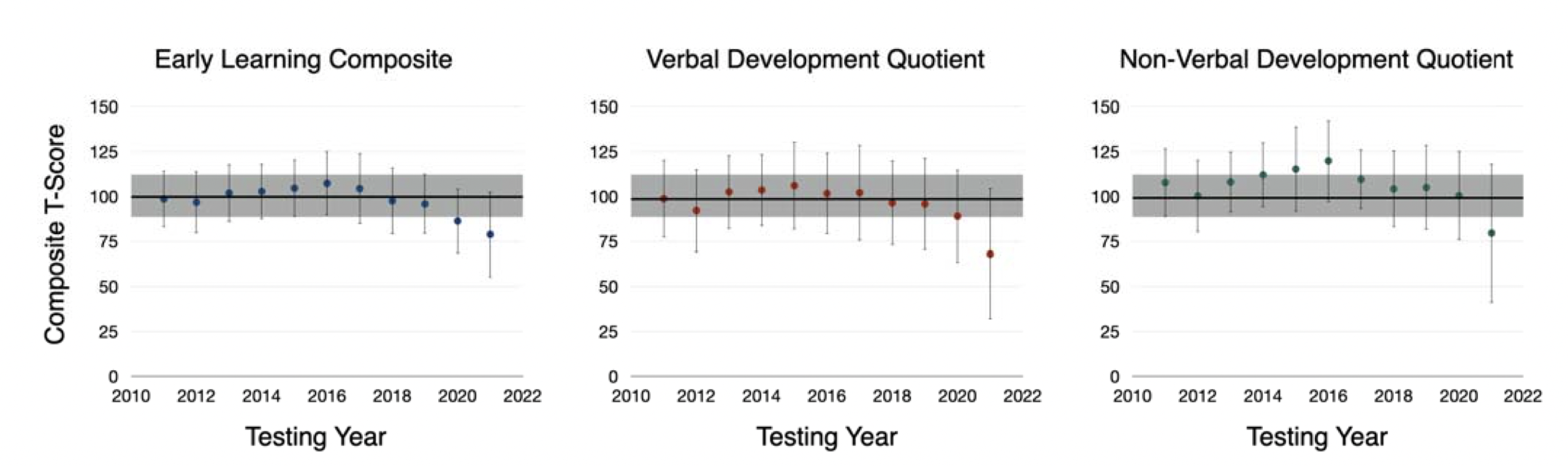
The comparison of cognitive skills over time was made possible by research being conducted in Rhode Island for over a decade.
Since 2009, Brown University and the Warren Alpert Medical School at Brown University has been home to a longitudinal study of child health and neurodevelopment, termed the RESONANCE study, now part of the NIH Environmental influences on Child Health Outcomes (ECHO) program.
Since 2011, 1224 cognitive assessments were collected from 672 healthy, full-term, and neurotypically-developing children between 3 months to 3 years of age. Repeated measures were separated by at least 1 year.
The dataset included 1070 assessments (from 605 children) prior to March 2020; 154 assessments (from 118 children) between March 2020 and June 2021; with 39 children who were born just prior to the pandemic in 2018 and 2019, and following during the pandemic to 2021.
Recognizing that the analysis from 2011 to 2021 contained differing sets of children, researchers reduced the dataset to 39 children who were enrolled up to a year prior to the pandemic and who had at least 1 visit before and 1 visit during the pandemic.
“We find that children born during the pandemic have significantly reduced verbal, motor, and overall cognitive performance compared to children born pre-pandemic,” researchers wrote. “Moreover, we find that males and children in lower socioeconomic families have been most affected. Results highlight that even in the absence of direct SARS-CoV-2 infection and COVID-19 illness, the environmental changes associated COVID-19 pandemic is significantly and negatively affecting infant and child development.”
“We certainly weren’t building for this moment,” said Deoni of the longitudinal data. “In one way we were very fortunate, but I would have rather not gone through the pandemic. The lab and all of our work on trying to understand the environmental influences that shape pediatric neurological health and development — such as water, air, lead, but also broadly, including nutrition, maternal health in utero — we’ve been really fortunate and lucky to have the funding to be continuously enrolling typically healthy mums and infants and toddlers.”
Deoni said the study is fairly unique in that the RESONANCE research never stopped during the pandemic, which is something researchers had to address.
“We had our researchers use plastic protection visors, when possible, so children could see the researchers' facial expressions,” said Deoni, who says that if they are able to compare data from other states, he is inclined to believe the results in Rhode Island will actually be better than most.
“My fear is we’re actually the best of the worst — this could actually be a best-case scenario,” said Deoni. “We have strong social programs [in Rhode Island] where needed. But what about other states where this isn’t the case?”
The researchers wrote in their findings that they believe actions can be taken to address the decline.
“What is unclear from our data..is if observed declines or impairments are temporary and will normalize as employment and school closures are lifted and children return to pre-pandemic levels of play and interaction, and family financial insecurity and mental health challenges subside,” they wrote.
“Unfortunately, when that will occur is also unknown given the ongoing surge of infections associated with new virus variants. It is clear, however, that young infants and children are developing differently than pre-pandemic, and that addressing this now while their brain is at its most plastic and responsive, is imperative,” they continue. “Programs such as unemployment insurance, Supplemental Nutrition Assistance Program (SNAP), the Special Supplemental Nutrition Program for Women, Infants, and Children (WIC), and housing assistance, may help minimize the impact of the pandemic on the most sensitive of children. In addition, further research directly exploring aspects of parent-child attachment, interaction, nutrition, food security, and environmental stimulation is needed to understand the primary driving factors underlying the trends presented here.”
“I’m always an optimist, but I think that the challenge is the longer things go on, the harder it gets,” said Deoni. “I use the analogy of building a house — you’re building the foundation of a brain. It’s a hell of a lot easier to [build] things with a good foundation.”
Professor Warns Against Politicizing Results
Deoni said that he fears people will use the results to say that lockdown measures were not — and are not — needed, and said the focus should be on increasing vaccinations — and awareness of the need for social interaction for infants starting at the family level.
“This is me speaking for myself, and not on behalf of the researchers, but to me, lockdowns, and working from home, while painful was absolutely necessary,” said Deoni. “That was the correct thing. My fear is that this [study] will be used as a counterpoint. That’s not solving the problem. Solving the problem is wearing a mask, and curbing unnecessary things — such as hopping on a plane [for vacation] — and getting vaccinated. Let’s solve the problem. We have the tools. If we care about kids. we can do it. There are counties around the world that are desperate to have tools we have at our disposal.”
“We’re all stressed and busy, but step away from the screen, read, play with your kids — anything like that will have tremendous help,” said Deoni. “Let’s encourage our neighbors who are weary about vaccines to get informed and vaccinated. Hopefully we can get through this.”