EXCLUSIVE: Doctor Says Politics Rules Compassion Centers
Stephen Beale, GoLocalProv News Editor
EXCLUSIVE: Doctor Says Politics Rules Compassion Centers

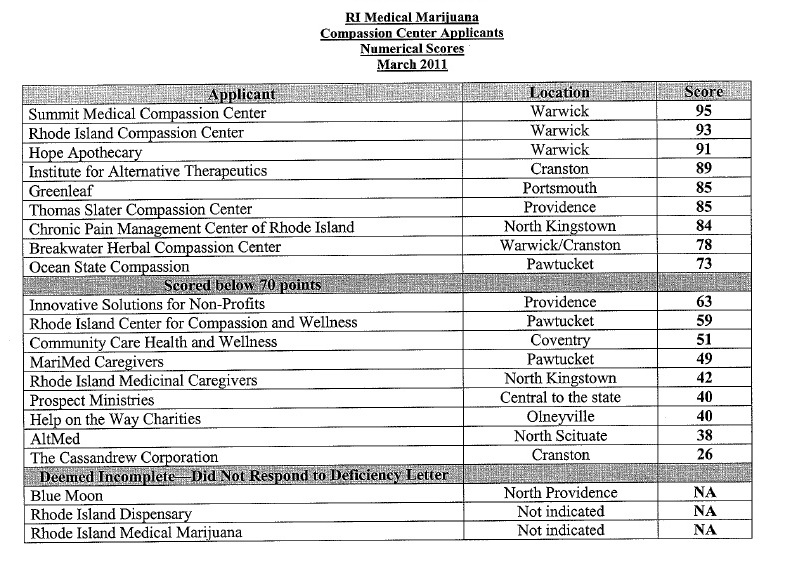
The document—simply a sheet of scores from 0 to 100—shows that the Health Department instead picked the first, fifth, and sixth ranked applications. Those are the Summit Medical Compassion Center in Warwick, Greenleaf Compassionate Care Center in Portsmouth, and the Thomas Slater Compassion Center in Providence. (A spokeswoman yesterday confirmed the authenticity of the document. See below for a copy.)
One doctor who was the chief executive officer for a losing application—which happened to score above both Greenleaf and Thomas Slater—now is accusing the state of being “highly subjective” in how it approved applications, saying that politics likely influenced the process.
GET THE LATEST BREAKING NEWS HERE -- SIGN UP FOR GOLOCAL FREE DAILY EBLAST“It makes you wonder whether or not there [were] more political factors in the process than objectivity,” said Dr. Michael Follick, a clinical professor of community health at Brown University and the CEO of the Institute for Alternative Therapeutics, which scored fourth.
Lowest scoring center has ties to Costantino
A previous GoLocalProv investigation found that the lowest scoring of the three approved applications—the Slater Center—would be located on property owned by close relatives of Steven Costantino, the Secretary of the Executive Office of Health and Human Services. The applications were submitted before Costantino took office this year—but they were approved just one week after he was confirmed.
At the time, it was not known that the Slater Center had been approved ahead of several other more qualified applications.
Costantino has said that he was not involved in the decision to approve the compassion centers. As a result, he said the situation did not create any potential conflict of interest for him.
A Health Department spokeswoman yesterday said the scores weren’t the only factor in the decision. She said the department also looked at the locations of the proposed centers. Each of the three approved centers is located in a different county.
But the department apparently did not give much indication that geography would be such a decisive factor before applications were submitted. Neither the state law authorizing the centers, nor the regulations the department issued, nor even the guidelines for the first round of applications reference geography or counties as factors. (Click here for more information.)
The law merely states that applicants must disclose where they would be located.
Health Department spokeswoman Annemarie Beardsworth said it wouldn’t make sense to not take location into consideration. “If you can only have three in the state, you don’t want them all on the same street,” Beardsworth said. “To our mind, convenience and access in Rhode Island is dependent on geography.”
As it happened, the top three scoring applications were all in one city—Warwick. The Health Department picked one of them. The other two that were approved are in East Bay and Providence County locations.

Doctor: Program 'reeks' of 'incompetence'
Follick said the process for approving the applications “reeked” of “incompetence” from the very beginning.
Last year, in the first round of applications, all the proposals were rejected because they didn't meet “minimum scoring requirements.” After a second round of applications, the three approved proposals were announced in March—only to have Governor Lincoln Chafee put a hold on the program after the U.S. Attorney for Rhode Island said the program violates federal law.
“I felt the whole thing reeked from the beginning,” Follick said.
“When they invalidated everything [the first time] it made me highly suspicious that someone who thought they were a shoe-in didn’t get it, so they threw everyone out,” Follick said. “It changed the ground rules completely because everyone got to see everyone else’s application.”
He called the release of the scores a “non-disclosure” that did little to help the losing applicants understand why they were rejected. He said the Health Department has not provided a breakdown of how the scores were calculated or any written feedback on why individual applications were not approved.
“I also suspect this was a process they’re just not familiar doing and it might have been a challenge they’ve faced,” Follick said. He added: “They obviously worked very hard at this. They really did.”
But after all that, Follick says he is now happy his application did not get approved. Otherwise, he said he would be hundreds of thousands of dollars in the hole since the program has been suspended.
If the Health Department holds a third round of applications would he apply again?
Follick says he’s had enough. “I wouldn’t go back for all the tea in China,” he said.
Officials for the second and third highest scoring applications did not respond to requests for comment.
If you valued this article, please LIKE GoLocalProv.com on Facebook by clicking HERE.