Legislative Grants: The Incumbent Gravy Train?
Stephen Beale, GoLocalProv News Editor
Legislative Grants: The Incumbent Gravy Train?

The controversy surrounds legislative grants issued to nonprofits. House and Senate members request the grants for their districts and the leadership in each chamber denies or approves them—the full House or Senate do not vote on them. So far, the Senate alone has doled out nearly half a million in the legislative grants since July 1—most of it going to the districts of senators facing a challenge in their re-election bids, according to a GoLocalProv review of state records.
“Recent ‘legislative grants’ given by legislators to local community groups are unethical,” stated Operation Clean Government. “These are taxpayer dollars being misused to promote election of challenged incumbents who are supported by General Assembly leaders.”
GET THE LATEST BREAKING NEWS HERE -- SIGN UP FOR GOLOCAL FREE DAILY EBLASTMarie Sorman, the president of Operation Clean Government, said the grants also ensure that members stay loyal to the leadership if they are re-elected.
“It’s worse than pork-barrel spending,” Sorman said. “They’re buying votes.”
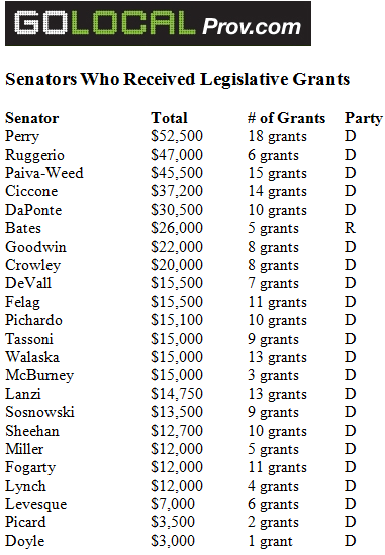
Of the 23 senators whose requests for grants were approved, all except two were facing a re-election challenge, according to a GoLocalProv review of state records. (See below table.) Fifteen senators did not receive any money, but 11 of them are running unopposed or not seeking re-election. Of the remaining four, two did not request the money.
So far, the House has issued much less in legislative grants since July 1—about $49,000, according to Operation Clean Government.
Spokesman denies political favoritism
A spokesman for the state Senate denied the grants were being used for political purposes.
“The Senate has built a strong reputation for issuing grants in a transparent and non-political manner,” said Greg Pare. “Community service organizations in each and every community have received support regardless of party affiliation or incumbency.”
Pare added: “To suggest that there is political favoritism ignores the fact that among the sponsors of the legislative grants that have been issued to date are a senator who is unopposed in November, a senator who is not seeking reelection, and a Republican senator who faces Democratic opposition in November.”
John Tassoni, a Democratic Senator from Smithfield seeking re-election, told GoLocalProv that the money goes to good causes. “These are grants that keep kids off the streets. They help youth sports get to where they need to be,” Tassoni said. Without the grants, he said “there wouldn’t be any food in the food bank or there wouldn’t be a bus for a senior who needs a ride to get his medication.”
But Sorman said taxpayer money shouldn’t necessarily go toward those nonprofits. “If these legislators feel that they are so worthwhile—and I’m not saying they’re not—they should be contributing their own money,” Sorman said. “Give me back my money and I will contribute to the organizations that I feel are worthwhile.”
Tassoni for one said he does contribute from surplus campaign funds. He also vehemently denied that the grants were influencing how he votes. “No one buys my vote. The votes are the votes,” Tassoni said.
The List: Who Got the Money?
Below is the list of all the senators who received legislative grants. Only two of them are not facing a challenge for re-election in November. Senator John McBurney is not seeking re-election and Senator Erin Lynch is running unopposed, according to a list of candidates on the Secretary of State’s Web site.