


RI Beachfront Property Owners Sue State Over Recently Enacted Coastal Access Law
GoLocalProv News Team
RI Beachfront Property Owners Sue State Over Recently Enacted Coastal Access Law

RIACT, which describes itself as a group of people who own beachfront property and hold private property rights along Rhode Island’s Atlantic coastline, says it is bringing the complaint against state officials “to halt the unconstitutionally [sic] enforcement of a state law that takes private property.”
Rhode Island Attorney General Peter Neronha, Department of Environmental Management Director Terry Gray, and Coastal Resources Management Council Director Jeffrey Williams are all named as defendants.
GET THE LATEST BREAKING NEWS HERE -- SIGN UP FOR GOLOCAL FREE DAILY EBLASTAttorney Daniel Procaccini is representing RIACT.
Grounds for Suit
“Many of RIACT members own title, in fee simple, to beachfront property in Rhode Island. Under their titles and the common law of the state, the shorelands lying seaward of the mean high water (MHW) line are public, but the lands located inland of the MHW line are held in private ownership,” asserts RIACT in the suit. “The state recently enacted a law, H. 5174 (“Act”), which abrogates the traditional MHW line boundary separating public and private beach areas and sets a new boundary at a more inland location, thereby expanding the public beach area inland at the expense of private property.”
The lawsuit states:
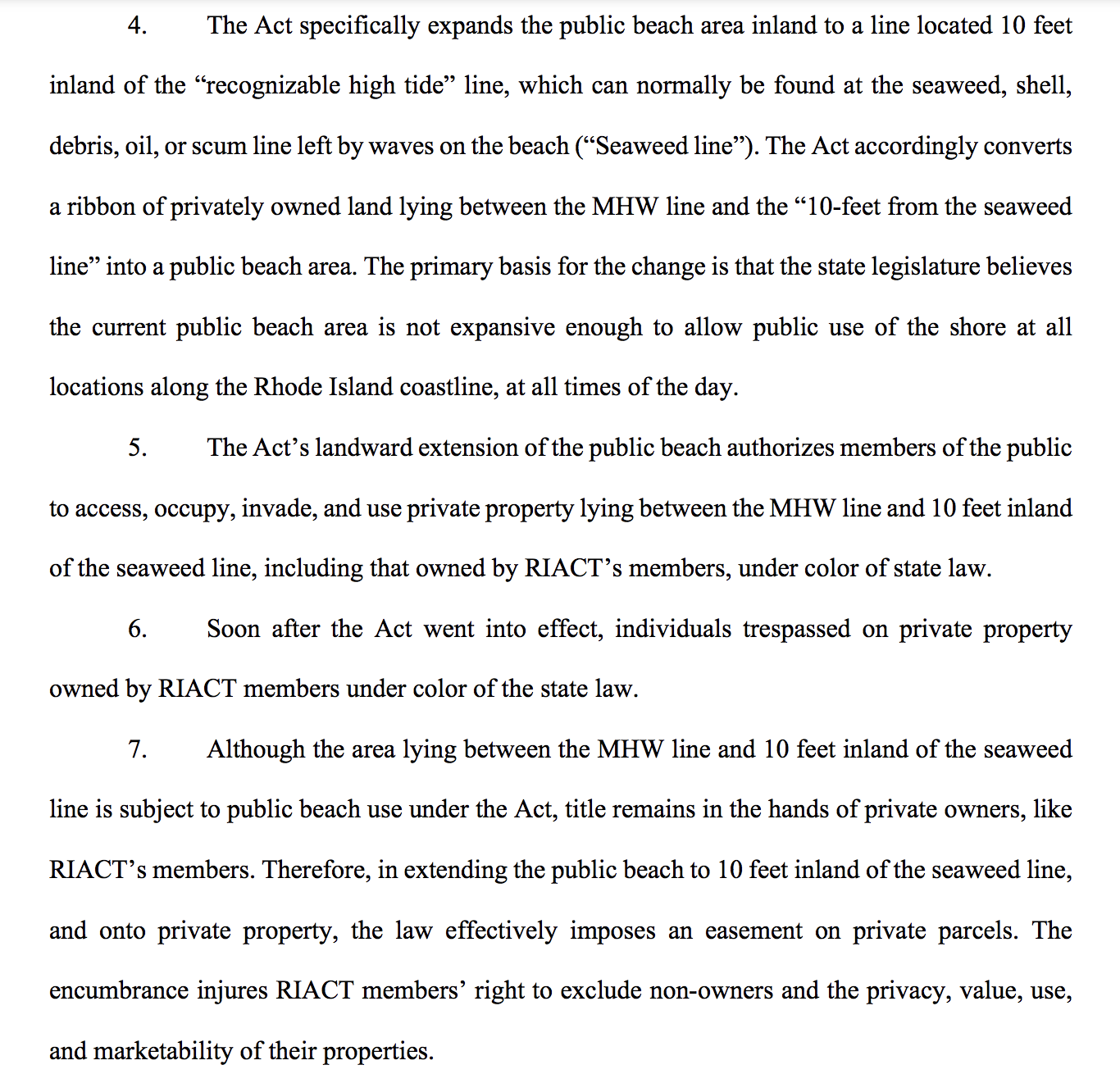
“Indeed, because the public easement imposed on private beach lands by the Act is bounded by migratory lines (such as the seaweed line), the easement itself is also migratory. This means that, when natural events push the seaweed line farther inland, the public beach area by the Act will also move farther inland onto previously unburdened parcels of private, coastal created property. The Act’s expansion of the public beach to 10 feet inland of a migratory seaweed line operates as a mechanism for a perpetual, unpredictable conversion of private coastal land into public beach areas,” the suit goes on to continue.
“While public beach access may be important to state legislators and officials, they may not simply redefine private shorelands as a “public beach” by the stroke of a pen, consistent with the Takings Clause of the Fifth Amendment. The Act constitutes a taking of property in violation of the United States Constitution, and enforcement of the law amounts to an ongoing constitutional violation,” according to the suit.
RIACT says damages are “not adequate” and is seeking an injunction “prohibiting state officials from enforcing the Act on the ground that it creates an ongoing violation of the United States Constitution.”