


RI Recycling Program Hemorrhages — Low Recycling Rates and Collapsing Revenues
GoLocalProv News Team
RI Recycling Program Hemorrhages — Low Recycling Rates and Collapsing Revenues
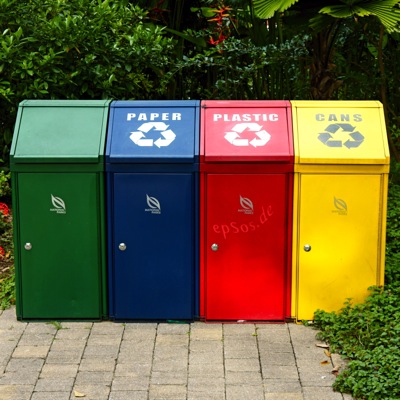
Rhode Island's curbside recycling program was first rolled out thirty years ago, and data shows that participation in the program continues to be dismally low — and questions about the financial viability and participation are growing.
Over the years, RI Resource Recovery, the agency responsible for the state’s recycling program, reported falling revenue and exploding costs in 2018. In 2019, the revenues for recycling are expected to fall 15 percent on top of three years of dismal and falling revenues.
GET THE LATEST BREAKING NEWS HERE -- SIGN UP FOR GOLOCAL FREE DAILY EBLASTThe quasi-public agency, with a full cadre of public relations officers, refused to answer questions about the agency's financial situation and low recycling rates.
How bad is the participation in the Rhode Island recycling program? In the State's capital city of Providence, which constitutes 17 percent of the population, but just 7 percent of items go to the material recycling center — glass, cans, etc. And the overall recycling rate is 12 percent.
Environmentalist Raising Questions
In a July 2017 appearance on GoLocal LIVE, Joanna Detz, Executive Director/co-founder of EcoRI NEWS - Rhode Island’s leading environmental publication, said that it is time to rethink recycling and move to simpler strategies like “reuse.”
“I think we should get rid of recycling - I think it we should focus on reuse. So many loads are rejected from contamination. We have not moved the needle,” Detz made the comments during her appearance on GoLocal LIVE.
Detz said Rhode Islanders and the environment might be better served by a “pay as you throw” strategy which charges people for how much waste they actually throw out.
“Recycling has been dysfunctional for a long time,” said Mitch Hedlund, executive director of Recycle Across America, a nonprofit organization that pushes for more standardized labels on recycling bins to help people better sort material. “But not many people really noticed when China was our dumping ground.”
The comments by Hedlund were made in the in a report in the New York Times.
Resource Recovery’s finances took nearly a $10 million hit in 2018, according to the agency’s audited financials, “Operating Revenues increased from $59.7M in FY2017 to $63.5M in FY2018 for an increase of $3.8M. Operating Expenses increased from $46.7M in FY2017 to $60.3M in FY2018 for an increase of $13.6M,” wrote the accounting firm Marcum in its annual audit.
A portion of the financial cratering at the agency is tied to the recycling program.
Buried in the agency’s financials is an admission that the floundering recycling program is hemorrhaging millions as global markets have collapsed.
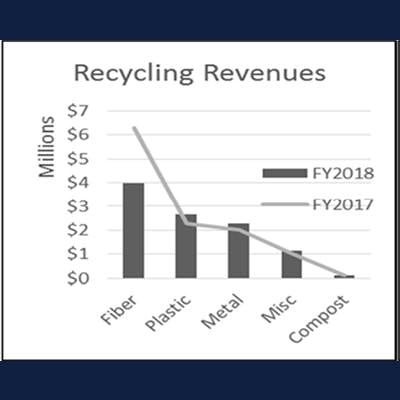
“Recycling revenues decreased by $1.6M to $10.2M. Fiber decreased by $2.3M to $4M,…Prices for commodities remained depressed for FY2018 since their significant decline approximately three years ago. China’s ‘National Sword’ policy set a much tougher standard for contamination of a 0.5 percent contamination limit which went into effect 3/1/18,” said the audit.
Newspaper recycling has completely collapsed and Resource Recovery is not selling the material. Now, the agency is paying to have newspapers and other fibers recycled, “As a result certain fiber commodities such as mixed paper and #8 Newspaper have been especially hard hit. Prices for these two items for the fourth quarter were at negative $23.00, meaning we had to pay to have these items recycled. This along with other uncertainties have a large impact on MRF revenues."
According to the report, “The recycling facility was not able to generate a profit and as a result, the Corporation was not able to distribute profits back to cities and towns as part of our municipal recycling profit sharing program, for the third year in a row.”
The trend is getting even worse. According to the agency’s financial projections for 2019, the revenue tied to recycling is expected to fall another 15 percent — it is budgeted to fall from $10.2 million to $8.6 million.

“Unfortunately, in recent months recycling processing plants have been shut down. For instance, the largest recycling hauler in the U.S. (who also owns many major landfills) has recently closed 25% of their recycling plants. In the state of California (a state known for its progressive recycling), more than 1000 recycling centers and processing plants have shut down,” said Recycle Across America — an environmental group who features HBO host Bill Maher as a spokesperson
“Philadelphia is now burning about half of its 1.5 million residents’ recycling material in an incinerator that converts waste to energy. In Memphis, the international airport still has recycling bins around the terminals, but every collected can, bottle and newspaper is sent to a landfill. And last month, officials in the central Florida city of Deltona faced the reality that, despite their best efforts to recycle, their curbside program was not working and suspended it,” reported the New York Times.
“Recycling as we know it isn’t working,” said James Warner, chief executive of the Solid Waste Management Authority in Lancaster County, Pa told the Wall Street Journal in May of last year. “There’s always been ups and downs in the market, but this is the biggest disruption that I can recall.”