


Russia’s Non-Nuclear Escalation in Ukraine - Mackubin Owens
Mackubin Owens - MINDSETTER™
Russia’s Non-Nuclear Escalation in Ukraine - Mackubin Owens
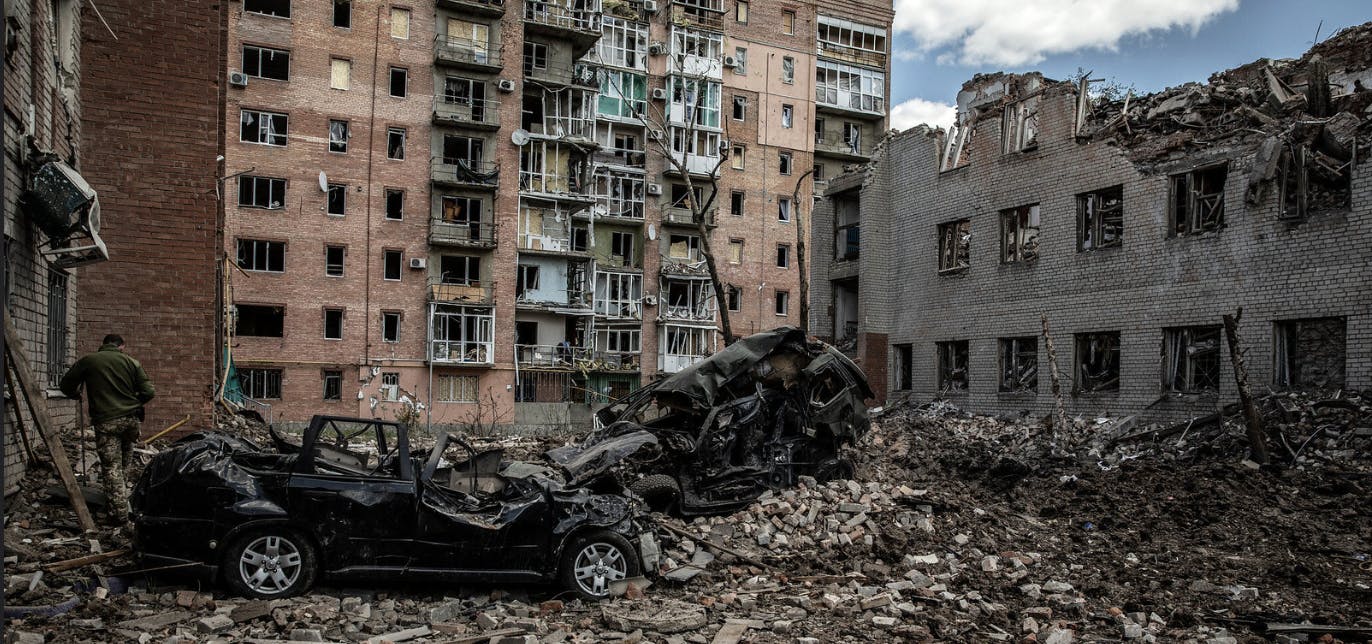
Russia recently launched a series of widespread and coordinated missile strikes against targets in 20 Ukrainian cities, attacking primarily civilian and critical infrastructure targets and leaving the country in ruins. Notably, Russia attacked Ukrainian thermal power plants and command centers, forcing Ukraine to impose emergency measures on electricity use.
GET THE LATEST BREAKING NEWS HERE -- SIGN UP FOR GOLOCAL FREE DAILY EBLASTPutin claims these attacks were retaliation for the recent “terrorist” attack on the Kerch Strait bridge connecting Crimea to Russia. But these escalatory attacks represent a broader response to Ukrainian successes in Eastern Ukraine, intended to raise the cost of the war for Ukraine. The fact that many of these targets were part of Ukraine’s energy infrastructure is a signal to the Ukrainians that they are in for a long, cold winter.
Having repeatedly failed at the operational level of war—the conduct of campaigns to achieve strategic success in a theater of operations—Putin has doubled down on the “Russian way of war,” which relies on brute force, making no distinction between military and civilian targets. Indeed, civilian targets seem to be a feature, not a bug. Indeed, as I argued in a GoLocalProv essay several months ago, one option for Putin is to “ruin and depopulate Ukraine, the way Richelieu reduced large parts of Germany to cannibalism during the Thirty Years War.”
Such an approach to war violates the law of armed conflict, which can be traced to one part of Christian just war theory, jus in bello, the just conduct of conflict. The purpose of jus in bello may seem paradoxical: to conduct war as humanely as possible, minimizing the suffering of the innocent and those, for instance prisoners of war, who ae no longer combatants. There are two parts of jus in bello: “discrimination,” distinguishing between combatants and non-combatants; and “proportionality,” limiting the use of force to the amount necessary to achieve the military objective. Discrimination and proportionality are balanced against “military necessity.” The Russians have not even pretended to abide by the norms of jus in bello. And it is not only Ukraine. The Russians adopted the same approach in the Second Chechen War in 1999 and in Aleppo, Syria in 2016.
By inflicting as much damage to Ukraine as possible, Russia may hope to force Ukraine’s leaders to the bargaining table, which Washington has, so far, opposed. The Biden administration seems to be seeking “regime change” in Russia. As I have argued before, if Putin is ousted, it is far more likely that he will be replaced by one of the many Russian hardliners who have criticized him for not being brutal enough in Ukraine, not by “liberal reformers.” “Putinism,” most likely in a more dangerous form, will outlive Putin.
In the meantime, because of the Russian infrastructure attacks. Ukraine is asking the United States for front-line air defense systems, such as the Patriot missile system. While our supply of the High Mobility Artillery Rocket System (HIMARS) to Ukraine has been a game changer in the ground war, the Pentagon’s stockpile of interceptor missiles for Patriots is low. There is a further danger. In order to supply these systems to Ukraine and manning them would require US or NATO troops and US contractors for maintenance. Of course, Russia is also relying on outside help, including Shahed and Mohajer combat drones from Iran. Iran reportedly is also preparing to provide two types Iranian short-range ballistic missiles.
At this point, many questions remain. How long can Ukraine maintain the operational momentum that has led to its successes? Can they rely on NATO’s continued military aid? And what options remain for Russia? As the recent critical infrastructure attacks illustrate, Russia, despite all of its operational, personnel, and logistical shortcomings, still has escalatory options that Ukraine does not. Do these include the use of nuclear weapons? As I argued in a recent GoLocalProv piece, the likelihood of his doing so remains low. For one thing, there is no military reason for him to do so. He is achieving the same effect with his infrastructure attacks.
As has been the case for some time now, the best option is a negotiated settlement. The fact is that the two sides have already agreed on the broadest issues: President Zelensky has already stated that Ukraine will not join NATO and Russia has already accepted Ukraine’s entry into the European Union. This leaves the disposition the Russian-occupied regions of eastern Ukraine, a difficult problem but not insurmountable, especially in light of the alternative: a devastated Ukraine. How does that serve the interest of NATO, the United States, and, most of all, the Ukrainian people?