


Starkman: If Misery Loves Company, Projo, Meet Hartford Courant
Dean Starkman, GoLocalProv News Editor
Starkman: If Misery Loves Company, Projo, Meet Hartford Courant
Of the three formerly dominant pillars of the region’s media, the Providence Journal, the Hartford Courant, and the Boston Globe, two can be said to have been particularly unlucky in their ownership.
The Projo’s story is by now well known. Essentially, it has been run as a lonely and neglected outpost by a Dallas-based media company, AH Belo, that itself has been shrinking by the minute.
GET THE LATEST BREAKING NEWS HERE -- SIGN UP FOR GOLOCAL FREE DAILY EBLASTRetreat
As recounted here, and elsewhere, Belo’s response to the shocking deterioration in the Journal’s strategic and financial position has been one of reaction and retreat – revenue declines followed by staffing cuts that struck at the very quality of product, the essence of the paper’s identity and credibility. These quality declines were followed by more revenue declines and more staff cuts.
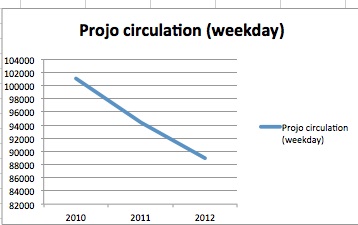
These charts continue to boggle the mind:
Circulation:
Revenue:
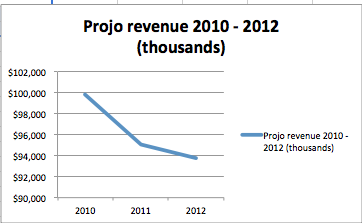
And that’s in just the past three years, years when the rest of the industry had started to stabilize.
Adding insult to injury has been debilitating executive bonuses totaling at least $3.3 million in the last three years– bonuses that more than doubled the concessions the same managers demanded from the rank-and-file workforce and that severely eroded product quality.
Similar strategies
And, in a move that as we’ll see finds echoes at the Courant, the downhill slide became irreversible in 2007 when Belo, to appease demands for short-term rewards for investors, separated its relatively healthy collection of TV stations from its newspaper group, including the Projo, which was just entering its defining period of collapse and disruption. The result was that the newspapers had no diversified revenue stream to cushion the downturn and to navigate the transition to the digital future, leading the papers into a dead end.
After years of withering assets and declining revenues, Belo decided to sell the Projo, leaving it to its fate.
And yet, believe it or not, the Projo was actually luckier in its parent than its rival 70 miles down US 6. Founded in 1764, the Courant is older than the United States itself and was once a regional powerhouse and dominant voice.
Heyday
Its journalistic peak came after it was bought by Times Mirror, the Los Angeles Times publisher, in 1979. It would pick up two Pulitzers and many other accolades in the 1990s, and like a lot of papers, seemed invulnerable.
That ended after 2000, when Times Mirror was bought by the Chicago-based Tribune Company, and, like the rest of the industry, struggled to adapt to the havoc wrecked by the Internet, which destroyed newspaper advertising revenue. Things went from bad to worse at the Courant’s parent after the lackluster TribCo went private in 2007 in a wildly leveraged deal led by vulture investor Sam Zell, a deal widely considered one of the most destructive in American newspaper history.
The Zell team’s juvenile antics became the stuff of legend and were detailed in excruciating detail by David Carr in The New York Times in 2010 and later in James O’Shea’s aptly titled, Deal From Hell: How Moguls and Wall Street Plundered Great American Newspapers.
Collateral damage
The Courant was just collateral damage in a sense, but suffered just the same. The TribCo entered bankruptcy in 2008 and only to emerge recently, now controlled by the same Wall Street firms that loaned Zell the money for the original transaction. Newspaper people, these aren’t.
Since the company went private and then into bankruptcy, the Courant’s financial information has been lumped in with the rest of the company. But even so it’s clear the paper has been suffering, and by some measures performing even worse than others in the Tribune Company portfolio, which also includes such still-viable stalwarts as The Baltimore Sun and the Sun Sentinel in southeast Florida.
Overall, revenue at the publishing segment of the Tribune Company has looked like this over the last three years:
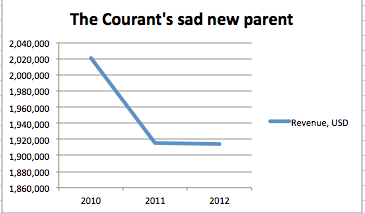
And in recent filings with the Securities and Exchange Commission, the company has said the Courant has lagged others in the newspaper group. When circulation revenue declined 2 percent in 2011 across the group, for instance, the company noted that, “the largest revenue declines in 2011 were at Chicago, South Florida and Hartford.”
Circulation nosedive
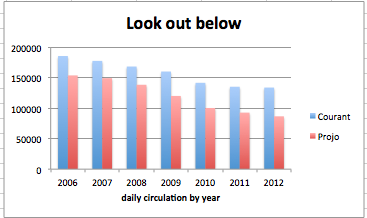
And there’s little wonder why, when you look at circulation figures provided by the Alliance for Audited Media. Daily circulation at the Courant fell to 133,684 in 2012, down 28 percent from 185, 358 in 2006.
It’s true that Hartford’s circulation slide hasn’t matched the complete collapse of the neighboring Projo, which plummeted fully 44 percent during the same period, to 86,534 from 153,578.
Still, it’s not a pretty picture as illustrated here:
And notice that the Courant, like the Projo, has consistently has performed worse than the national average in circulation losses. That’s here:
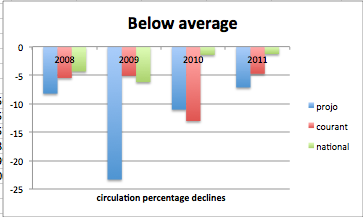
True, few can beat the Projo in utter circulation futility, particularly when you consider the Connecticut economy is actually performing worse even than Rhode Island’s.
But, really, the Courant deserved much better.
Clouds ahead
The trouble is, the worst is almost certainly yet to come.
Last month, the Tribune Company announced--just as Belo did six years ago--that it was separating its relatively healthy TV assets and spinning off its eight ailing newspapers as a standalone company.
This is a classic short-term strategy, reaping immediate profits on the healthy assets while stripping newspapers of the cushion they need to navigate the digital transition.
But it gets even worse than that. Unlike Belo, and for that matter Rupert Murdoch’s News Corporation, which also recently separated into TV and newspaper companies, the Tribune Company is saddling the new Tribune Publishing Company with new debt, which has not been disclosed but is expected to be significant. The new debt not will not be for reinvestment but will be to pay a special dividend to investors.
As Crain’s Chicago Business put it in writing about the deal: “Such dividends are fairly common in corporate spinoffs, but Tribune Publishing isn’t a fast-growing spinoff looking to spread its wings. It’s an old-line company fighting for long-term survival.”
No cushion
Not only will the Courant and its peers have no cushion, they will be burdened by unproductive debt expenses going forward. Adding insult to injury, the newspapers, including the Courant, will be stripped of the very real estate in which their reporters, editors, and sales people operate. So on top of other indignities, the Courant will be paying rent on the downtown Hartford headquarters it used to own.
Morale at the paper is said to be at rock bottom, understandably so.
“If I were working there, I’d be looking for somewhere else to go,” says Maureen E. Croteau, a professor and head of the Journalism Department at the University of Connecticut in Storrs.
In November, Tribco announced 700 job cuts, about six percent of the workforce, including in Hartford. And no one expects those to be the last.
So problems at the Projo find echoes down US 6. And the dilemma there is the same here.
The out-of-town owners have no stake in the paper’s future. But the rest of us do.
13 Best MINDSETTER™ Columns of 2013

LOOKOUT: Rhode Island Needs to Talk Twin River
By John Hazen White
Demand for table games at Twin River casino has prompted the Lottery Commission to grant the facility additional gaming tables, and the state’s take from the combination of video slot machines and table games is going up each month as a direct result of the tables in place.
The 14 new tables to be added will make for a grand total of 80. More gaming tables will surely be added down the road.
I suppose we should all be cheering about this because of the enhanced revenue stream the state will enjoy, which it desperately needs, but it begs a larger and more troubling question: what will happen to Twin River – and more importantly to the state – when Massachusetts’ three casinos and its single racino slot parlor come on line?

Climate Change On the Table… Finally!
By Rob Horowitz
A leaked draft of a major report expected to be released in the Fall by the International Panel on Climate Change(IPCC), an international group of scientists under the auspices of the United Nations, landed on the front page of The New York Times last week. The report, a comprehensive and consensus analysis of the latest scientific research on climate change, finds that if greenhouse gas emissions continue apace a sea level rise of as much as 100 feet by the end of the century is a real possibility. It characterizes the assertion that human activity is the cause of most of global warming as a “near certainty.”

Trying To Make Sense Of The Zimmerman Verdict
By Don Roach
I’m struggling to make sense of the verdict in the Trayvon Martin case as I’m sure many people are. I have a number of gut reactions at war with my respect of the justice system. And it’s a battle. So, what I decided to do Sunday was investigate as much of the public facts as possible in order to piece together why in the world a 17-year-old boy is dead.

In US Schools, Incorrect Answers Are ‘Un-American’
By Julia Steiny
Back in the 1990s, circumstances so maddened Dr. Matthias Felleisen, he felt forced to create Program by Design (PxD) to bring life back to computer science and algebra, both. Since then, thousands of students have used it to learn the elements of programming, with or without a teacher. Even I could understand its free, online textbook. The PxD target audience were first-year college students, but Felleisen's team wanted it to be accessible to clever 10-year-olds. The NSF and other major funders continue to be impressed.

Big Labor Wants To Shuffle The Deck On Obamacare
By Lisa Blais
While the beat goes on across Rhode Island to trumpet information about HealthSourceRI, the health insurance exchange created as a result of Governor Chafee’s Executive Order in response to the Affordable Care Act (ACA), the AFL-CIO has been pleading with the Obama Administration to waive some requirements of the ACA, otherwise known as Obamacare, for members of their multi-employer health and welfare plans.

3 Ways to Restore Confidence in RI’s Government
By Gary Sasse
In the late 1960’s when I was in graduate school many of my classmates sought careers in government and not on Wall Street. They believed that public service could make a difference in the lives of Americans. This positive view that government was part of the solution has been replaced by a more cynical view of government at all levels. This should not be surprising because too many times government has been ineffective in providing essential public services. Earlier this year the Pew Center for the People and the Press found that “trust in the federal government remains mired near an historic low and frustration with government remains high.”

Time for a Bold, New Budget Process
By Donna Perry
Governor Chafee’s State of the State blueprint is not yet 24 hours old and so the reactions and assessments of it are still pouring in. However, before the battles begin over spending, borrowing, cuts, labor provisions, and whether or not there will be any meaningful changes to spur economic development, both the Governor and General Assembly members should pause, take a deep breath, and consider a proposal from a wise and truly independent voice in the State Senate.

Rhode Island’s Gina Raimondo Turns Opaque
By Russell Moore
Gina Raimondo was all about transparency—during her first year in office. Apparently, sunlight was so 2011. The General Treasurer, who admirably took up the fight for pension reform after her predecessor—Frank Caprio—lost his campaign for governor thanks to his leadership on the issue, named her report describing the need for pension reform “Truth in Numbers”. It was a brilliant move, as she successfully separated the issue from emotional politics over the promises made to retirees that the state couldn’t keep.

CITY/STATE: How White Providence Really Is
By Aaron Renn
The city of Providence is a very diverse place. In fact, it’s over 62% minority, making it a so-called “minority majority” city. However, the city of Providence is only a very small part of the overall state and region. 
Metropolitan Providence is one of the whitest major regions in America. Looking at metro areas with more than one million people, Providence ranks third in the country for the total non-minority population. The percentage of the population that is “white only, non-hispanic” – Hispanic people can be of any race – is nearly 80%. Only Pittsburgh and Cincinnati are higher.

What Politicians Can Learn From the Pope
By Carol Ann Costa
In less than a month since Jorge Mario Bergoglio emerged as Francis the 1st , this new Pope has through his decisions and actions gained my full attention and respect. What he has shown us is that you rarely go wrong when you return to your mission. Perhaps Francis’ undeniable devotion to the works of Mercy, both corporal and spiritual, can provide a teachable moment for each of us— and our politicians in particular.

Corporate ‘Reform’ Alienating Teachers/Principals
By Aaron Regunberg
Want Better Schools? Stop Making Educators Miserable.
The Metlife Survey of the American Teacher recently released a report from their 2012 investigation into the state of U.S. educators. The annual survey, which was conducted among 1,000 K-12 public school teachers and 500 K-12 public school principals, offers an invaluable snapshot of the condition of those professionals to whom we entrust the educating of our nation’s youth. This year’s results continue a disturbing—and an escalating—trend that should have all of us seriously reconsidering what kinds of strategies will actually, positively reform our education system.

Helen Glover, Keith Olbermann + Broadcast Brutality
By Andrew Gobeil
"The television business is a cruel and shallow money trench, a long plastic hallway where thieves and pimps run free, and good men die like dogs. There's also a negative side."
The quote above is often attributed to Gonzo journalist Hunter S. Thompson, who frequently denied he was a journalist at all. Whether or not he said it isn’t necessarily the point; whether or not it was said to describe the television business, or music business, or radio business isn’t necessarily the point either. Hell, you could be nodding in affirmation as you read it at your desk in the finance world, or the world of politics or sales or law or….well, now you do get the point.

Lessons From Boston’s Post-Bombing Lockdown
By Travis Rowley
In the midst of the ongoing debate over the 2nd Amendment, I discovered lessons to be learned from the events in Boston this week.
Let me start with this: Owning a gun is not a natural right. After all, how can a firearm be a natural right if man had to invent and manufacture it?
But the right to defend oneself is a natural right...


