


Reduced State Workforce Causes Government Chaos
Stephen Beale, GoLocalProv News Editor
Reduced State Workforce Causes Government Chaos
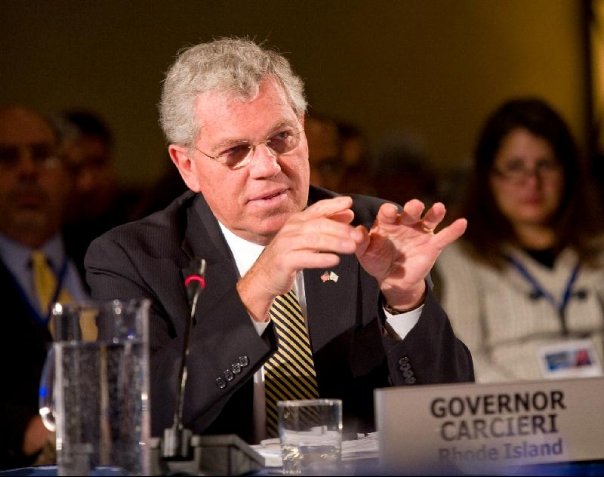
The number of workers in state government fell by an estimated 2,000 people over the last eight years, which former Governor Don Carcieri said helped him save the state an estimated $1 billion during his tenure.
But having fewer employees had an adverse impact on state services—leading to everything from long lines at the DMV to unmanageable welfare caseloads, according to Michael Downey, head of Council 94 of the American Federation of State County and Municipal Employees.
GET THE LATEST BREAKING NEWS HERE -- SIGN UP FOR GOLOCAL FREE DAILY EBLAST“You can’t reduce the state government by 2,000 people and think you’re going to have the same amount of services,” Downey said. “It’s just not happening.”
Several state Republican leaders, however, defend the cutbacks, saying they were not only necessary but also beneficial. They blame the General Assembly for failing to do its part to make sure the cuts were implemented correctly.
Feeling the strain, from bridges to the courts
A shortage of state health inspectors—just seven for 8,000 restaurants and other eateries in the state—recently prompted one state senator to warn of an increased risk of food-borne illness, such as the salmonella outbreak last month. And late in 2010, the head of the Rhode Island Superior Court warned that low numbers of sheriffs threatened courtroom security.
In December 2009, the call center at the Department of Labor and Training had such a serious backlog in unemployment claims that it had to close for several days just to catch up.
Downey blames much of this on the shrunken state workforce. He said the numbers of Council 94 members at the DMV has been cut nearly in half during the latter part of the Carcieri administration—from a high of 150 workers to approximately 80. The numbers of Council 94 workers at DOT has been reduced by roughly half and the number of sheriffs is down by about 40, according to Downey.
He said technicians who handle welfare cases at the Department of Human Services are facing an “astronomical” caseload. “Some of them have been getting so stressed out they have been going to the hospital,” Downey said. “They want to do the job but they just can’t keep up with it.”
GOP leader: room for more cuts
But Gio Cicione, the state GOP chairman during the latter half of Carcieri’s time in office, pinned the blame on the General Assembly. He said Carcieri did his part in trimming the size of the workforce while lawmakers dodged the tough political choices, failing to make the necessary reductions in state programs.
“If you simply say everything is a priority even if we can’t afford to do everything, then everything gets done poorly,” Cicione said. “The state employees now suffer because of the lack of political will from the Legislature.”
State Rep Joe Trillo, R-Warwick, also defended the employee cuts. “I think it’s a good thing we have less employees than when Governor Carcieri took office,” Trillo said. “I think there’s still room to cut more.”
He said he couldn’t say exactly where there is room for more because he does not have access to the exact figures, but he noted that some U.S. counties with populations comparable to Rhode Island have a considerably smaller workforce than Rhode Island state government.
As for why there are so many backlogs and shortages, Trillo pointed to some state employees who are upset over the changes in pay and benefits. “I think those employees are holding back,” Trillo said. “We have people who are being counterproductive to the effort to make small government more efficient and they’re protected by the unions.”

Thomas Mullaney, the State Budget Officer, offered a mixed view of the impact of a reduced workforce. “It was cause for concern in many areas because many of those retirees were senior staff with vast knowledge and experience that the state was now losing,” Mullaney said.
He added: “From a budget perspective, it was a good thing because there were significant personnel savings, much of which has continued due to many jobs not being refilled or filled with lower cost employees.”
Mullaney said the widespread reduction in the workforce could affect Governor Lincoln Chafee’s ability to make his own cuts to the budget. “In terms of limiting options for the Governor, reduced staffing levels in some areas does limit the ability to leave positions that become vacant now, vacant for too long, which we may want to do to save money,” Mullaney said.
Union leader: Budget cuts backfired
Toward the end of his administration, Carcieri aimed to achieve roughly $100 million in savings through a smaller workforce. But Downey claims that plan backfired. “I would argue that he cost taxpayers money and didn’t save them a penny,” Downey said. “I fully believe that.”
He said the administration soon realized that it needed many of those employees it had lost. But instead of making new hires, it turned to outside contractors.
Downey argues that contractors cost more than state employees—saying that his union is as concerned about the cost of state services and taxes as anyone. “We all pay taxes,” Downey said. “We don’t have some special privilege that we don’t pay taxes.”
Downey, who works as a plumber at the University of Rhode Island, said he earns approximately $20.47 an hour. A contract plumber, on the other hand, fetches anywhere between $100 and $150 an hour, he said.
However, Downey’s hourly wage does not take into account the cost of his benefits, including health care, retirement, vacation time, and sick days. Downey did not have an exact estimate for how much higher his hourly rate would be if those benefits were included in the calculation. But he said he believed that even if those benefits were included, state workers like himself would still be cheaper than contractors.
If you valued this article, please LIKE GoLocalProv.com on Facebook by clicking HERE.
The Reduction in State Workers
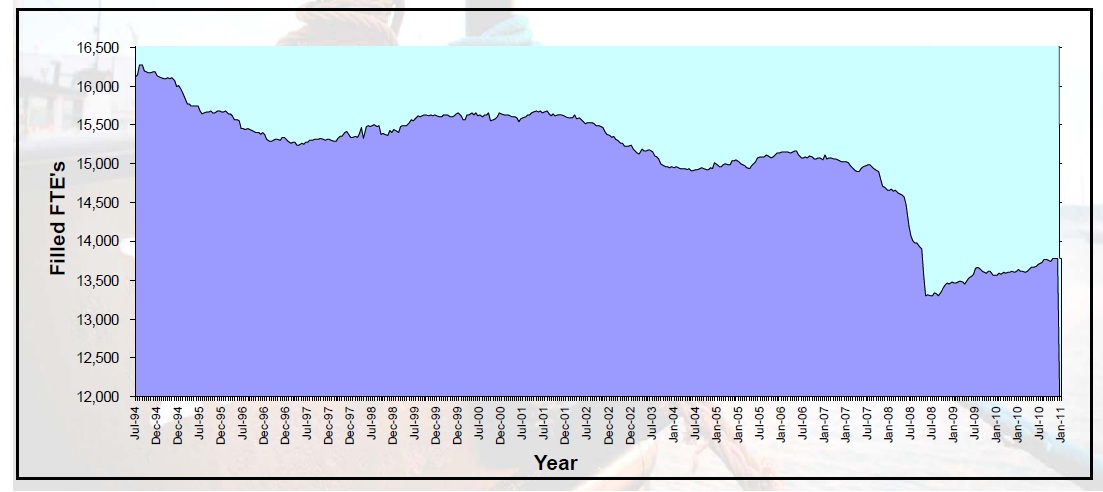
Source: State Budget Office (On the left, FTE stands for full-time equivalent, an acronym for an employee.)