INVESTIGATION: State Jobs Program 80 Percent Unfilled
Stephen Beale, GoLocalProv News Contributor
INVESTIGATION: State Jobs Program 80 Percent Unfilled

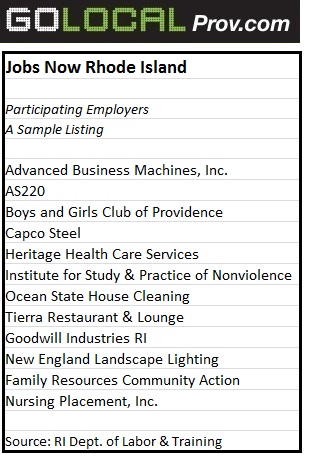
Known as Jobs Now Rhode Island, the program could have tapped into as much as $47 million in federal funds to cover the wages of private-sector workers from April 1 to September 30, 2009.
GET THE LATEST BREAKING NEWS HERE -- SIGN UP FOR GOLOCAL FREE DAILY EBLAST

As a result, the state had to leave $40 million in federal funds on the table.
In total, the state has received $801.2 million in stimulus funds as of December 2011. Just how much of an impact did those federal funds have? Is Jobs Now the rule or the exception to how successful the stimulus program was in the Ocean State?
DATA: As stimulus spending went up, so did unemployment
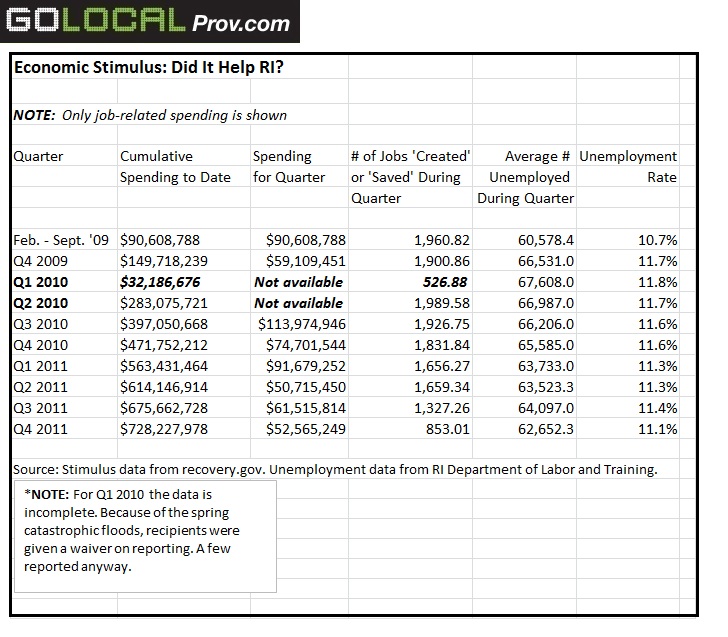
Rhode Island state government, businesses, and various nonprofits have received $728 million in stimulus funds that specifically are related to “creating” or “saving” jobs. On average about $70 million in stimulus dollars was spent each quarter in Rhode Island, funding as many as 2,000 jobs—along with associated equipment, supplies, and other expenses, according to federal stimulus records. (See below chart.)
But those are just the jobs that were directly funded through the stimulus.
The numbers don’t account for all the indirect jobs that presumably would have resulted from a stimulated economy.
Before the first stimulus dollars found their way to Rhode Island, the unemployment rate stood at 9.7 percent in January 2009. In March it cracked double digits, hitting 10.1 percent.
One year later—after the stimulus program presumably had some time to take effect—the unemployment rate was at an all-time high of 11.8 percent. The rate has eased down somewhat since then, but, at 11.1 percent, it is still higher than what it was before the inception of the stimulus program.
Stimulus in RI: Boon or ‘Boondoggle’?
For state Rep. Brian Newberry, the House Minority Leader, the data reinforces his view that the stimulus program was a complete waste of money. “The entire Obama stimulus program was nothing more than a boondoggle to benefit Democratic interest groups,” said Newberry, R-North Smithfield. “It did nothing to stimulate the economy, but just put the nation into debt for a trillion dollars.”
As a state rep, he said he’s seen stimulus funds used to plug budget deficits, which he said did little to help the state. “All it did was mask the problems,” Newberry said. “It did nothing but kick the can down the road.”
But some suggest that the stimulus was too small to handle the magnitude of the economic problems facing the country in 2009.
He said the unemployment rate was not a fair way to measure the overall impact of the stimulus. “There is no reason to believe the state’s economy is so simple that the effect of the stimulus can be extracted from the data as easily as that,” Sgouros said. “The people who invented sophisticated statistical analyses weren’t just doing it for the fun of it. They invented those techniques in order to answer questions just like this.”
The state Office of Economic Recovery and Reinvestment, which oversees stimulus spending among state agencies, does not have any studies of the impact in Rhode Island, according to its deputy director, Laurie Petrone. She said her office was constrained by the reporting guidelines established by federal authorities.
Instead, Petrone pointed to two national studies: one by the Congressional Budget Office, dated February 2012, and a second, by the President’s Council of Economic Advisers, from December 2011.
Both studies clam the stimulus program has continued to help the economy—raising GDP, reducing unemployment.
But neither has a state-by-state breakdown. (Click here to read the CBO report. The CEA report can be accessed here, but the site is currently down.)
Experts: May never know how successful stimulus was

“It is important to keep in mind that the stimulus over that period wasn’t just fiscal stimulus, but monetary stimulus as well. Given this and other complications in evaluating the relationship between fiscal stimulus funds and the RI jobless rate, it is safe to say that the unemployment rate here likely would have been higher than it actually was over the period of stimulus, but it is almost impossible to say by how much or for how long the benefits persisted,” said Leonard Lardaro, the University of Rhode Island economist who produces the monthly Current Conditions Index of the state economy.
A spokeswoman for the Department of Labor and Training agreed. “We may never be able to measure how well the American Recovery and Reinvestment Act moderated the recent economic downturn,” said Laura Hart.
But she added: “We do know, however, that ARRA did allow both adults and youth to find short-term employment that not only reduced the strain on the unemployment insurance trust fund and other social support systems but also injected federal dollars into the local economy.” (For every federal dollar spent, $1.60 eventually circulated in the local economy, Hart said, citing a formula that she said had been developed by Moody’s.)
Jobs Now: Success or not?
In the case of Jobs Now Rhode Island, state officials were given a limited timeframe for successfully getting those federal dollars into the local economy.

Funds for the jobs program—which actually were channeled through a federal welfare program (TANF) and managed locally by the Department of Human Services—had to be claimed by September 30, 2010.
By October 4, the number of filled positions had increased, to 392, still shy of the 1,711 available positions.
When asked why so few positions had been filled—especially when so many were unemployed—Hart said the reason was a lack of qualified applicants for the unfilled positions.
“The jobs matching component of the Jobs Now program highlights the skills gap inherent in the current workforce,” Hart said. “Frequently, entrants to the workforce or displaced workers in declining industries do not have the skill sets necessary to fill the job openings that do exist in the marketplace. Rhode Island is not alone in experiencing this national phenomenon.”
The state has been taking “proactive steps” to address the “skills gap,” Hart added. She said the state had been targeting investments in Rhode Island’s industries that have been the most successful and are most likely to grow.
“Funded by the Governor’s Workforce Board and known as ‘industry partnerships,’ these investments in healthcare, bioscience, defense, IT, hospitality, marine trades and construction should help the state build its workforce strategically and help reduce future skill gaps,” Hart said. “In addition, the GWB has been working with RIDE and CCRI to build career pathways in such areas as health care and IT, so that entry-level workers have the educational resources available to them to ensure upward mobility.”
If you valued this article, please LIKE GoLocalProv.com on Facebook by clicking HERE.