


When Men Wore Hats - Dr. Ed Iannuccilli
Dr. Ed Iannuccilli, Columnist
When Men Wore Hats - Dr. Ed Iannuccilli
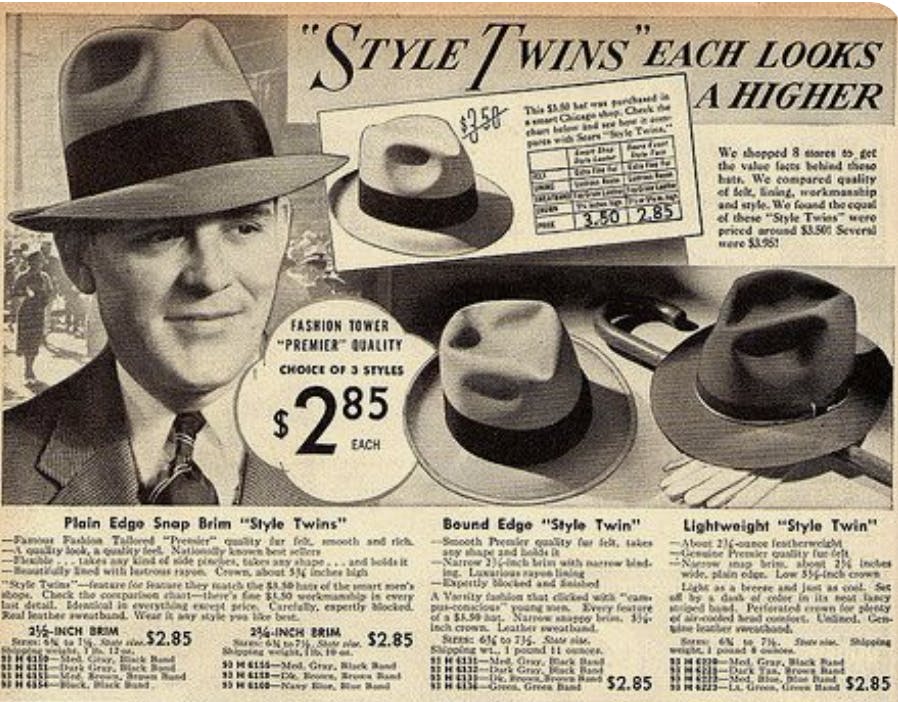
There were the days when men wore hats. No, not baseball caps. No, not backward. No, not while dining. They wore classy hats . . . felt fedoras with brims tipping downward, or a Panama curved modestly over the forehead. It might have been to keep the sun and the rain off their heads but, more likely, it was simply a fashionable part of their dress, part of a culture which lent style to the day. People dressed with pride when they went to work, to a restaurant, to the movie theater, or to church.
Hats were a popular guide to that culture. There was a store in downtown Providence, Danbury Hats, devoted solely to the hat.
GET THE LATEST BREAKING NEWS HERE -- SIGN UP FOR GOLOCAL FREE DAILY EBLASTA gentleman did not consider himself fully dressed without something nice covering his head. A fedora settled comfortably meant that you were important. This daily ritual projected worth as they walked along, heads high, never neglecting to tip the hat to a lady or remove it when entering an elevator.
My aunt once related, “Your Dad never left the house without his soft hat, often spending what seemed like hours in front of the mirror adjusting and readjusting it. One evening, after he positioned it perfectly, he asked me to help him with his coat. I brushed the hat, knocking it sideways. He turned, stared at me for what seemed like forever, and said, ‘Thanks.’”
Up to the late forties, wearing a hat was almost a necessity. But why have stylish hats fallen out of fashion? There are several theories. Yes, jobs and lifestyles have changed. Yes, fashion and taste have shifted. Or conceivably, it was the upheaval of youth in the late 1950s and 1960s. But a major move away may have been because of the dapper President John F. Kennedy who appeared at his inauguration in 1961 without a hat. And so too did President Eisenhauer rarely wear one.
Today, hats are worn as a cover, or part of a uniform, but not a fedora because its singular message as a sign of fashion and elegance has disappeared. Few accessories have been mocked more in the past several years than the fedora, notwithstanding its association with cool guys like Humphrey Bogart and Indiana Jones. The wide-brimmed beauty is now a memory.
Recently, I tried wearing the pork pie hat, one usually worn with a turned-up brim and a flat crown simulating a pork pie. It was a hat popular with both men and women in the mid-19th century. Dean Martin re-popularized it. I bought one and turned the ridge down, shaping it like the fedora. It felt good to snap the brim. It felt good to tip my hat to a passerby, whether man or woman. I liked it, but it just did not seem a fit for me, so I stopped wearing one.
Hats once meant dressing well. Dressing well is good. Wouldn’t it be nice to return? I think I’ll look for another pork pie; one with a little feather in the brim. It’s time.