


Whitcomb: More Twitter Toxicity Coming? Stolen-Metal Mess; Waterfront Adjustments
Robert Whitcomb, Columnist
Whitcomb: More Twitter Toxicity Coming? Stolen-Metal Mess; Waterfront Adjustments

“We that acquaint ourselves with every zone,
And pass both tropics and behold the poles,
GET THE LATEST BREAKING NEWS HERE -- SIGN UP FOR GOLOCAL FREE DAILY EBLASTWhen we come home, are to ourselves unknown,
And unacquainted still with our own souls.’’
From “Nosce Teipsum: Of Human Knowledge,’’ by John Davies (1569-1626), Welsh-English poet, lawyer and politician
“The most stringent protection of free speech would not protect a man falsely shouting fire in a theatre and causing a panic.... The question in every case is whether the words used are used in such circumstances and are of such a nature as to create a clear and present danger that they will bring about the substantive evils that Congress has a right to prevent.’’
-- Oliver Wendell Holmes Jr. (1841-1935), U.S. Supreme Court justice
“Freedom of the press is guaranteed only to those who own one.“
-- A. J. Liebling (1904-1963), New York-based journalist famed as a sports writer, war correspondent, food writer and journalism critic.

Many worry that he’d seek to make money off the site by, among other things, running Tweets of lie-filled conspiracy theories and demagogues who would attract and energize many users. A big question is how many people would quit Twitter in revulsion and how many would joyfully dive into what may become a toxic swamp.
Musk would seem likely to invite Trump back on Twitter, which would not please those who worry about speech that encourages violence and spreads misinformation and disinformation, some of it from such dictatorships as Russia and China. Some major social media outlets have tried to moderate that nasty stuff in the past couple of years.
And would Musk make Twitter into an occasional mouthpiece of China, where the mogul is building a Tesla plant and has other business interests?
We’ll see what happens but all this doesn’t look good for democracy. Would he surprise us by doing his bit to defend democracy by means of careful monitoring of the site? Who knows? As I said, he’s erratic.
Of course, there’s already too much concentration of media by billionaires. There’s Jeff Bezos owning The Washington Post and Michael Bloomberg owning Bloomberg News. But they have generally been hands-off and responsible owners. Then there’s the likes of the amoral Mark Zuckerberg, whose main aim in running Facebook seems to be simply making himself as many billions as possible, like the asset-stripping private-equity owners of the Gannett newspaper chain, who control far, far too many of America’s dwindling number of local newspapers.
And of course, there’s Google, whose immense power to steal news stories and take advertising revenue away from local media has turned so many places into news deserts, undermining local civic life.
We need more national media that have wide and diversified ownerships and are not controlled by a few billionaires in our Gilded Age.
As I’ve asked before regarding the growing concentration of wealth and power in other parts of the economy, where is the Justice Department’s Antitrust Division? The bigger these companies and their owners get, the more they can use their lobbying, fueled by campaign contributions (much of them hidden), to drown out the voice of the voters, turning the country into an out-and-out plutocracy.
“We can have democracy in this country, or we can have great wealth concentrated in the hands of a few, but we can't have both.’’
-- Louis Brandeis (1856-1941), American lawyer and then U.S. Supreme Court justice
xxx
xxx
Switzerland, which long ago declared itself an official neutral nation, though it’s really a Western country, is another example of industrial-strength cynicism. It has used its neutrality and secretive banking system to make itself into a wonderfully efficient and lucrative place for people connected with dictatorial regimes like Putin’s to hide ill-gotten gains.
xxx
This sort of mandate won’t fly in America and would be virtually impossible to enforce. And it smells unconstitutional. I’m sure that Senator Bell means well – COVID will be with us for the indefinite future – and he must have realized that he would be fiercely denounced for this idea. But it’s hard to believe that he wouldn’t have known this would be a nonstarter.
xxx

xxx
There’s been a national epidemic of thefts of catalytic converters from vehicles so that the thieves can fence the pricey metals. This has gotten pretty bad in Providence, where thieves have been brazenly stealing them from cars and trucks parked in private driveways. International supply-chain problems, certain to worsen as COVID and the war in Ukraine continue, will make things worse before they get better.
A friend to whom this happened asked the police officers to whom he reported the theft:
"Why aren't you going to the junkyard/metals reclamation places down on Allen's Avenue {on Providence’s waterfront} and finding out who is selling them the converters?" They had no answer.
xxx

xxx
I drove through a storm of petals from flowering trees last week that cut visibility to a few feet. Exhilarating, though it was so cold I wondered if the Native Americans had something like Indian Winter – the flip side of Indian summer.
xxx
Sometimes I miss old-fashioned expressions as they gradually disappear, such as “that’s neat,’’ “he’s a good egg’’ and “she did a swell job.’’ Or people who might not even like you calling you “darling,’’ as in a movie from the ‘30s and ‘40s, between flourishes of their cigarettes, maybe in ivory holders. Actually, even with their lethality, I miss the graceful gestures around smoking cigarettes – the twirling, the smoke rings….
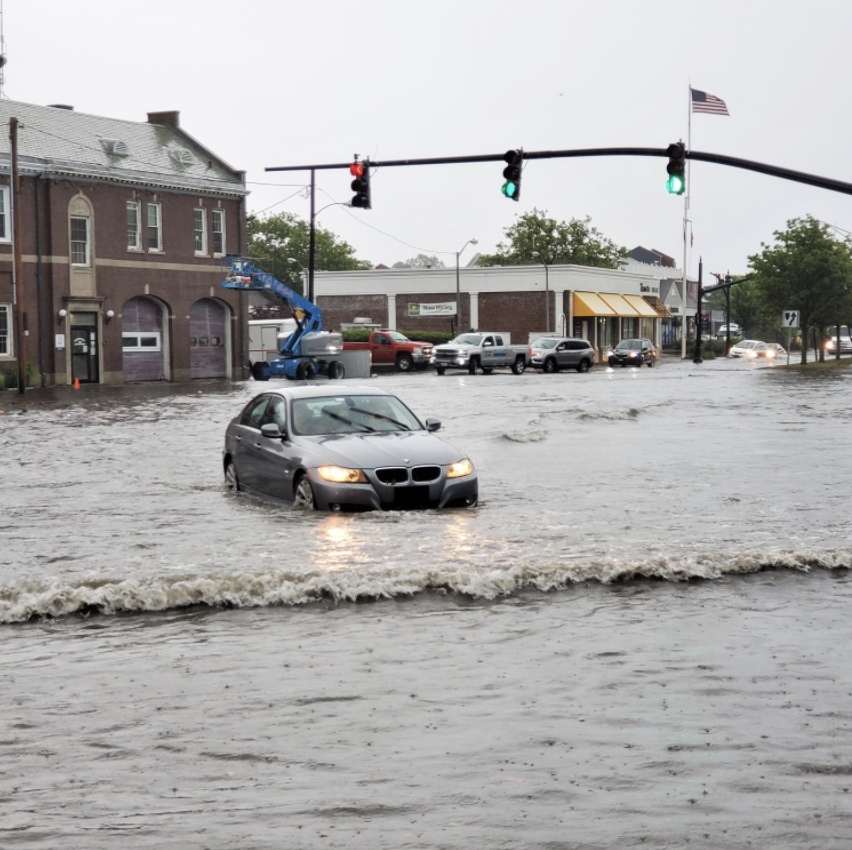
The stuff below is a heavily edited version of some of the remarks I made in a talk a couple of weeks ago and seem to me particularly resonant as we head into summer coastal vacation season:
Most of us are in denial or oblivious when it comes to sea-level rise caused by global warming. For example, Freddie Mac researchers have found that properties directly exposed to projected sea-level rise have generally gotten no price discount compared to those that aren’t, though that may be changing. And some states don’t require sellers to disclose past coastal floods affecting properties for sale. Politicians often try to block flood-plain designations because they naturally fear that they would depress real-estate values.
So the coast keeps getting more built up, including places that may be underwater in a few decades. It often seems that everyone wants to live along the water.
As the near-certainty of major sea-level rise becomes more integrated into the pricing calculations of the real-estate sector, some people of a certain age can get bargains on property as long as they realize that the property they want to buy might be uninhabitable in 20 years. Younger people, however, should seek higher ground if they want to live near the ocean for a long time.
A tricky thing is that real estate can’t just be abandoned—it must pass from one owner to another. Some local governments’ coastal permits require owners to pay to remove their structures when the average sea level rises to a certain point. Absent such requirements, many local governments’ budgets may not be enough to pay for demolition or the moving costs associated with inundation. There are some interesting liability issues here.
What to do?
Administrative mitigation would include raising federal flood-insurance rates and more frequently updating flood-projection maps. More localities can take stronger steps to ban or sharply limit new structures in flood-prone areas and/or order them removed from those areas. And, as implied above, they should implement flood-experience-and-projection disclosure requirements in sales documents.
As for physical answers to thwarting the worst effects of sea-level rise, especially in urban areas, many experts believe that some form of the Dutch polder approach, which integrates hard stone, concrete or even metal infrastructure, and soft nature-based infrastructure, along with dikes, drainage canals and pumps, may have to be applied in some low places, such as Miami and Boston’s Seaport District. Barrington and Warren look like polder country.
Polders are large land-and-water areas, with thick water-absorbent vegetation, surrounded by dikes, where the ground elevation is below mean sea level and engineers control the water table within the polder.
Just hardening the immediate shoreline, and especially beaches, with such structures as stone embankments to try to keep out the water won’t work well. That just makes the water push the sand elsewhere and can dramatically increase shoreline erosion.
On the other hand, creating so-called horizontal levees – with a marshy or other soft buffering area backed with a hard surface -- can be a reasonable approach to reduce the impact of storms’ flooding on top of sea-level rise.
Certainly establishing marshes (and mangrove swamps in tropical and semi-tropical coastal communities) can reduce tidal flooding and the damage from storm waves, but that may be a political nonstarter in some fancy coastal summer- or winter-resort places. Then there’s putting more houses and even stores and other nonresidential buildings on stilts, though that often means keeping buildings where safety considerations would suggest that there shouldn’t be any structures, such as on many barrier beaches. Still, it would be amusing to see entire large towns on stilts. Good water views.
Oyster and other shellfish beds can be developed as (partly edible!) breakwaters. And laying down permeable road and parking lot pavements can help sop up the water that pours onto the land. I got interested in how shellfish beds can act as a brake on flood damage while editing a book about Maine aquaculture last year. Of course, the hilly coast of Maine provides many more opportunities to enjoy a water view even with sea-level rise while staying dry than does, say, South County’s barrier beaches.
In more and more places where sea-level rise has caused increasing ‘’sunny day flooding’’ -- i.e., without storms -- streets are being raised.
I’m afraid that, barring, say, a volcanic eruption that rapidly cools the earth, slowing the sea-level rise, the fact is that we’ll have to simply abandon much of our thickly developed immediate coastline and move our structures to higher ground.
Working-waterfront enterprises -- e.g., fishing and shipping -- must stay as close to the water as possible. But many houses, condos, hotels, resorts and so on can and should be moved in the next few years. If they don’t have to be on a low-lying shoreline, they shouldn’t be there as sea level rises. For that matter, entire large communities may have to be entirely abandoned to the sea even in the lifetime of some people here.
Coastal communities and property owners face hard choices: whether to try to hold back the rising ocean or to move to higher ground. Nothing can prevent this situation from being expensive and disruptive.
Common sense would suggest that we not build where it floods and that we should stop recycling flooded properties. Again, flood risks should be fully disclosed and we need to protect or restore ecologies, such as marshes, shellfish and coral reefs and dune grass, that reduce flooding and coastal erosion.
Nature wins in the end.