


Whitcomb: Reed, McKee and Time; Europe Looks Elsewhere; Hemispheric History
Robert Whitcomb, Columnist
Whitcomb: Reed, McKee and Time; Europe Looks Elsewhere; Hemispheric History

Bright striped urchins flay each other with sand.
They have contrived a conquest for shell shucks,
GET THE LATEST BREAKING NEWS HERE -- SIGN UP FOR GOLOCAL FREE DAILY EBLASTAnd their fingers crumble fragments of baked weed
Gaily digging and scattering.”
From “Voyages,’’ by Hart Crane (1899-1932), American poet
“In June as many as a dozen species may burst their buds on a single day. No man can heed all of these anniversaries; no man can ignore all of them.’’
-- Aldo Leopold (1887-1948), American naturalist and writer. He spent most of his life in the Southwest and Upper Midwest.
“If my books had been any worse I should not have been invited to Hollywood, and if they had been any better I should not have come.’’
-- Raymond Chandler (1888-1959), British-American novelist (The Big Sleep, etc.) and screenwriter
xxx
So the geometry of winter is long gone, and we’re swimming in a setting that’s as green as it gets around here. And we keep turning on the car’s windshield wiper as the pollen (mostly from pines?) keeps drifting down. These days are luscious if, in their own way, melancholic in the soft air. June is a time of certain big endings.
But meanwhile, in intimations of mortality, a chilly wind comes up the Bay, feeling like November.

When to become an observer more than a participant? I wish that more high-level politicians would consider this question and retire, I’d say by age 70 or 72.
Yes, some people can move deep into old age with seemingly little decline in cognitive acuity, but the chances of an abrupt fall off increase at an accelerating clip, along, of course, with ever more obvious physical problems.
A GoLocal editorial last week noted that Rhode Island U.S. Sen. Jack Reed is 75 and plans to run for re-election next year. He’s been a very effective senator and seems to be in good health. But his chances of remaining in good health over the next few years are much less than if he were, say, 60. Thus, the editorial recommended he retire. I agree.
And the Ocean State’s governor, Dan McKee is 73, and says he’ll run again next year. Bad idea, including because of his age.
A big trouble is that so many high-level politicians feel that their identity is all wrapped up in their positions, and some may consider themselves indispensable. But as the old line goes, “The cemeteries are filled with indispensable people.’’
The catastrophic effects of Joe Biden, with the aid of certain people around him, not stepping aside until it was too late to prevent a very elderly fascist sociopath and his thieving toadies from gaining power (thanks also, of course, to the willful ignorance, civic sloth and wishful thinking of tens of millions of voters and nonvoters) will poison America for the indefinite future.
One reason that so many politicians hang on is advances in health care, at least that applying to the more obvious signs of aging (as opposed to what’s happening to one’s brain), which can help mask cognitive decline. That’s especially for powerful and affluent people with better access to the best health care than most people have, though U.S. longevity on average has declined in recent years.
Consider that Franklin Roosevelt, who died in 1945 of a stroke at 63, was then considered old. Now, many people like to think of themselves as “late middle-aged” at 63. FDR, who had severe heart disease, didn’t have the advantage of such treatments as statins and bypass surgery. He might have served out his fourth term, though that would not have been a great idea since there were other signs of decline, such as his naivete about world-historical mass murderer Joseph Stalin. Thank God Harry Truman took over.
Anyway, we should all ruthlessly probe our capabilities and in so doing decide unselfishly, or at least realistically, when to step aside. That doesn’t mean, of course, that we shouldn’t be available to offer our experience-based advice to those still in the arena, if they want it, and to carefully watch the passing scene as citizens.
xxx

I wish that many more people at the local, state and federal levels who oppose this or that tax increase affecting this or that interest group would bravely suggest which taxes should be raised to pay for the government stuff they want and which programs they’d slash rather than just give us generalized whining.
Be specific! As for the Feds, taxes should be raised at most levels if America is to start moving toward true solvency and away from the fiscal Fantasyland it’s been living in. And some big programs, such as the Pentagon’s gigantic “cost-plus” contracts and giveaways to agribusiness, need to be cut big time.
Or, in the long term, make taxes much more broadly based – at the local, state and federal levels -- than they are now by eliminating the tax breaks for sectors with powerful lobbyists. That would let tax rates be lowered. Okay, I’m dreaming….
As the late Louisiana Sen. Russell Long (1918-2003) famously put it:
"Don't tax you, don't tax me, tax that fellow behind the tree".
xxx
The Rhode Island Fire Code needs an update.
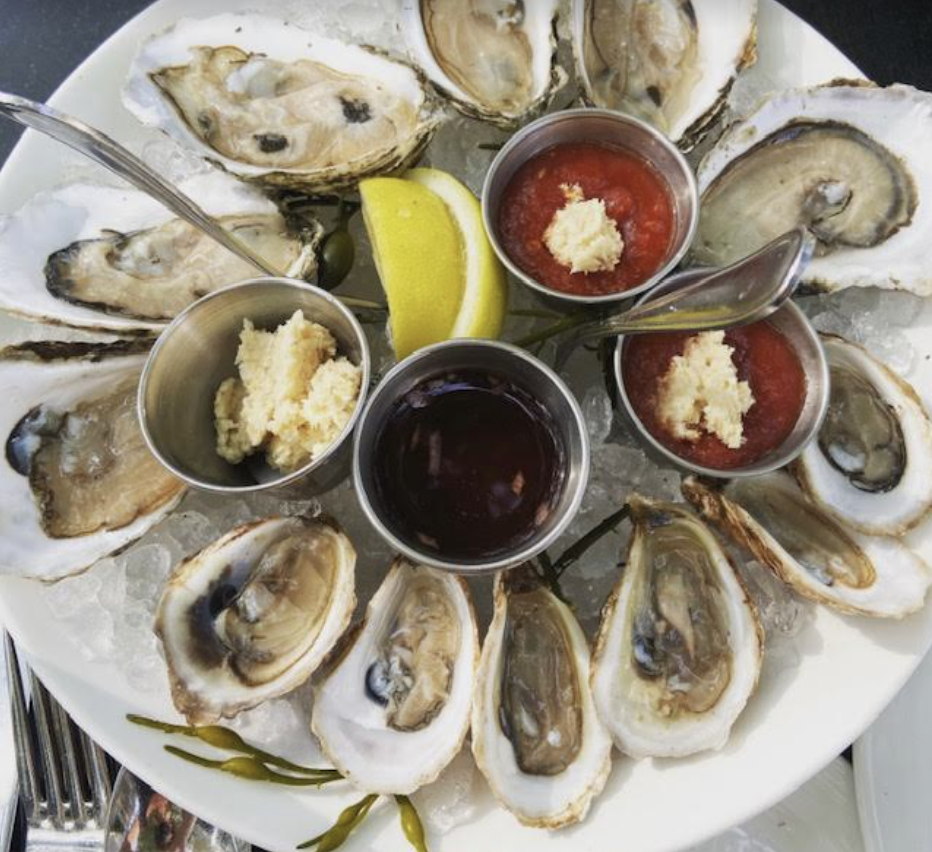
Rhode Island oysters are good, but not as delicious as Maine ones.
They’re Looking Elsewhere
Trump and his servants have been talking about doing a “big, beautiful’’ trade deal with Europe. While some smaller, perhaps mostly cosmetic, deals will be done, the Europeans will not give Trump anywhere near what he demands. After all, he has reneged on previous trade deals and is a pathological liar. And they’re tired of being insulted.
Europeans are quite rationally looking to expand their commercial ties away from Trump’s deeply unreliable America, including toward his nemesis China. This reminds me of King Charles last week supporting the idea of “new alliances’’ for Canada, in response to Trumpian threats.
Thank God that Canada and most of Europe is holding fast to the central principles of the West. As columnist Jennifer Rubin, a conservative, wrote last week:
“While Trump’s mindless assault on higher education, scientific research, artistic and academic freedom, and expertise of all kinds batters institutions and even undermines American prominence in certain fields, he cannot destroy our collective (Western) cultural heritage, ingenuity, and economic dynamism. In part, that is because our scientific and cultural advances have been internationalized, reinforced, and incorporated into the fabric of developed societies around the globe.’’
The United States has ceased to be a truly Western country, but Canada, which finally realizes that it must jack up defense spending big time, is very much so. Hit this link:
AI vs. Education
What are we going to do about artificial intelligence eroding education? While new programs for determining if students are stealing stuff from ChatGPT, etc., exist, they are grossly inadequate. This, as many academics and others have noted, undermines students’ development of their critical thinking, their ability to do original research and their capacity for synthesizing information and opinions.
Suggestions for dealing with this challenge include more oral and written (with pens) exams. Those blue books! Back to the future. It’s early on in the AI revolution, and other ways must be developed to preserve the best traditions of learning. What AI will do to jobs for students after they graduate is another vast and worrisome question.
On the Road
I was in Manhattan last week on business, and the traffic where I mostly was, on the West Side, wasn’t quite as horrific as it was before congestion tolls went into effect at the start of the year. And the air wasn’t as polluted.
Trump, to stick it to his native city, where many residents detest him, is ignoring the principles of federalism and seeking to kill the tolls. Such anti-congestion programs have been enacted successfully in some big cities around the world.
The Trump regime alleges that the program hurts working-class people—about which the billionaire-run regime cares little. But in fact, by using the toll money (which totaled $216 million in its first four months) for improving mass transit, it helps poorer people and small businesses.
Speaking of mass transit, let’s hope that the Pawtucket-Central Falls train station, which opened in January 2023, will continue to bring new life to those old mill towns. Is anyone using it to go to the new soccer stadium?
Then there’s the proposed “Central Corridor” proposal for passenger-train service from New London to Brattleboro, Vt., with the idea of synergistically linking the University of Connecticut flagship campus, at Storrs, with the University of Massachusetts flagship, at Amherst.
If wouldn’t happen any time soon!
xxx
Cars, electric and otherwise, have become such complicated giant computers that they’ve become examples of technology for the sake of technology. Nonintuitive control panels!
A New Look at Our Hemisphere
America, América: A New History of the New World, by Greg Grandin, is a brilliant, if highly opinionated, interpretation of the often-fraught entwined histories of North America (north of Mexico) and Latin America since the arrival of Europeans. Colonialization was full of mutual miscomprehension and brutality: The Spanish and Portuguese were awful, and so were the English, though not quite as bad; the natives the Europeans butchered had their faults, too. And the United States displayed much arrogance and selfishness. For much of the past 250 years, we’ve tended to see Latin America as a sort of gigantic colony/plantation for U.S. businesses.
Grandin’s epic story tells stories of heroes and villains, and humanitarian, legal and even theological advances, often in the face of corruption and tyranny. It also provides what seems to me an unprecedented survey of Latin America’s contributions to international relations and law, including the creation of the United Nations, and economic policy. You’ll probably look at the Western Hemisphere very differently after reading this book.