Riley: Mr. Magaziner, No More Spin - Just the Facts
Michael G. Riley, GoLocalProv MINDSETTER™
Riley: Mr. Magaziner, No More Spin - Just the Facts

What he didn’t tell you is that the calendar year was January 1, 2014 to December 31, 2014 and thus contains only half of fiscal year 2015. The first six months of 2014 are already in the books and CAFR. So far in the current fiscal year, the state has actually lost money and that’s not good. Since the beginning of July 2014 both the state of Rhode Island and the City of Providence are down roughly .5% vs. the S & P 500 gain over the same period of + 5.03%. That is dramatic under performance.
Bad start to 2015 compounds fiscal 2015 problems
GET THE LATEST BREAKING NEWS HERE -- SIGN UP FOR GOLOCAL FREE DAILY EBLASTAs if the last 6 months of performances weren’t bad enough, calendar year 2015 has been awful, with a January 2105 loss of 3.10%. Both the City of Providence and the state have significantly negative returns for fiscal 2015 once January figures are released.
How could both funds be doing so poorly? What are the ramifications? Is it possible to get the State Treasurer and the City of Providence officials to stop all the spinning and accurately report the numbers? The asset performance numbers are available virtually every day to state and city officials why do we have to wait months? To remedy this lack of transparency I have built proxy portfolios to track the performance of assets in both funds on a daily basis. I hope to expand this to the entire state.
Here are the real Numbers you need to know*
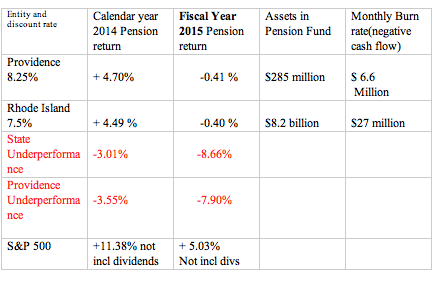
*My data is mostly derived from actual performance and Government reports..some reports were missing
The City has estimated it will make 8.25% this year fiscal 2015 vs the approximately down 3% actual performance with only 5 months left in the fiscal year. The State estimated 7.5% for its returns and has similar losses in fiscal 2015.
Why does this matter?
Overestimating returns allows government officials to place fewer dollars into the pension fund annually to protect workers. The worse funded the plan, the more negative the effect of under performance on the stability of the plan. Providence is clearly unstable and though the state is funded around 60%, both operate on a negative cash flow. A study released this month on State Public Funds shows that aggregate funding level has fallen every year since 2001 to today’s 71.8% and median state funding was 72.8%. As pointed out, Rhode Island is significantly worse at 60% and especially vulnerable due to the possible unwind of the pension reform of 2011.
Providence is dramatically worse and without any plan to fix it. It is between 20% and 27% funded, depending on which rating agencies are referenced. Providence can’t take many hits to its pension fund as benefit payouts now exceed $100 million annually to be paid out oto Providence employees and retirees, while normal contributions from employees to the pension fund are about $11 million annually. This $89 million dollar gap is supposed to be covered by investment income and normal & discretionary government contributions from previous years underfunding. Unfortunately, proper funding isn’t happening and the pension liability grows. This is true for both the state and the City of Providence; as a result, there has been no significant improvement in funding ratios despite 5 years of quantitative easing and the greatest bull run in history.
For those who believe that this “bull run” can’t last, there are huge warning signs. The city should already have a plan B if the pension fund collapses. If investment returns in Providence are flat or down for just a few years the fund may be forced to liquidate. Pension funding and benefits will absorb a greater % of city and State spending crowding out necessary services. The State has a much more stable condition, yet not great, and if the courts unwind pension reform it could be a complete disaster.