


David Brussat, Dr. Downtown: Truly Historic Preservation Tax Credits
David Brussat, GoLocalProv Dr. Downtown
David Brussat, Dr. Downtown: Truly Historic Preservation Tax Credits

The program was passed by the General Assembly in 2001 and it worked like a charm. In less than a decade it created $1.3 billion in growth, 22,000 construction jobs, 6,000 permanent jobs and $800 million in wages at a cost of $300 million. Each dollar invested created more than four dollars of growth. It was canceled in the recession but revived in 2013, creating another flow of economic stimulus. Yet it was not extended in 2014.
When the program’s 30-percent offset was combined with the 20-percent offset of its federal sister, it provided a very significant incentive to favor the renovation of old buildings over the construction of new ones, which is usually less expensive. The program thus served to strengthen one of Rhode Island’s few competitive advantages - its historic beauty.
GET THE LATEST BREAKING NEWS HERE -- SIGN UP FOR GOLOCAL FREE DAILY EBLASTA governor who fails to extend that program cannot truly be said to favor economic growth in Rhode Island.
Raimondo’s Dud Incentive Program
Instead of extending a proven job creator, Raimondo proposes innovation incentives that sound good but already exist in state law to little effect. Little will come from adding more. Five such high-tech subsidies have been available to the 195 redevelopment commission since 2011. The result? Nothing so far. The commission has signed off on a student dorm.
In 2013, the preservation credit program’s revival was achieved in spite of blowback from the 38 Studios fiasco, which put all tax credits under a cloud. This year the preservation tax credits are haunted by public concern that the program would be sucked dry by one project, the renovation of the Industrial Trust (“Superman”) Building.
Raimondo should have the courage to spike those fears and revive this program. Instead of proposing tax incentives that merely seek to offset the high cost of doing business in Rhode Island, she should cut those high costs first, attacking tax and regulatory burdens that hurt all businesses. Then let’s see whether the high-tech subsidies that already exist will bear fruit.
She should extend the historic tax credits with a vigor she has directed to innovation credits. After all, the historic buildings that qualify are already here and aren’t going anywhere. Unlike innovaction credits, preservation credits cost the state any money until the work is done and the jobs already in place, making the kind of bait and switch that 38 Studios pulled impossible.
What preservation credits created
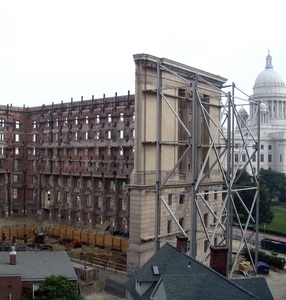
Rhode Island’s preservation credits strapped booster rockets on a federal credit program in effect since 1976. In 2008, the state removed those boosters, in effect deepening the recession here.
While a state does ride national economic trends, their manifestation is purely local. The national economy expands the level of total investment nationally, but it flows into a state based on the local factors that attract or repel money. Here the preservation tax credits helped mitigate the downer of the state’s business climate. That was a major factor in our boom in 2001-2007. Ending the credits helped kill Rhode Island’s ability to emerge from the recession.
With national economic trends beginning, at last, to trickle down to Rhode Island, and with news of Buff Chace and other developers eyeing even more old buildings to redevelop, now is the time to strap that booster rocket back on.
Raimondo's last man standing

At some point, under Gina Raimondo or the next governor, the State Tourism Council will start to look like low-hanging fruit to budget cutters. By then, so will the State Planning Council and Commerce RI. Stephen Pryor’s successor will already be long gone. Dr. Downtown’s thought experiment of eliminating entire agencies may become the fiscal policy of Rhode Island. Let us hope the governor hires someone to masterplan that possibility, worst-case-scenario-wise.
Raimondo's Budget - Winners and Losers

Winner
Lower-Income Senior Citizens
Acknowledging one of Speaker Mattiello's top priorities for the legislative session -- cutting taxes on social security benefits -- Raimondo's budget proposal exempts Social Security benefits from state personal income tax for single filers with Federal Adjusted Gross Income less than $50,000 and for married filers with Federal AGI less than $60,000. "This proposal would place Rhode Island on an equal footing with Connecticut," said Raimondo's office -- adding that the proposal is "estimated to reduce the final payments component of personal income tax by $3.9 million in FY 2016."
Photo: Neil Moralee/Flickr

Loser
Million Dollar Second Home Owners
Says Raimondo, "revenue options were specifically chosen to minimize impact on working Rhode Islanders." The Governor proposed establishing a statewide property tax for non-owner occupied residences (i.e., vacation homes, second residences) and vacant residential land valued at greater than $1.0 million. This effort would provide $11.8 million through a "relatively small number of wealthy taxpayers," said Raimondo. And some disagreed with the approach. "Her proposal for increasing taxes, whether on health insurance plans, on a new, statewide property tax on second homes valued at over a million dollars, on cigarettes or on anything else, is a complete non-starter," said Monique Chartier with RI Taxpayer. "Rhode Island has a spending problem, not a revenue problem, as evidenced by some of the highest taxes in the country and it is surprising that the governor, with her financial background, does not recognize this."
Image: Andrew_Writer/Flickr

Winner
Construction Workers
The Governor’s budget includes an additional $20.0 million from state debt refinancing proceeds to create a capital fund to help address school facility needs -- and establishes a School Building Authority within RIDE to oversee distribution of school modernization funds, targeting facilities in greatest need. Lifting the school construction moratorium, the budget proposal sets the annual construction aid appropriation at $80.0 million starting in FY 2017. According to Raimondo, this will "create fiscal stability with predictable funding and allows for projects to be prioritized." In addition, a non-school package of real estate tax incentives is intended to "encourage construction of job-producing projects, with a focus on development near transit hubs and historic structures."
Photo: Alan Kotok/Flickr

Loser
Smokers
The Governor’s budget proposed a number of additional revenues, including increasing the state’s cigarette excise tax by $0.25 per pack, from $3.50 to $3.75 per pack. "This increase will raise $7.1 million in FY 2016 while discouraging smoking and improving health outcomes," said Raimondo. According to the Tax Foundation, Rhode Island had the third highest cigarette tax in the country in 2014.


Winner
Open Government
Raimondo touted launching the state's first web-based budget tool - and good-government watchdogs Common Cause weighed in on the development. Said Executive Director John Marion,"The state budget is the most important document produced by our government every year and until now that document has been trapped inside clunky PDF documents. With the new interactive budget Rhode Island now has a tool that makes those hundreds of pages much more accessible. Two key features stand out; the ability to look at how individual line items have grown or shrunk going back until 2008, and the ability to look at how the Governor's budget stands up to what the General Assembly eventually enacts. That second feature, if updated in real time, will empower citizens and journalists to much more easily follow the General Assembly's budget deliberations than they have been able to in the past. By extension that means we can more easily hold both the Governor and the legislature accountable for the hundreds of decisions made in the budget. Finally, by freeing the budget from PDFs, and providing the raw file for download, the democratization of data has reached Rhode Island's shores. Now anyone who is interested can build their own tool to analyze the choices reflected in the state budget.

Loser
AirBnB
The Governor's budget proposal recommends requiring providers of unlicensed rentals of lodging accommodations, such as Airbnb, to be subject to all state lodging taxes. According to Raimondo's office, this proposal is anticipated to enhance sales and use tax revenues by $851,512 in FY 2016.

Winner
Tourism Industry
The Governor’s budget modifies the distribution of lodging tax dollars to provide a greater share to statewide tourism efforts to support a major state tourism marketing campaign -- but it comes at a cost. "To provide sufficient resources for this initiative, the Governor’s budget establishes new revenue sources dedicated to tourism promotion. The budget proposes expanding sales and lodging taxes to online resellers of lodging accommodations, who currently pay no taxes on their markup over the wholesale prices. The budget also closes an existing loophole that exempts vacation houses and small bed and breakfasts from paying the sales and lodging taxes. Finally, the budget would apply sales and local lodging taxes to unlicensed rentals, which have increasingly become an alternative to hotels, bed and breakfasts and other licensed lodging. Further, the Governor proposes redirecting a greater portion of the state hotel tax to dedicate more funds to statewide tourism, marketing, and economic development at the Commerce Corporation. The net effect of changes to the tourism funding formula and new revenue sources is an additional $6.4 million annually."

Loser
State Workers
The Governor’s budget proposes achieving savings of $22.0 million related to personnel and employee benefits. "Administration officials will work with state employees and their representatives to find the savings while avoiding significant layoffs," said Raimondo -- who volunteered to do her part for cost savings by announcing Thursday evening that she would be taking a 5% paycut herself.

Winner
Kindergarteners
At the same time the State expands access to pre-K classes, some communities still do not offer full-day kindergarten. "The Governor has noted the importance of providing quality full-day kindergarten in all of our communities. Her budget includes an additional $1.4 million to expand full-day kindergarten to children in every city and town by August 2016. Finally, to ensure that our teachers reflect the growing diversity of Rhode Island’s children, the budget includes $250,000 in grant funding to recruit and train more diverse teachers," wrote the Raimondo office.
Photo: woodleywonderworks/Flickr

Loser
Hospitals
For DHS, the Governor recommends reinstituting the hospital licensing fee at 5.703 percent on FY 2013 net patient revenues to increase FY 2016 licenses and fees revenues by $156.1 million.


