


Rhode Island Hospital Uses Google Glass to Diagnose Skin Conditions
GLocalProv News Team
Rhode Island Hospital Uses Google Glass to Diagnose Skin Conditions
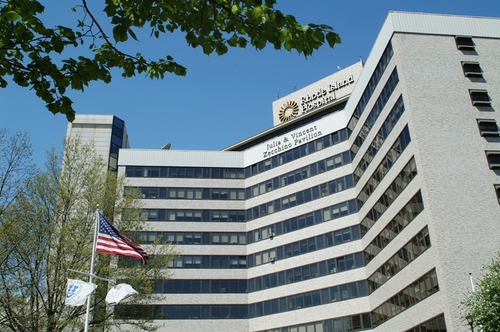
For the patients who qualified for the trial, the emergency department physicians at Rhode Island Hospital used Google Glass -- a pair of eyeglasses with a computer, camera and microphone built into the frame – to contact a dermatologist through a video link using Glass and running a third-party, Health Insurance Portability and Accountability Act (HIPAA)-compliant video platform. Later, patients were surveyed about their experience with teledermatology.
Skin problems account for 3.3 percent of emergency department visits, and most patients wait months to see a dermatologist.
GET THE LATEST BREAKING NEWS HERE -- SIGN UP FOR GOLOCAL FREE DAILY EBLAST“While the patients prefer in-person visits, they said they preferred the video consultation over a more widely practiced telephone consult,” said Paul S. Porter, M.D., the principal investigator and a physician in the emergency department of Rhode Island, Hasbro Children’s and The Miriam hospitals. “For patients, a fast and accurate diagnosis means a faster path to satisfactory treatment. A device like this democratizes telemedicine because a hospital can start a program for a few thousand dollars and gain access to an experience that was only previously available at a much higher price point.”
Because of the interactive nature of the device, the teledermatologists were able to appreciate both the gestalt of nonspecific skin eruptions and specific skin diseases. Additionally, the off-site doctors were able to interact with the on-site doctors by asking questions and requesting additional skin locations to examine. During the process of informed consent, medical staff explained to patients that no information was stored, and the live transmission was encrypted. The participants overwhelmingly believed that their privacy was protected.
The study had several limitations: Because of the small size and single-site status, results cannot be generalized to other institutions; the accuracy of the diagnosis in the cases wasn’t measured; and the financial and workflow effects of the device weren’t addressed.
Videowall courtesy of New Mobile Phones/flickr
Top 10 Hospitals in Rhode Island Rated By Patients

#10 Kent County Memorial Hospital
Kent County Memorial Hospital
Warwick, RI
New England Rank: 61
No. of Beds: 359
Kent Hospital is a nonprofit, acute care hospital which serves a number of towns in central Rhode Island. Kent’s Emergency Services Department receives 70,000 visits each year, making it the second busiest in the state.
Highlights: When surveyed, 80% of patients stated that 80% of their doctors communicated well with them, and 78% said that their nurses did.

#9 Rhode Island Hospital
Rhode Island Hospital
Providence, RI
New England Rank: 57
No. of Beds: 719
This private, not-for-profit hospital was founded in 1863 and has been serving Southeastern New England for over 150 years. Rhode Island Hospital acts as a major trauma center for the region, while also providing the Ocean State with the only facility dedicated solely to pediatric care.
Highlights: 78% of patients reported that their doctors always communicated well, and and 76% said their nurses did.

#8 Memorial Hospital
Memorial Hospital of Rhode Island
Pawtucket, RI
New England Rank: 49
No. of beds: 294
This community hospital has provided primary and ambulatory care services for residents of the Blackstone Valley of Rhode Island and southeastern Massachusetts for 120 years.
Highlights: Memorial’s highest marks were earned for its staff’s communication skills—84% of patients said they were given information about what to do during their recovery at home.

#7 St. Joseph of RI
St. Joseph Health Services and Hospital of RI
North Providence, RI
New England Rank: 32
No. of beds: 231
St. Joseph's treated 188 patients in its first year in 1892, and now, it currently serves 99,000 patients annually.
Highlights: Great communication at St. Jospeh got the highest marks from patients--82% said nurses always communicated well, and 80% said the same of doctors.

#6 Roger Williams
Roger Williams Medical Center
Providence, RI
New England Rank: 28
No. of beds: 176
Located in one of Providence’s oldest neighborhoods, Roger Williams is a community-owned and governed health care organization that provides some of the most advanced specialty care currently available.
Highlights: RW's highest marks were earned for its staff’s communication skills—86% of patients said they were given information about what to do during their recovery at home.

#5 Women and Infants
Women and Infants Hospital of RI
Providence, RI
New England Rank: 24
No. of beds: 247
One of the nation’s leading specialty hospitals for women and newborns, Women & Infants is the ninth largest stand-alone obstetrical service in the country with nearly 8,400 deliveries per year. In 2009, Women & Infants opened what was at the time the country’s largest, single-family room neonatal intensive care unit.
Highlights: Stellar communication is a hallmark at Women and Infants—82% of patients said they were given information about what to do during their recovery at home.

#4 Westerly Hospital
Westerly Hospital
Westerly, RI
New England Rank: 9
No. of beds: 125
The Westerly Hospital is a 125-bed hospital featuring private patient rooms that provides Washington (RI) and New London (CT) County residents a wide array of medical, surgical, laboratory and rehabilitative services using state-of-the-art technology in an intimate, community hospital setting.
Highlights: Communication is key at Westerly Hospital—83% of patients said they were given information about what to do during their recovery at home.

#3 Newport Hospital
Newport Hospital
Newport, RI
New England Rank: 6
No. of beds: 129
Founded and funded by Newporters in 1873, Newport Hospital began as a 12-bed cottage hospital on donated land, and now has 129 licensed beds. In 2011, the hospital received its second consecutive designation as a "Baby Friendly" hospital by the World Health Organization and UNICEF.
Highlights: Newport’s highest marks were earned for its staff’s communication skills—86% of patients said they were given information about what to do during their recovery at home.

#2 Miriam Hospital
Miriam Hospital
Providence, RI
New England Rank: 5
No. of beds: 247
Founded in 1926, Miriam Hospital is a private, not-for-profit hospital, with a history of providing superior patient care. The hospital is staffed by more than 870 physicians, approximately 50 full-time house staff (medical school graduates), a nursing staff of 500 and more than 2,300 employees.
Highlights: The overall patient experience at Miriam Hospital was incredibly positive—83% said they would definitely recommend the hospital to another person.

#1 South County Hospital
South County Hospital Inc.
Wakefield, RI
New England Rank: 1
No. of beds: 93
An independent, non-profit, acute-care hospital in Rhode Island, South County Hospital offers the latest advances in technology and a comprehensive range of medical and surgical services to its patients.
Highlights: Great communication is a hallmark at South County--85% of patients said their doctors communicated well, and 85% said their nurses did. Additionally, 91% of patients reported that they were given information about what to do during their recovery at home.


