


America’s Offshore Wind Industry Began With RI GOP Governor Pushing and Democratic Opposition
GoLocalProv News Team
America’s Offshore Wind Industry Began With RI GOP Governor Pushing and Democratic Opposition

Today, it is President Donald Trump and the Republican Party working to kill offshore wind, but nearly 20 years ago, at the inception of the industry in America, it was a Republican leading the effort and a Democrat trying to stop it.
GET THE LATEST BREAKING NEWS HERE -- SIGN UP FOR GOLOCAL FREE DAILY EBLASTRepublican Rhode Island Governor Don Carcieri was a conservative, pro-business politician. Socially, he was opposed to gay marriage and abortion.
First elected in 2002, Carcieri promised to cut state government and create 20,000 jobs.
His two terms were bumpy as he often clashed with the Democratic legislature.
In Carcieri’s final years, he pushed two major economic development strategies. The first economic development initiative involved a funding scheme that provided $75 million to 38 Studios, a video game company founded by former Red Sox pitcher Curt Schilling.
That was an almost immediate failure, with the company going into bankruptcy in less than two years after Carcieri and the Economic Development Corporation (EDC) pushed through the massive public spending for the fledgling company. The investment, bankruptcy, and legal actions made Rhode Island national news. It was an abject embarrassment.
The second Carcieri initiative was to create an offshore wind industry in Rhode Island. Massachusetts had first attempted to build an offshore wind project in America, but powerful interests, including U.S. Senator Ted Kennedy, the Koch brothers, and even Walter Cronkite, opposed the Cape Wind project.
The offshore wind industry began in earnest in Rhode Island in 2008, as Carcieri pushed through legislation to start the wind industry in the state.
It took almost a decade, and the first successful project in America was Deepwater Wind.
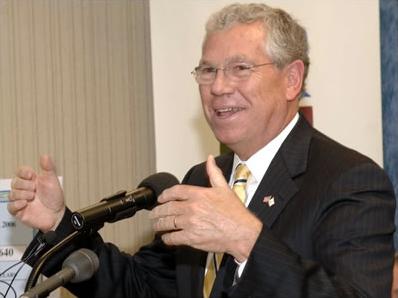
In September of 2008, Carcieri announced that Deepwater Wind was chosen as the developer to construct a wind energy project off the shores of Rhode Island that could provide 1.3 million megawatt-hours (MWh) of electricity per year, 15 percent of all electricity used in the state. It was expected that the project would cost more than $1 billion to construct, with all the capital coming from private investment sources.
“Today marks a major step to bring wind power to Rhode Island and to reach our goal of at least 15 percent of all electricity in the state be renewable energy,” Carcieri said at the time. “Of the many forms of renewable energy alternatives available, wind is the proven leader. Wind power is clean, green power that is not subject to variations and increases in fuel prices. Rhode Island is uniquely positioned to lead the nation with the development of this country’s first offshore wind farm.”

The lead opponent to the project was the Democratic Rhode Island Attorney General.
In July of 2010, GoLocal reported that Attorney General Patrick Lynch took his opposition to the proposed wind farm off Block Island to the next level, announcing he was challenging the constitutionality of a new law that allowed the project to move forward.
As reported, the law would send the issue back to the Public Utilities Commission, which had already once turned down a proposed contract between National Grid and Deepwater Wind, After the law took effect, Deepwater Wind filed a new proposed contract with the PUC.
“We continue to fight against this special-interest measure and inside deal tailored to put only one entity, Deepwater Wind, on the fast track to develop a costly demonstration project that isn’t needed and will create only six full-time jobs,” said Lynch, who at the time was a Democratic candidate for governor.
“It’s an exercise in futility that will not spur economic development in Rhode Island, will not generate much-needed jobs for our residents in a cutting-edge industry and, despite its supporters’ promises, provides absolutely no guarantee that our state will rise as the primary purveyor of affordable wind energy along the Atlantic coast," Lynch added.
Charges of Inside Deal
Carcieri hammered away at Lynch for saying the new law was “an inside deal” tailored to favor just one company—Deepwater Wind.
“The Attorney General is making a reckless charge that the new law was the result of an inside deal tailored to favor one developer,” said Carcieri at the time. “The Attorney General should know that there was a competitive process to select a preferred developer for the proposed wind farm. The process was open, transparent, and based on competitive scoring of all interested applicants.”
Carcieri said Deepwater Wind was chosen because it had the lowest energy price, the strongest financial assets, and could commit to creating jobs in Rhode Island.
“The Attorney General is either uninformed or misleading the public – which is it?” Carcieri concluded.
The project was ultimately cut down to a pilot project located off Block Island.
After a battle to get the pilot project approved, Deepwater was off and running, but faced challenges, including financing, legal, and local zoning.
In May of 2017, Block Island switched over and was powered by Deepwater — making American history.
The success of the project made global news, and the Block Island project was featured in a national Citi ad.
Today, the success of Deepwater seems forgotten, and the offshore wind industry is mired in political and legal chaos.
It all started in Rhode Island.