


CDC Issues New and Questionable Guidelines For Pandemic Masking and Social Distancing
Nick Landekic, Guest MINDSETTER™
CDC Issues New and Questionable Guidelines For Pandemic Masking and Social Distancing

The previous CDC guidelines for determining risk level considered the weekly rate of new COVID cases. Based on the rate of new cases, the risk level was determined to be one of four categories:
GET THE LATEST BREAKING NEWS HERE -- SIGN UP FOR GOLOCAL FREE DAILY EBLAST
High: Over 100 cases/100,000 population/ in a week
Substantial: 50-99/100,000/week
Moderate: 10-49/100,000/week
Low: Under 10/100,000/week
Under the prior guidelines, indoor masking and social distancing were recommended in areas of Substantial or High infection transmission, which would currently apply to 96% of counties in the U.S. (including all of Rhode Island, which is at High risk).
The new CDC guidelines are now based on three measurements:
1. New hospital admissions for COVID over the previous week;
2. The percent of hospital beds filled by COVID patients; and
3. New COVID cases per 100,000 people over the previous week (like the prior guidelines).
These three metrics are then weighed to determine one of three risk levels: Low, Medium, or High, according to the following chart:
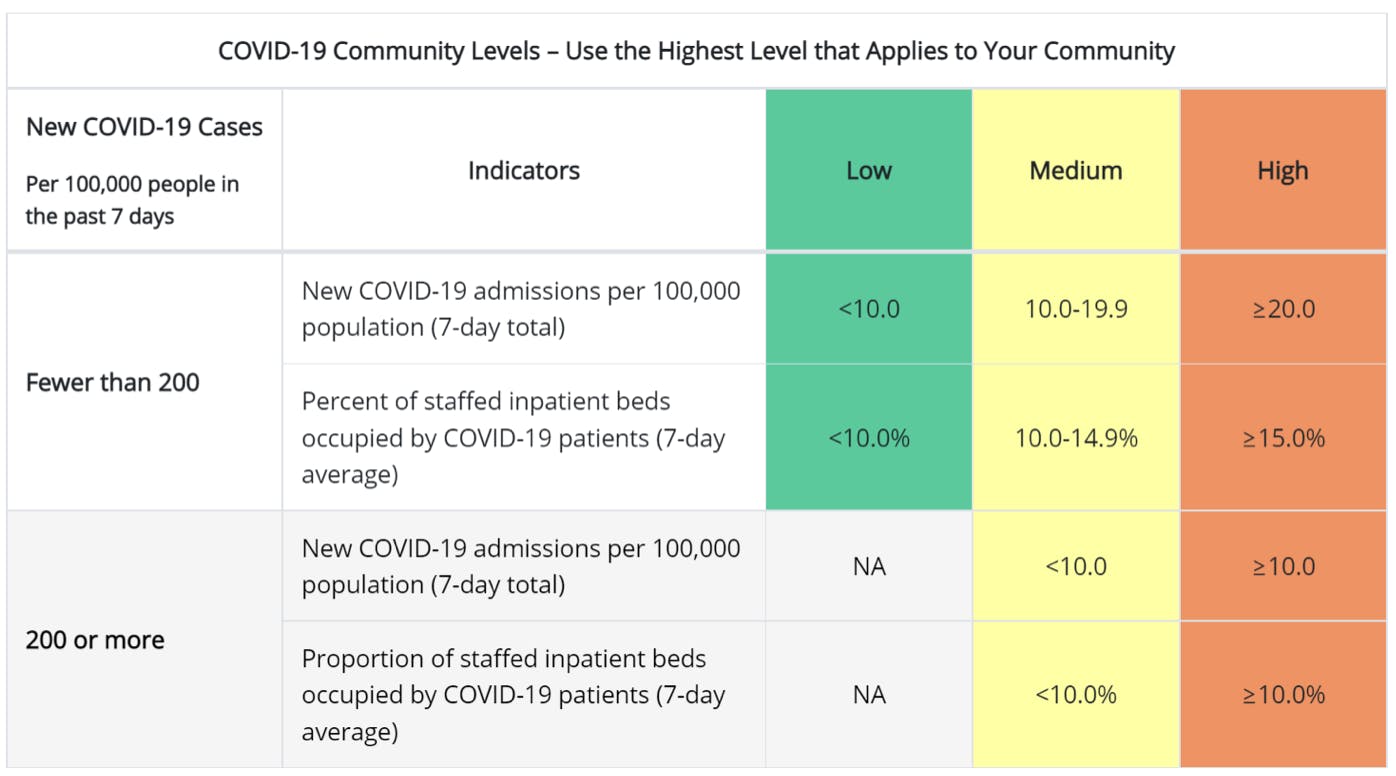
Source: https://www.cdc.gov/coronavirus/2019-ncov/science/community-levels.html
There is a complex set of guidelines for recommended behaviors for both individuals and communities at each of the three new risk levels. Full details are described on the CDC website, with a short summary below:
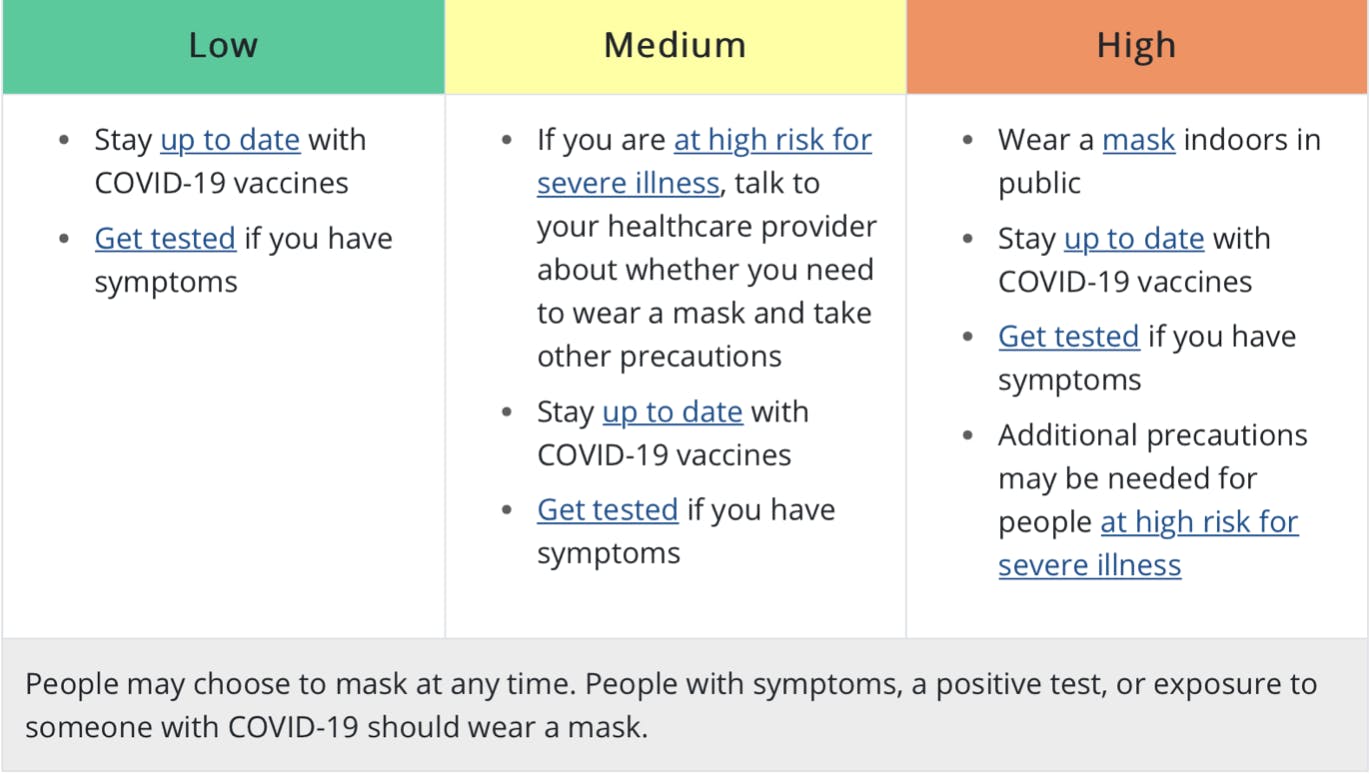
Under the new guidelines, 28% of counties are currently categorized as High risk, 42% at Medium risk, and 30% at Low risk. All of Rhode Island would now be classified as Medium Risk.
In short, the new CDC guidelines suggest that in areas and at times of Low risk, fully vaccinated and boosted individuals could go without masks and social distancing indoors. In areas and at times of High risk, indoor masking and social distancing are recommended for everyone.
What is much less clear and has more ambiguity is what to do in places and at times of Medium risk, which currently is the largest part of the country and all of Rhode Island.
Questions and Potential Concerns
The consideration of hospitalization rates is a very good and important additional metric to add beyond just new COVID case rates. This is particularly needed since testing is way down, and the reported numbers of new cases may no longer be indicative of actual numbers in many areas.
In Rhode Island, over the past week there have been an average of 6,261 tests done daily, only about one-fourth of the rate of nearly 24,000 tests per day in mid-January.
However, there are some questions and potential concerns regarding the new guidelines.
First, the level of new cases being used to determine when masking may not be needed is now 200/100,000/week. This is four times higher than the previous level of 50/100,000/week. It is unclear what, if any, scientific rationale and data were used to set this new, much higher level.
In the U.S. we are still experiencing about 2,000 COVID deaths every day. On an ongoing basis, this would be over 700,000 deaths per year. What scientific studies demonstrate that it is safe to raise the bar so much at this time despite this high death rate?
Second, while recommended activities at the risk levels of ‘high’ (= everyone wear masks) and ‘low’ (= masking not needed indoors if vaccinated and boosted) are clear, there is a great deal of vagueness at ‘medium’ risk. The new guidance essentially advises to ‘talk with your doctor if you are at high risk for severe disease’. This places all the onus and responsibility on individuals, and asks and expects people to do things that many may not. The CDC seems to be in part abrogating their duty as the highest public health leader in the country and pushing the responsibility to individuals and their personal physicians.
There are a great many conditions that have been shown to result in ‘increased risk’ of becoming infected or having a poor outcome from COVID above and beyond being ‘immunocompromised’. Inlcuding, diabetes, being overweight, hypertension and many other cardiac and cardiovascular conditions, asthma and other chronic lung diseases, Sickle Cell Disease, and particularly, age https://www.cdc.gov/coronavirus/2019-ncov/need-extra-precautions/people-with-medical-conditions.html.
93% of COVID deaths to date have been in those over age 50. Should age be considered an ‘increased risk’ under the new CDC guidelines? Should anyone over age 50 wear masks indoors and practice social distancing at times and in places of ‘Medium’ risk? Should ‘Medium’ risk mean ‘High’ risk for those over 50?
Third, these guidelines seem to accept the current death rate as the ‘new normal’. Does this mean that as a society, we are essentially codifying and embracing around 2,000 deaths a day as being OK? Are we saying that it’s acceptable for an additional roughly 700,000 people to die each year in the interests of the economy, so that some people can go back to living as if it were 2019?

It will be imperative to be rapidly responsive to changing conditions. When future surges of variants come, the CDC must be promptly reactive in communicating the increased risk and need to wear masks indoors, and people will need to listen and change their behaviors.
We should also bear in mind that we are all learning about the pandemic as we go. What seems like the best course of action one day can be superseded and no longer true when new information becomes available. That’s how science works. The people at the CDC do the best they can with the information available at the time, but history has shown that some decisions have proven to be premature.
Last year the CDC made a recommendation that masks no longer needed to be worn indoors, only to then have to reverse the policy and reintroduce mask-wearing by summer https://www.cnbc.com/2021/07/27/cdc-to-reverse-indoor-mask-policy-to-recommend-them-for-fully-vaccinated-people-in-covid-hot-spots.html. Likewise time may show these new recommendations might need revision as well. The virus has repeatedly taught us painful lessons that must be heeded. It moves faster and is smarter than we are.
Another source of guidance for COVID infection risk is covidactnow.org, a collaboration among the Harvard Global Health Institute, Stanford University Medicine, and Georgetown University Medical Center. Covidactnow provides daily updates on COVID risk based on –
- Daily new cases, the current amount of COVID in a community,
- Infection rate, the direction and speed of growth of infections, a predictor of the future, and
- Positive test rate, a double-check on the confidence of the data.
Covidactnow analyzes these metrics and determines infection risk on five different levels: Extremely High, Very High, High, Medium, and Low.
And, Covidactnow currently ranks Rhode Island’s risk level as High. 49 out of 50 states are currently ranked as High, Very High, or Extremely High risk, with only Nebraska at Medium.
We all desperately want the pandemic to be ‘over’ and to be able to return to ‘normal’ life. Unfortunately, simply wishing for something doesn’t make it so. The pandemic is not yet over, and we are likely to be facing waves of new variants for years to come. We want to find safe, reasonable ways to ‘live with COVID’, but should remember that the cost of mistakes can be very high.
Nick Landekic a retired scientist and biotechnology executive with over 35 years of experience in the pharmaceutical industry.