


COVID Vaccine Booster is Crucial for RI's Protection Against Omicron
Nick Landekic, Guest MINDSETTER™
COVID Vaccine Booster is Crucial for RI's Protection Against Omicron

This is becoming a complex time -- public health measures have been scaled back, the emergence of the more transmissible BA.2 variant, and waning vaccine effectiveness, all happening at the same time.
Cases of the new Omicron BA.2 subvariant are spiking in Europe, which has always predicted what happens here a few weeks later. Some public health experts are sounding the alarm that now is the time to get ready.
GET THE LATEST BREAKING NEWS HERE -- SIGN UP FOR GOLOCAL FREE DAILY EBLASTIf you have been vaccinated, the most important thing you can do to protect yourself is to get a third, booster shot. Studies have shown that a booster shot is needed to generate sufficient antibody levels to protect you again Omicron. Without a booster shot, you are not adequately protected.
Why is a booster shot needed?
The COVID vaccines teach our bodies to make antibodies that bind to and deactivate the virus. Antibody levels in our bodies are thus a key way of determining if we are protected against infection.
A third vaccine dose is needed to protect you against Omicron infection for two reasons: first, antibody levels produced by vaccines decline over time, and second, Omicron has greater immune escape, meaning it is more resistant to vaccines, than previous variants and it takes a higher level of antibodies to neutralize it. This can only happen after a third dose.
Most vaccines both need multiple doses to work, and do not give life-long immunity. Periodic booster shots or new vaccinations are needed to continue to provide protection. The flu vaccine provides about 4-6 months of protection. That, combined with new strains appearing every year means that annual flu shots are the norm for continued protection. With some vaccines, effective protection can vanish in as little as 3 months.
The Omicron variant is 33 to 74 times less susceptible to antibodies from the Pfizer and Moderna vaccines compared with the original COVID Wuhan strain – meaning, it takes a 33 to 74 times higher antibody level to neutralize the Omicron compared to the original virus.
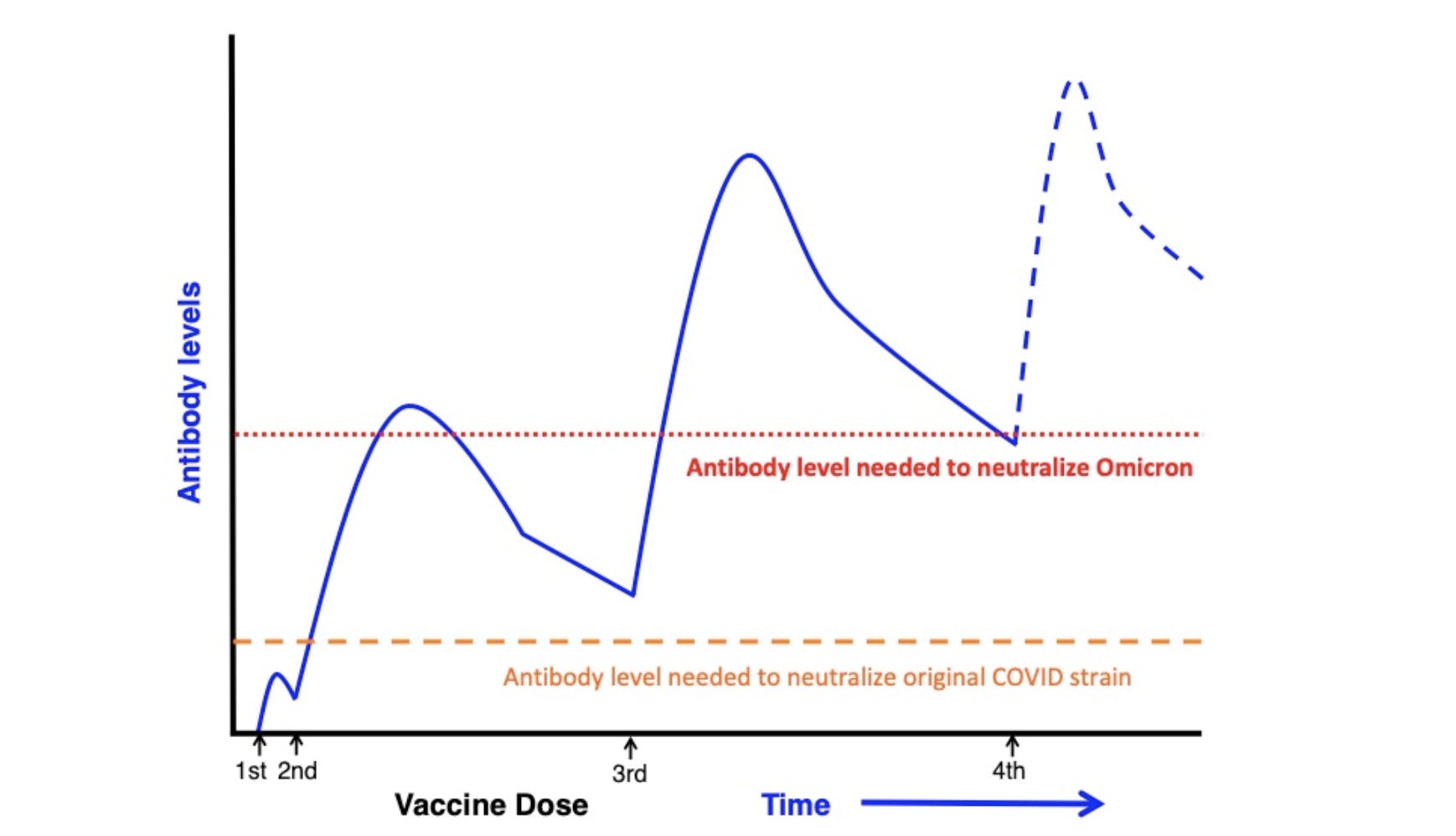
The graph below shows why a third, booster shot is needed to protect you against Omicron (for illustrative purposes only). The blue line illustrates the level of antibodies in your body over time, after the first and second shots of the mRNA vaccine series, and after a third, booster dose. The dashed orange line shows the antibody level needed to neutralize the original Wuhan strain of the virus. The dotted red line shows the much higher level of antibodies it takes to neutralize the Omicron variant. Without a third dose, there is little protection against Omicron - two shots of a Pfizer or Moderna vaccine cannot produce a high enough level of antibodies.
Data from the Centers for Disease Control show that adults who are vaccinated and boosted have a 68-fold lower risk of dying of COVID, and a 13-fold lower risk of getting infected, compared to being unvaccinated.
After six months, the initial two-dose Pfizer vaccine is only 9% effective in protecting against symptomatic infection from the Omicron variant. A third, booster dose increases protection against infection to 67%, as well as 86% effectiveness in protecting against hospitalization, and 94% effectiveness in protecting against death.
The COVID vaccines should probably have always been thought of as a ‘three-dose series’ rather than two doses plus a booster. A fourth dose may also be needed, particularly for older people and the immunocompromised, to boost antibody levels as they decline over time. Israel and some other countries are already giving a fourth dose of COVID vaccine. In the U.S. a fourth dose is currently approved for use in immunocompromised individuals https://www.cdc.gov/vaccines/covid-19/clinical-considerations/interim-considerations-us.html. Last week both Pfizer and Moderna filed with the Food and Drug Administration for use of a fourth vaccine dose in the general population, as additional protection against Omicron.
A booster shot of COVID vaccine provides better protection with a stronger immune response than getting infected by Omicron. A booster shot produces antibody levels about three times higher than having a COVID Omicron infection.
While 81% of Rhode Islanders have received their initial vaccine series, less than half of those – only 48% - have also received a booster shot. Between the unvaccinated and unboosted, this means over 640,000 Rhode Islanders are currently unprotected against the coming Omicron BA.2 surge. If you have made the effort to be vaccinated, a few extra minutes of time to get a booster shot seems like a minor inconvenience compared with the much bigger potential problems of getting infected.
“We shouldn’t be assuming that the virus is done with us. If we sweep them under the rug, they come back stronger. They come back harder. They kill more people,” said Dr. Bill Hanage of Harvard’s T.H. Chan School of Public Health.
Nick Landekic is a retired scientist and biotechnology executive with over 35 years of experience in the pharmaceutical industry.