


EXCLUSIVE: Engineer Warned RIDOT That Washington Bridge Joints Could Fail
GoLocalProv News Team
EXCLUSIVE: Engineer Warned RIDOT That Washington Bridge Joints Could Fail

The report was submitted as part of a 2020 bid by the Cardi Corporation for the construction work to repair the bridge. The work was initially awarded to Cardi and then reassigned to Barletta Heavy Machine after legal fights.
After more than 40 stories by GoLocal, the U.S. Attorney in Providence reached a $1.5 million non-prosecution agreement with Barletta and one top employee of the company pled guilty to charges. And then, nearly three months after the U.S. Attorney's action, Rhode Island Attorney General Peter Neronha filed charges against Barletta as a corporation as well as an employee.
GET THE LATEST BREAKING NEWS HERE -- SIGN UP FOR GOLOCAL FREE DAILY EBLASTAccording to representatives of Cardi Corporation, who had partnered with the Connecticut engineer Michael “Pete” Culmo, who today is the Chief Bridge Engineer at CHA Consulting in Hebron, Connecticut, the issue was known to RIDOT officials for nearly three years.
Culmo warned in that submission that the design preferred by RIDOT officials had serious technical issues and due to wear, could cause failure.
This is the very issue flagged by Culmo in his warning to RIDOT in 2020.
“The addition of the link slab alters the location of the hinge point at the end of the beams. Before adding the link slab, the hinge point is at the bearing. With the addition of the link slab, the hinge is now located at the mid-depth of the deck. End rotation brought on by live loads leads to movement at the bearing, resulting in shearing forces on the bearing pin and beam ends. This can lead to several problems. The bearing pin could fail, and the beam end could be damaged due to the force transfer at the pin. Note that the link slabs cannot be moved to the expansion ends of the hung spans, because that will lead to problems similar to those noted above,” wrote Culmo.

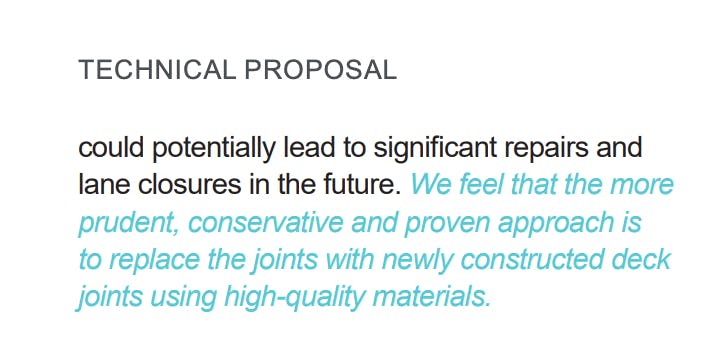
“The potential damage to the beam ends with the introduction of link slabs is a significant issue. If the beam ends become damaged, the bridge above the damaged beams would need to be closed for extensive repairs. Our team does not want to burden the State with a design that could potentially lead to significant repairs and lane closures in the future. We feel that the more prudent, conservative and proven approach is to replace the joints with newly constructed deck joints using high-quality materials,” he added.
He further outlined, “The goal of this project is to provide a design for the Washington Bridge with a 25-year design life. The Department and our team have seen mixed results with replacement of aging deck joints, especially asphaltic joints on high truck traffic volume roadways. The use of the EMSEAL bridge expansion joint system is proposed for deck expansion joints. Considered a 25-year design life system, this is a Department-approved product that, in our opinion, is a more durable joint system, especially for interstate highway use. This joint is made with elastomeric concrete headers located within the overlay portion of the deck; therefore, it is also easily removed and replaced when the deck overlay is replaced at regular maintenance intervals.”
Governor Dan McKee's office refused to respond to questions.
This story was first published at 12/11/23 8:46 PM