


How COVID-19 Could Change American Federalism – A Second New Deal?
Gary Sasse, MINDSETTER™
How COVID-19 Could Change American Federalism – A Second New Deal?
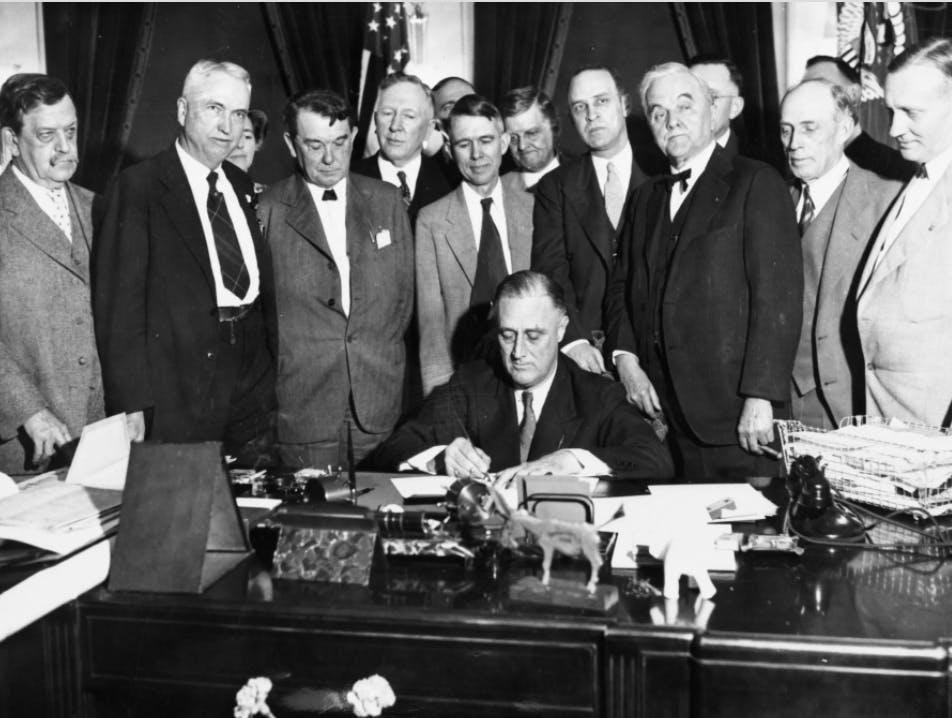
Economic and social upheavals have had tremendous influence on the role government plays making economic policy and providing for the public welfare.
The United States confronted the excesses of industrialization at the beginning of the Twentieth Century by enacting laws to protect consumers from ruthless business practices and anti-competitive monopolies.
GET THE LATEST BREAKING NEWS HERE -- SIGN UP FOR GOLOCAL FREE DAILY EBLASTIn response to the Great Depression, President Franklin Delano Roosevelt’s New Deal redesigned the scope of federal power. To alleviate the economic collapse in the 1930s, the United States went from a laissez-faire driven economy to a regulated one aimed at improving equity and balancing conflict between economic interests.
New Deal initiatives such as granting labor the right to bargain collectively, establishing the social security system, and insuring bank deposits modernized our capitalist system. A New Deal today would address such concerns as healthcare, income security, educational equity, and reform of the unemployment insurance system.
Prior to the pandemic the American economy, while showing cracks, was fundamentally sound. Today the nation’s economy is experiencing both an economic free fall and the shredding of the social safety net.
In the second quarter of 2020, the Congressional Budget Office projects that the economy will experience a sharp contraction. It projects that the economy will decline by 12 percent, and the jobless rate will hit 14 percent. Further, small businesses that employ 50 percent of the workforce are teetering between illiquidity and insolvency.
In Rhode Island, IHS Markit estimates that the unemployment rate will top 15 percent and the state’s economy will decline by 7.6 percent in the fiscal year beginning in July 2020.
It would not be surprising if economic and governance changes emanating from COVID-19 result in America’s second New Deal. This observation is not driven by my ideological preferences, but by historical precedent and economic realities.
State and governors will be called upon to play leadership roles if there is to be another New Deal. In fighting the coronavirus governors are showing that the electorate is looking for unifiers, not hyper partisans. For example, 80 percent of Ohio Democrats approve of Republican Governor DeWine’s handling of the pandemic. In Rhode Island, about 60 percent of Republicans believe Governor Raimondo is doing either an excellent or good job managing the coronavirus.
The pandemic has reminded Americans about the importance of government in their lives. Profound steps can be expected to retool long-neglected federal agencies. Something as consequential as the second New Deal mandates that government be both competent and accountable.
After dealing with a major crisis Congress and the President have historically evaluated agency performance, identified weaknesses and taken steps to implement corrective actions. As former Senate Majority Leader Tom Daschle said, “I don’t think there is any doubt that there will be a massive effort to reorganize government in the aftermath of Covid-19.”
After World War II President Truman appointed a commission headed by former President Hoover to recommend ways to restructure the federal government. The Reorganization Act of 1949 implemented its recommendations.
It may be time to convene another Hoover Commission to suggest a plan to improve governmental efficiency, effectiveness, and transparency
Perhaps of greater significance, the coronavirus will have an enormous impact on the relationship between government and the economy. Economic dislocations resulting from COVID-19 could signal greater federal government leverage over economic decisions and thus less for free market forces. For example, the changing nature of work coupled with massive unemployment and technological disruptions will challenge the federal government to redesign income security programs and the relationship between the states and the federal government.
In 1996 President Clinton proclaimed that the "era of big government is over." When the pandemic abates, expenditures for health, income security, workforce development, and business subsidies may continue to grow. The result will be a revival of “big government” as liberals promote a New Deal agenda and Republicans espouse “fiscal conservativism” but do not practice it.
The economics of globalization will also be impacted by the coronavirus. Free trade adds value to America’s economy. Nevertheless, supply chain command to protect critical technological and manufacturing capacity will need to be revisited.
Lincoln said that “The dogmas of the quiet past are inadequate for the stormy present.” Nothing could be truer when dealing with a worldwide pandemic.
.jpg)