Who Influenced RI’s Election?
Stephen Beale, GoLocalProv News Editor
Who Influenced RI’s Election?

Such expenditures—which are not coordinated with a candidate or a campaign—have fewer reporting requirements and no limits on the amount that can be spent for or against a candidate. Rhode Island, as elsewhere in the country, has seen an explosion of such independent expenditures this year, according to Richard Thornton, the director of campaign finance for the Rhode Island Board of Elections.
In a normal year, he said the state might see just one such independent expenditure. This year, there have been dozens of them. (See below for a list.)
GET THE LATEST BREAKING NEWS HERE -- SIGN UP FOR GOLOCAL FREE DAILY EBLASTUnlimited expenditures ‘bad for democracy’
The Supreme Court earlier this year opened the floodgates to such spending in its Citizens United decision, which concluded that corporations can spend unlimited funds in an election.
“Now anyone or any corporation or any individual can expend unlimited amounts of money for or against a candidate. That’s not good for democracy,” said John Marion, executive director of Common Cause Rhode Island. “If Exxon Mobil in 2012 gets mad at David Cicilline and puts $1 million into the race, that’s not good for democracy.”

One group that attracted a lot of attention in the 2010 election was Americans for Common Sense Solutions, which ran a series of attack ads against David Cicilline. “These shadowy far-right groups with these flowery names represent a direct threat to our democracy,” said Eric Hyers, the campaign manager for Cicilline. He said the organization should be “ashamed” of the false ads it ran against Cicilline.
‘Genie is out of the bottle’
One loophole in the system is the reporting requirements: independent expenditures do not have to be filed with the Board of Elections until seven days after they are made. That means that money spent within seven days of an election will not be disclosed until afterwards—too late for voters. Marion said Common Cause will push for for state legislation that would require disclosures within 24 hours.
Hyers agreed: “Voters deserve to know before the election who these people are, who is funding them, and how they are spending their money.”
Who were the top spenders… and beneficiaries?
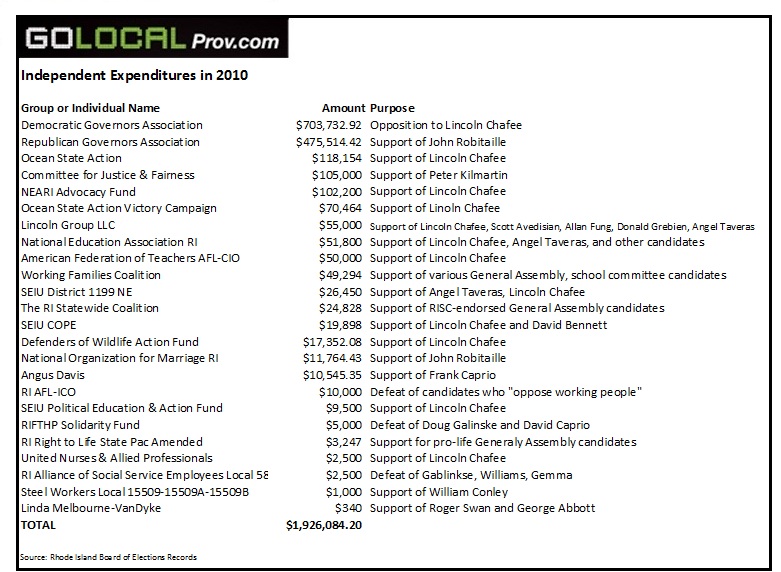
The GoLocalProv review of independent expenditures shows they span the political spectrum—from a number of union organizations to conservative groups like the Rhode Island Statewide Coalition and the Rhode Island chapter of the National Organization for Marriage. In all, there were two dozen individuals or groups making independent expenditures—most of them in the last month of the election.
By far, the biggest spenders were the Democratic Governors Association and the Republican Governors Association, which spent $703,732.92 and $475,514.42, respectively. Neither of their candidates won. But the candidate who did win—Lincoln Chafee—drew broad support from independent expenditures. Eleven organizations—largely union-affiliated—made expenditures on his behalf.
Independent Expenditures
The below table lists individuals or groups that made independent expenditures in 2010. The total amount spent is listed next to each. For more information about these expenditures, visit the online records of the Board of Elections (scroll down to the section that says "Other Filings"). Note that expenditures to advocate for or against a ballot question are classified separately from independent expenditures and therefore are not included in the table.