


Is Rhode Island Ready for the Delta Variant?
Nick Landekic, Guest MINDSETTER™
Is Rhode Island Ready for the Delta Variant?
This was both predicted and predictable, based on the rapid rise of Delta in other areas where it has emerged such as England, Japan and India, where it now causes 95% of COVID infections. The Delta surge of infections in Japan has resulted in spectators not being able to attend the Olympic games. It can be expected to continue to increase in the U.S.
News and information continues to rapidly come out about the Delta variant. Much is still unknown, but this is what is known right now.
GET THE LATEST BREAKING NEWS HERE -- SIGN UP FOR GOLOCAL FREE DAILY EBLAST1. The Delta variant is much worse than previous strains
There have been a number of studies in the past few months analyzing the impacts of Delta and other variants. The World Health Organization described Delta as the "fastest and fittest" variant yet. It is 40%-60% more contagious and easily spread than the Alpha (B.1.1.7) variant, which itself was more transmissible than the original strain.
It also causes more severe illness, in part because it multiples faster in the body. A recent study suggests that Delta can create a 1,000 times higher viral load in the body than earlier strains. This makes the infection more serious, and also makes infected people more contagious sooner. The risk of being hospitalized is double with Delta than other strains.
Delta also has some level of resistance to vaccines and antibody based treatments, though the vaccines continue to be generally very effective against it.
It’s also clear that this phase of the pandemic is primarily affecting younger people. This has been seen around the world, and here in Rhode Island about 70% of COVID cases in the past two months have been in those under age 39.
2. The Delta variant is hurting those who are not vaccinated
Half of all states in the U.S. are reporting increases in COVID cases in the past week. This follows what has happened around the world where Delta has become predominant, such as England. In the U.S. COVID cases are up 16% in the past week, along with a 9% increase in hospitalizations.
The curves look like the beginning of another surge, because that’s what it is.
There is a correlation between lower vaccination rates and higher infections and hospitalizations – the more people vaccinated, the fewer get infected https://coronavirus.jhu.edu. States with low vaccination rates are experiencing on average three times more infections than those with higher vaccinations.
According to Dr. Rochelle Walensky, Director of the Centers for Disease Control, around 93% of COVID-19 cases in recent days have occurred in counties with vaccination rates of less than 40%, and 99.5% of COVID-19 deaths have occurred in unvaccinated people.
Even starker is a comparison of the highest vaccinated states with the lowest – those with low vaccination rates are experiencing approximately 10 times higher rates of new infections.
State % 1+ vaccine dose Daily New Cases/100,000
Vermont 74% 0.6
Massachusetts 71% 0.7
Connecticut 68% 1.4
Maine 67% 1.0
Louisiana 39% 11.4
Arkansas 43% 16.1
Missouri 45% 16.1
Nevada 50% 13.7
Source: covidactnow.org
The evidence continues to be overwhelming: vaccinations reduce infections. People and places that shun vaccines are paying a painful price.
3. We don’t have a good idea of what’s happening in Rhode Island
The good news in Rhode Island is that infections have been steadily declining since the beginning of May. Since early June, the risk in Rhode Island has reduced from ‘High’ to ‘Medium’ according to covidactnow.org, though the CDC still rates RI at “moderate” risk of infection https://covid.cdc.gov/covid-data-tracker/#county-view.
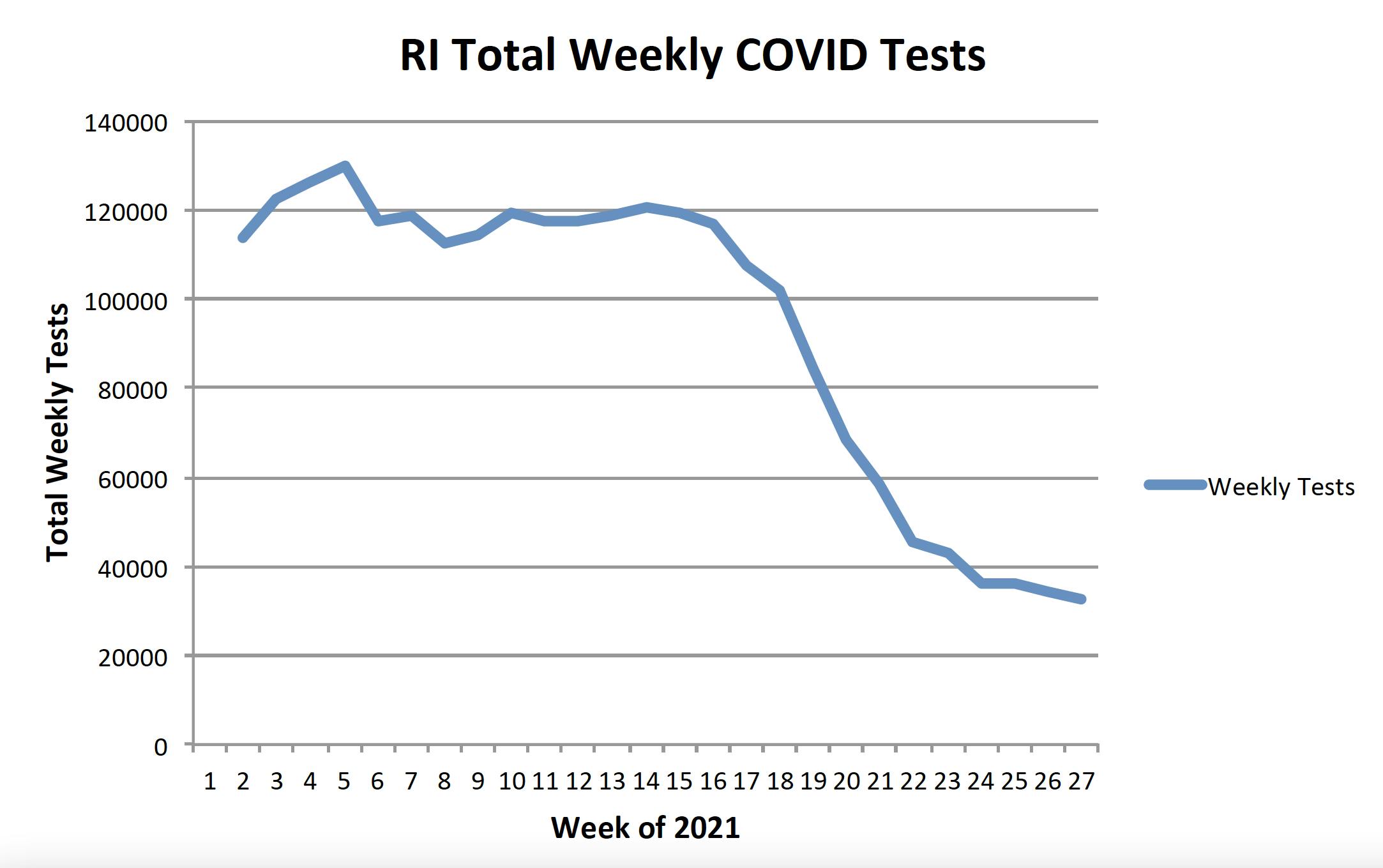
However, testing has declined dramatically, from over 130,000 weekly tests done in late January, to only 32,609 last week – a 75% decrease. Testing has been declining steadily since the beginning of April. The state has closed a number of testing centers in the past few weeks, making it more difficult to get tested.
Unless enough testing is done, we cannot know what is actually happening with Delta or other variants. Given the ominous developments in other states and the surges occurring around the world, now is not the time to be cutting back on our early-warning system. Without enough testing, we are setting ourselves up to be blindsided by Delta, and won’t know what hit us until hospitalizations spike – which will be too late to do anything about it.
Last week new hospitalizations for COVID increased to 16 from 11 the prior week (and 14 in the past 5 days), spiking to 82% of ICU capacity – Critical according to covidactnow.org. We don’t know if this is simply variability in the numbers, or the beginning of a bigger problem driven by July 4th spreader events.
Only a small number of Delta cases have been confirmed in Rhode Island so far, though out of a low level of testing. In the past week, only 50 genomic sequences for COVID variants were done in Rhode Island, making it difficult to know how widespread Delta is or where the hot spots are. Without this knowledge, it’s impossible to either react to flare ups, or proactively prevent problems.
It is crucial to do enough testing and genomic sequencing to identify variants and contain outbreaks before they can spread. In total, Rhode Island has done only 4,093 genomic sequences – out of 4.5 million total COVID tests and 152,738 positive cases. With Delta and other variants circulating and causing major problems elsewhere, now is the time to dramatically ramp up testing and genomic sequencing, not cut back. By scaling back testing and sequencing, we leave ourselves wide-open to being caught off guard.
It was just a few short months ago that Rhode Island was literally the most highly infected place on Earth https://www.golocalprov.com/news/ri-is-the-most-infected-place-in-the-world-according-to-new-data. We’ve learned a lot since then and pulled back from that precipice. Let’s not forget those painful experiences and risk an encore performance of one of the darkest and deadliest times in Rhode Island’s public health history.
4. The vaccines work against Delta
In the past couple of weeks several studies have reported varying rates of effectiveness of the mRNA vaccines against the Delta variant, with reported effectiveness in preventing symptomatic illness ranging from 64%-88%.
What is important is that all of these studies show the mRNA vaccines to be very effective in preventing symptomatic illness, and almost completely (though not perfectly) effective in preventing serious illness, hospitalization, or death. If you are vaccinated and encounter Delta, you are much less likely to get sick, and have very little chance of hospitalization or death. Each of these studies were done somewhat differently and in their own particular populations. We are fortunate to have vaccines that work so well and have shown excellent safety profiles.
You are far more likely to have health problems from COVID than a vaccine side effect.
5. It’s past time to get vaccinated – or risk becoming a mutation factory
All viruses mutate. This is the fundamental evolutionary process of nature. Life evolves in ways to promote its own survival. In the case of the coronavirus, this means evolving in ways to become more contagious, cause more serious illness (and thus create more virions), or become resistant to vaccines.
The more people who are infected, the more variants that will be created, and the greater the risk that the virus will continue to evolve in ways that may be increasingly resistant to vaccines.
Each person who chooses to go unvaccinated not only endangers their own health and life and is a risk to others, but is also essentially a mutation factory. An infected person will have between 1 and 100 billion virions in their body. Based on how quickly the coronavirus mutates this means each infected person could potentially generate thousands to hundreds of thousands of new mutations. How many of those might result in a new variant with increased transmissibility, severity of illness, or resistance to vaccines?
Unrestrained by masking or social distancing, one infected person could cause 1,000 infections in one month, and one million infections in two months.
“My body my choice” doesn’t apply when a person’s actions can cause harm to or the deaths of many other people.
Unless more people get vaccinated, enough to break the cycle of transmission (“herd immunity”), there will likely continue to be new, increasingly dangerous variants emerging every few weeks. There are already additional ones circulating beyond Delta.
Another new variant recently described is called Lamba (C.37) first identified in Peru https://www.livescience.com/lambda-coronavirus-variant.html. It contains 7 mutations in the virus’s ‘spike’ region, including one, termed F490S, that a recent study says may be a ‘vaccine escape mutation.’
Peru has the highest per capita COVID death rate in the world, and is a stark example of what a deadly variant can do. Lamba has already been found in the U.S.
Here in Rhode Island we might already be experiencing an increase of the Gamma variant, also called P.1 or “Brazil”. 236 cases of Gamma have been confirmed so far in Rhode Island, including a 20% increase and representing nearly 80% of all COVID cases sequenced in the past week. Gamma is also both more transmissible than previous strains and shows some resistance to vaccines. Both Gamma and Delta are rapidly becoming predominant in the U.S..
Each person who becomes infected can become the source of another variant. You would not enjoy (and may well not survive) the experience of a new variant coming from your body, and our state doesn’t want to become known for producing the ‘Rhode Island variant’.
The only way to break this cycle is by significantly increasing vaccination numbers. RI is doing OK, but must do much better if we are to avoid another surge.
Even Donald Trump and his family were vaccinated, receiving it early in the pandemic in January. If even he chose to get it, shouldn’t you?
Nick Landekic a retired scientist and biotechnology executive with over 35 years of experience in the pharmaceutical industry.