


General Assembly’s ‘Incumbency Protection Racket’
Stephen Beale, GoLocalProv News Editor
General Assembly’s ‘Incumbency Protection Racket’

In fiscal year 2011, the House issued $409,000 in such grants, while the Senate racked up more than $1.1 million in grants to a smattering of local charities and nonprofits—everything from food banks and youth sports to school groups.
GET THE LATEST BREAKING NEWS HERE -- SIGN UP FOR GOLOCAL FREE DAILY EBLASTUnlike other spending items, the grants are awarded to individual state reps and senators by the leadership in each chamber of the General Assembly, instead of being approved by the full House and Senate. (See below for the lists of how much House and Senate members received.)
Some General Assembly members and government watchdogs blast the program as pork-barrel spending that helps incumbents get re-elected. Others say the grants can be used by the leadership as a way or rewarding rank-and-file members for voting their way.
In the House, a GoLocalProv review of the grants shows that none went to any Republican members—but none of those reps applies for grants either. All but one of the state reps who voted against Gordon Fox as Speaker—Lisa Baldelli-Hunt—did not receive a grant. In the Senate, on the other hand, grants were spread between members of different parties.
One state rep, Rene Menard, told GoLocalProv he didn’t even bother to apply for a grant. He said the leadership uses them to control votes on the House floor. “I frankly believe that legislative grants are a form of securing votes and I’m not going to give my vote away for a legislative grant. The only people who own my vote are the people who elected me,” said Menard, D-Manville.

House Minority Leader Brian Newberry said the grants waste taxpayer money, describing them as one of his biggest pet peeves about the General Assembly. “I don’t think it’s right for us to take taxpayer money, give it back to people and claim we’re doing them a favor,” Newberry said. “It’s no different than federal earmarks.”
‘Incumbency protection racket’
But, unlike Menard, Newberry does not think the grants are way of getting members to vote with the leadership. Instead, he said they about keeping incumbents in office. “I do think the grant program is an incumbency protection racket,” Newberry said. “It’s ridiculous.”
Those concerns were echoed on the Senate side by Sen. Ed O’Neill, an independent from Lincoln. “It’s a tool that incumbents use to curry favor with selected constituents,” O’Neill told GoLocalProv. “I think that’s the old way of doing things—the good old boy network.” (Like Newberry, O'Neill did not seek any grants.)

“Particularly in these difficult economic times, legislative grants are more important than ever to help community organizations to maintain their ability to offer their services to those in need,” Paiva Weed said in a statement. “The Senate has built a strong reputation for issuing grants in a transparent and non-political manner. Regardless of party affiliation, incumbency, or any number of other factors, grants have been made available to community service organizations in each and every community in Rhode Island.”
Fox spokesman Larry Berman said the grants, which range from $500 to a few thousand dollars, provide “badly needed assistance” to senior citizen groups, youth sports programs, PTAs, and many other civic and charitable organizations. “In this difficult economy, non-profit agencies and community organizations are struggling more than ever to provide very worthy services to the public,” Berman said. “The legislative grants awarded by the General Assembly help fill the fund-raising gaps and the lack of resources that are no longer available in municipal budgets.”
General Assembly members defend program
Other House and Senate members also rebuffed accusations that the grants are merely a political tool. When he was first elected, Sen. James Sheehan, D-North Kingstown, said he issued a press release to announce his grants. Now, he said he makes the donations quietly—out of sensitivity to concerns that the grants are used to bolster incumbents’ popularity.
Rep Raymond Gallison, D-Bristol, also denied that the grants are a popularity-booster for incumbents. “I don’t see it that way,” he said. He said the money is going to organizations focused on charitable endeavors—not helping incumbents get re-elected.

The grants also have come under fire from good government groups and others concerns about the process used to determine which organizations get them. Menard said there is no objective criteria for how the grants are given out. “What makes your library or senior center better than mine?” he said.
“The concern I have with legislative grants is they don’t follow the due process of other appropriations and legislation,” O’Neill added. “So it is very subjective.”
John Marion said the process circumvents the role of the General Assembly, which constitutionally is charged with deciding how state funds are spent. “We disagree with the process,” said John Marion, executive director of Common Cause Rhode Island. “We generally agree with those who say this isn’t a way to allocate the state’s resources—that basically the Assembly should vote on the individual grants.”
Not like ‘handing out lollipops’
That simply isn’t practical when there are hundreds of such grants, Gallison said. “If you had to go through each individual one, then we would still be there doing that,” Gallison said.
He said the total amount in the fund for the grants is a line item in the budget—and members are free to vote against that article if they feel strongly that the program should be eliminated.
Gallison and Sheehan also said claims that the process does not have any objective criteria is false. Gallison said the House has charities and other organizations receiving the money fill out a formal application and file it with the House Fiscal Office. Sheehan said the Senate has a set of criteria it follows, including the requirement that the money go to nonprofits. He said the Senate also monitors how the money has been spent to ensure it is used for the purpose intended.
“It’s far from handing out lollipops,” Sheehan said.
But he did agree with critics on one point. “It’s an allocation of money. I think it’s fair to be appropriated through the budget process.”
If you valued this article, please LIKE GoLocalProv.com on Facebook by clicking HERE.
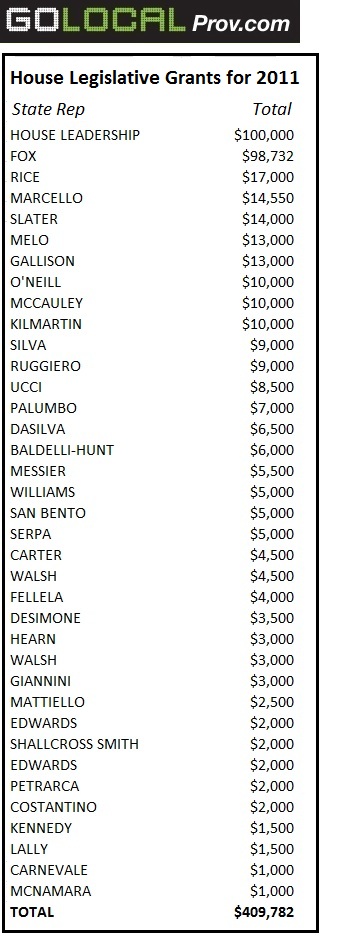
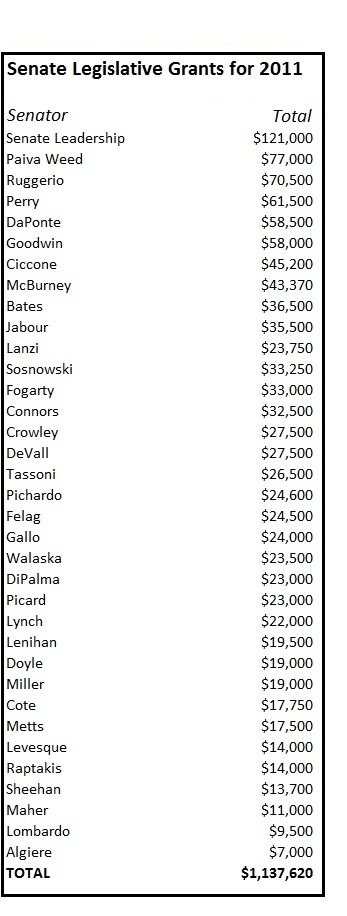
Note: Because the grants were given out over the course of the 2010-2011 fiscal year, some reps and senators who are not currently serving are listed as recipients.