


Marijuana Growing Facilities "Serious Concern," Says RI Fire Marshal
Kate Nagle, GoLocal Contributor
Marijuana Growing Facilities "Serious Concern," Says RI Fire Marshal
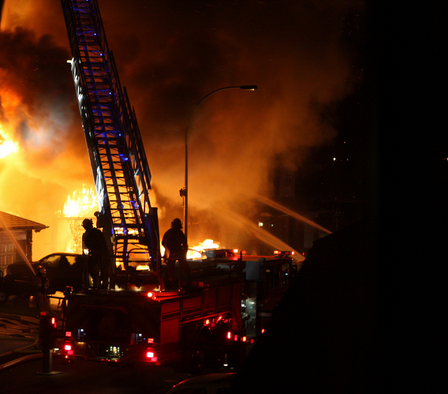
State Fire Marshall John Chartier spoke with GoLocal following a five alarm fire on Kinsley Avenue that was put out on Tuesday, where the Cannabis Producer Association of New England (CPA) had been located.
Chartier said as an investigation is underway that he couldn't speak to the cause of the fire that began Monday night that required mutual aid from additional Rhode Island towns and injured one firefighter, but he did address his concerns about marijuana growing facilities in general in Rhode Island the state.
GET THE LATEST BREAKING NEWS HERE -- SIGN UP FOR GOLOCAL FREE DAILY EBLAST"Regardless of that fire, we've had concerns about grow facilities," said Chartier. "We've had at least two fires related to marijuana grow facilities in the state. A grow facility might be installed not quite up to code, which could lead to electric overloads, or be using butane as part of the process. Again, I'm not speaking directly to the [Kinsley Avenue] fire as it's still under investigation."
The utilization of the highly flammable butane in the production of butane hash oil has recently come under scrutiny. In Colorado, where marijuana is legal, the City of Aurora said it is looking ban all private hash oil production, as the city had six explosions or fires since October 2013 linked to the manufacture of hash oil at private residences, according to the Denver Post.
SLIDES: See Butane Hash Oil Explosions Across U.S. BELOW
On Tuesday, Chris White with the Cannabis Producer Association acknowledged that the office was no longer there, but he could could not provide any further comment on the fire or destruction of the building. The Rhode Island Patient Advocacy Coalition had been slated to begin "grow classes" at CPA's location on Kinsley Avenue today.
Fire Marshal Chartier said that the fire was still "under consideration" on Tuesday in conjunction with the fire department and the Bureau of Alcohol, Tobacco, Firearms and Explosives.
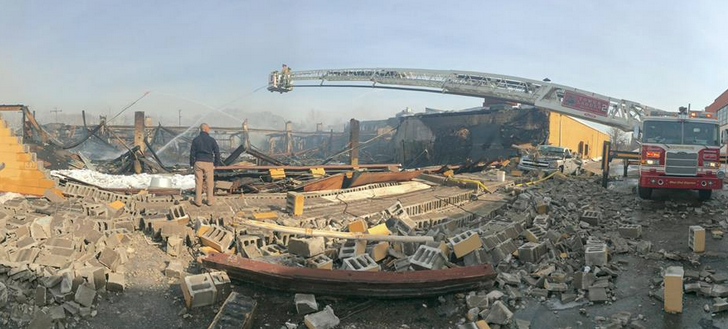
Chartier said on Tuesday that the fire scene was still "hot" after it began burning on Monday night -- so their dogs couldn't be sent in to sniff out if there were any accelerants.
Noting that he couldn't speak specifically to the Kinsley Avenue fire, Chartier said that his office has seen fires related to marijuana production in Rhode Island recently.
"We had one near Central Falls and one in Barrington, but nothing of a fire of this magnitude," said Chartier. "What's happening with grow centers -- you get a license to grow, once you get that license, you can basically go and take it anywhere you want. You can go to a private home. The question has been, the folks at the Department of Health know the license owner, that doesn't mean we know where the facility is."
"The one in Barrington was an electrical overload," said Chartier of the two fires referenced. "The other one was in Valley Falls. The amount of grow lamps is an issue, especially in a cold environment, as it often doesn't conform with the amount of electricity that's available."
"Butane, on the other hand, is a highly flammable type of gas," said Chartier. "I don't know what it's used for in some marijuana production - just that it's used."
Law Enforcement Insight, Advocates Stress Regulations
Like Chartier, O'Brien said he couldn't speak to the Kinsley Avenue fire, but rather the general situation regarding marijuana production in the state.
"If you're a [medical marijuana] patient, you're allowed twelve mature plants and 2.5 ounces," said O'Brien. "If you're a caregiver, you can have up to twenty four mature plants and five ounces."
"If there's butane present, and someone's growing marijuana, you can't do that," said O'Brien. "If you come upon a residence, and there's anything combustible along with marijuana, they can charged with manufacturing."
Last October, San Francisco police officer Keith Graves wrote a piece for the website PoliceOne entitled, "Butane Hash Oil: An Explosive Threat to Officers."
"Over the past few years, use and manufacturing of Butane Hash Oil (BHO) has skyrocketed," wrote Graves."This poses a significant threat to street officers and narcotics officers who are the first to respond to these explosions. If officers don’t take the right steps to ensure their personal safety on scene of a BHO lab, they can find themselves the next victims in a BHO explosion."
"We haven't arrested anyone in the state for locating butane with marijuana," said O'Brien. "With that being said, we just received clarification from the [Rhode Island] Attorney General a few weeks ago with regard to butane 'honey oil.' The [Attorney General's] office and appellate groups came to the conclusion that we can make arrests. I can only speak to the state police for not making any so far, I don't know about cities and towns."
The Office of the Attorney General refused to comment on Tuesday on the recent clarification made to law enforcement regarding butane and marijuana.
Jared Moffat with the legalization advocacy group Regulate Rhode Island said that he wasn't aware of any butane being used at the Kinsley Avenune location.
"I definitely wasn't aware of anything going on there, so I can't speak to that," said Moffat, who was at the press conference last week introducing tax and regulation legislation. "But butane hash should be regulated -- it's our core argument. Any production should be regulated to minimize public health risks."
"If you don't regulate, you'll have people do it an unregulated setting," Moffat continued. "Resisting regulation would ensure something like this kind of event could happen in the future, but again, I'm not speculating as to whether or not it was the cause."
Butane Hash Fires in the U.S.

November 2011
Medford, Oregon
The heater in the house turned on causing the butane to explode. Seven people, including two kids, escaped from the explosion.

November 2013
Bellevue, Washington
The fire was started by three men who were using butane to extract hash oil from marijuana. The fire cost $1,500,000 in damages and former Mayor Nan Campbell died in the fire.
The three men were charged in July of 2014
Photo courtesy of ssalomans/ flickr

May 2014
Manitou Springs, Colorado
Hash oil was linked to dozens of explosions but no one was hurt. A couple was taken into custody on suspicion of first degree arson but were later released on bond.

May 2014
Puyallup, Washington
An illegal hash oil operation went up in flames featuring more than 300 cans of butane. Nobody was injured in the explosion but two people were detained.

October 2014
Missoula, Montana
An explosion took place at a University of Montana apartment due to a man attempting to extract hash oil from marijuana. The man, Patrick Wayne Austin, was held on $50,000 bail.
Photo courtesy of brandonwu/flickr

October 2014
Walnut Creek, California
The top floor of a four unit apartment building was completely blown off and two people were critically injured and another was unaccounted for. The fire consisted of one large explosion and then dozens of other smaller explosions following it.

October 2014
Jackson, Michigan
A 20 year old boy attempted to extract hash oil from marijuana by "open blasting" in his upstairs bedroom in his parents house when it caught fire. The 20 year old had a medical marijuana card.

October 2014
Visalia, California
After extinguishing the fire, the firefighters determined the residents had been cooking hash oil from marijuana when vapors ignited and caused an explosion.
The home had $80,000 in damages and another $20,000 damages to the contents of the home.

November 2014
San Bernardino County, California
A man was killed and two others were injured after a home exploded and significant amounts of marijuana and butane were found in the debris.
Photo courtesy of paulbanday/ flickr


