RI's Most Dangerous Colleges and Universities
Stephen Beale, GoLocalProv News Contributor
RI's Most Dangerous Colleges and Universities
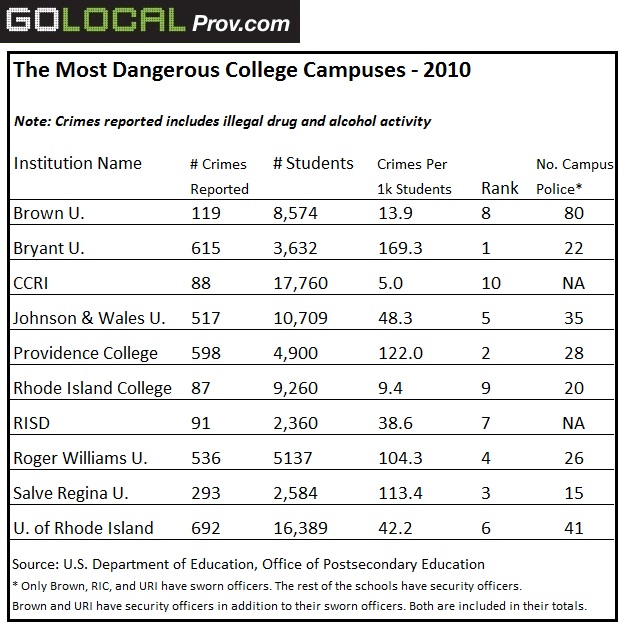
When the number of crimes reported was compared to the size of the student population, Bryant University rose to the top, followed by Providence College, Salve Regina University, and Roger Williams University.
GET THE LATEST BREAKING NEWS HERE -- SIGN UP FOR GOLOCAL FREE DAILY EBLASTThe crime data includes offenses committed by students and non-students alike. It includes anything that was reported to campus authorities whether or not there was an arrest or a conviction. Colleges and universities have to report anything that happens on a public sidewalk or street next to their campus, but they do not have to count incidents involving students at a local bar or a house off campus that they do not own.
Because of the difference in surroundings, schools in rural and suburban environments might have more criminal offenses recorded than those in cities, said Dan Egan, the president of the Association of Independent Colleges and Universities of Rhode Island.
Because a college campus in a more rural setting is self-contained, most student misbehavior will occur on campus, unlike a more urban school, according to Egan. “You might appear to be a safer campus in a less safe area than a less safe campus in a safer environment,” Egan said.
That might explain why Bryant, Salve Regina, and Roger Williams rank higher than schools like Brown University and Rhode Island College. But it does not account for why Providence College had the second highest crime rate in the state. (See below for more.)
Another possible explanation for the disparity: confusion over exactly what has to be reported to the U.S. Department of Education, as required by a federal law known as the Clery Act.
“I think there are still colleges who are a little confused as to how to report and the Department of Education isn’t good about giving advice on how to report,” said Paul V. Verrecchia, the president of the International Association of Campus Law Enforcement Administrators and currently the chief of campus police at the College of Charleston in South Carolina. “I think some schools are over-reporting in an abundance of caution, which is almost as bad as underreporting.”
More students disciplined than arrested
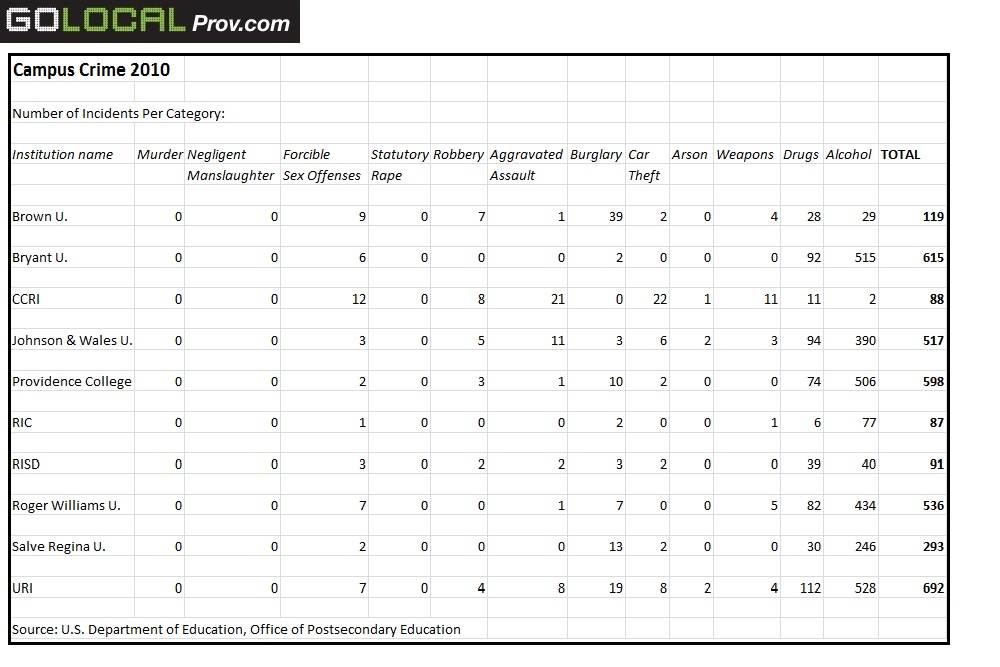
The numbers tallied by GoLocalProv include cases where a student was disciplined for alcohol and drug activity that violated the law. In fact, the bulk of criminal activity on all the campuses surveyed resulted from substance abuse, with most other criminal activity keeping to a minimum.
Across the board, schools chose to discipline students internally rather than have them arrested for drug and alcohol violations. For example, just one Brown student was arrested for a drug violation in 2010, while 27 students were disciplined for drug violations and 29 were disciplined for violations of liquor laws. The University of Rhode Island recorded 518 disciplinary actions for alcohol and only ten arrests in 2010.
“To me the disciplinary system is a better way to go because there’s no educational component in the criminal justice system,” said Verrecchia, a former chief of police at Brown and a veteran of the Providence Police Department.
And, sometimes, Verrecchia said discipline is the only option for those colleges and universities that do not have sworn officers with the ability to make an arrest—which is everyone except CCRI, URI, RIC, and Brown. Under Rhode Island law, possession of alcohol by a minor is a violation and police officers could not make an arrest or issue a citation without witnessing it.
At Roger Williams University, the school has an agreement with local law enforcement on when violations will be handled internally and when local authorities will be called in to make an arrest. Those violations that are more severe trigger an arrest, according to a spokesman.
Why is Bryant at the top?
Several of the schools with higher crime rates said their ranking resulted from stricter policies.
In a statement to GoLocalProv, Bryant University said: “The University has a long-standing agreement with the town of Smithfield that requires Bryant to refer all use of illegal substance, regardless of the amount, to the Smithfield Police Department. This is not the same policy at other institutions.”
Because Bryant security officers are not sworn police, they cannot actually confiscate illegal substances, so they have to call in local authorities, Smithfield Police Chief Richard St. Sauveur told GoLocalProv. “They do the right thing by calling us,” St. Sauveur said. “I truly believe as a result of that process their drug numbers are higher than other colleges and universities.”
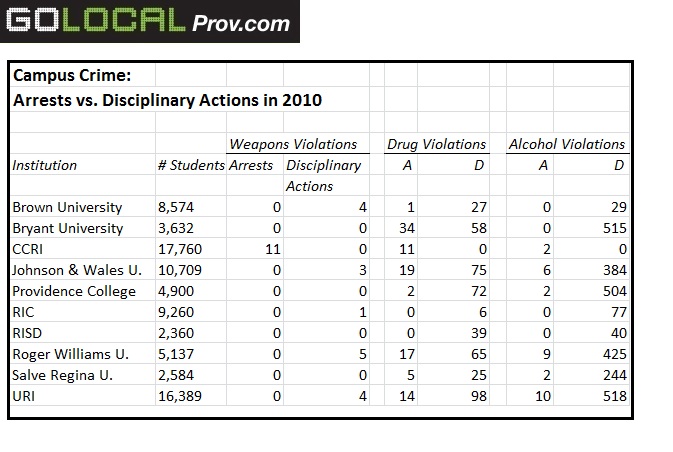
But that is not what pushed Bryant to the top of rankings. Instead, it was the number of disciplinary actions for liquor violations, which came out to a total of 515—the most of anyone except, URI, which is about four times the size of Bryant in terms of overall student enrollment.
“You could really use that number as a positive,” St. Sauveur said. “What that really means is they are proactive and aggressive in their alcohol enforcement on campus.”
Providence councilman calls for crackdown
The issue of crime and local colleges has come to a head in the Elmhurst neighborhood of Providence, where city councilman David Salvatore has called on the Police Department to start enforcing a five-year-old ordinance that allows them to affix stickers to houses that are deemed public nuisances due to public drunkenness, violations of the housing code, and excessive noise. (Narragansett adopted a similar, controversial ordinance in 2005.)
Salvatore said student behavior off-campus has been a recurring issue in his conversations with constituents since he took office earlier this year. “I don’t want to paint all college students with the same brush. I think the majority of students who live in our city love Providence and they want to preserve the quality of life,” Salvatore said. However, “students have to realize that they are the guests and Providence is the host city.”
Salvatore said that he—along with a coalition of neighborhood groups including the Elmhurst Crime Watch Association—has been working with Providence College to identify the “problem houses” in the neighborhood. So far, 15 have been identified, he said.
So far, Salvatore said they have yet to receive a response.
Johnson and Wales spokeswoman Lisa Pelosi told GoLocalProv yesterday that the school has a director of community relations who has been “working closely with the city councilmen and the Elmhurst Neighborhood Association” on “issues” involving its students who live in the Elmhurst area. Pelosi said off-campus students are required to abide by a “Good Neighbor Policy.” Those found in violation face disciplinary sanctions by the university
Providence College spokesman says campus is not dangerous
A spokesman for Providence College said it is not fair to compare schools on the basis of disciplinary actions since policies vary from one school to another. For example, at Providence College, if liquor is found in a dorm room, all the students living in that room are referred to discipline even if some of them were not drinking or actually holding the liquor.
“I strongly suggest to you that disciplinary referrals of this nature are not a ‘crime,’ nor do they contribute to Providence College being a ‘dangerous’ campus,” said Providence College spokesman Steven Maurano. “If they were not drinking, they didn’t violate any law and they didn’t commit a crime. But our policy does mandate that they be referred for campus discipline.”
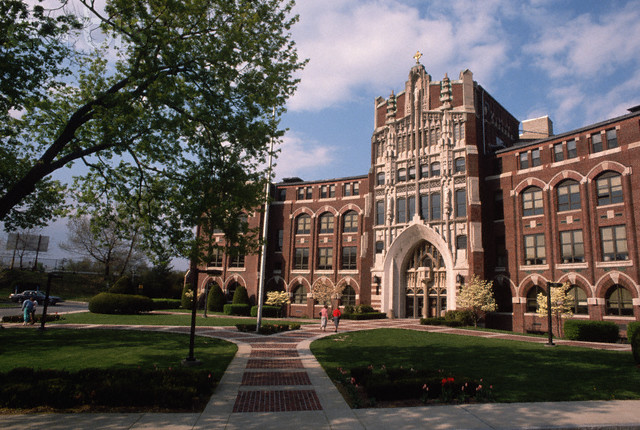
Maurano said he did not have a breakdown of how many of the 504 liquor-related disciplinary at Providence College were for incidents that did not actually involve violations of the law.
After Providence College, Salve Regina University had the third highest crime rate, but a university spokesman declined to comment on where the school came out on the rankings. Spokesman Matt Boxler said the school has been able to reduce the number of alcohol-related incidents by sending a university official along with a Newport community policing officer to each off-campus house after complaints over disruptive behavior.
What some schools say they are doing right
Those schools that had low crime rates also had varying explanations for their success. Rhode Island College, for instance, recently held a series of emergency drills on campus in conjunction with Providence police, fire, and other government agencies, according to spokeswoman Jane Fusco. She said the school has installed a network of 39 free-standing telephone booths, known as the blue-light notification system, that allow students to call police if there is an emergency. The system also acts as a public broadcast system for campus-wide emergencies.
At the University of Rhode Island, Baker said campus security officers lecture on safety and substance abuse issues at “URI 101,” a special orientation course that freshmen must take. “Hopefully that’s having some effect,” he said. He noted that the university also has a three-strikes-and-you’re-out policy on students caught illegally using drugs or alcohol.
“In our opinion, the crime rate is never low enough,” Baker said. “We always work toward making it better.”
If you valued this article, please LIKE GoLocalProv.com on Facebook by clicking HERE.