


Whitcomb: Corporate Questions; Thought Police; Unresolved and Resolved Wars
Robert Whitcomb, Columnist
Whitcomb: Corporate Questions; Thought Police; Unresolved and Resolved Wars

“Our lives are spinning out
from world to world;
GET THE LATEST BREAKING NEWS HERE -- SIGN UP FOR GOLOCAL FREE DAILY EBLASTthe shapes of things
are shifting in the wind.
What do we know
beyond the rapture and the dread?’’
“The Abduction,’’ by Stanley Kunitz (1905-2006), American poet
“Journalists belong in the gutter, because that is where the ruling classes throw their guilty secrets.’’
-- Gerald Priestland (1927-1991), BBC foreign correspondent, presenter and commentator on religion
“When the missionaries first came to Africa, they had the Bible and we had the land. They said, ‘Let us pray.’ We closed our eyes. When we opened them, we had the Bible and they had the land.’’
-- Desmond Tutu (1931-2021), South African Anglican bishop and theologian, best known for his human-rights work
I wish that my allergies let me smell the explosion of blooms in the past week or so! Of course, this time of year has the proper light, warmth and wetness for maximum plant growth. Meanwhile, the kids put maple seeds on their noses and think of summer vacation, and more and more frequently the wind comes from the southwest, sending us Route 95 car exhaust.

A question about the new Centreville Bank Stadium, in Pawtucket, home of the Rhode Island FC soccer team, is whether that it was sold out on May 3, for the team’s first home match, suggests that it will be a long-term success.
Or were many of the about 10,700 attendees mostly there out of curiosity to see the pretty place, which will cost Rhode Island taxpayers around $132 million over 30 years? Americans’ increasing interest in the nearest thing to the world sport will help, but the seats are expensive – from $34 to $436 -- and baseball, football and basketball are deeply embedded in the national psyche.
Then, there is the food. Maven's sandwiches are priced between $18 and $34.
Poor Hasbro

A big question in Rhode Island is whether the cost of the tariff trauma will lead Hasbro to decide not to move to Boston but rather to stay in Rhode Island, where most costs are cheaper and there are many designers, in part because of RISD. To get it to stay, will state politicians promise it tax benefits and other incentives that would deplete those that could be offered to smaller companies to stay in, or move to, the Ocean State?
xxx
Let’s watch Boston mayoral candidate Josh Kraft’s proposal to address the city’s housing affordability crisis. His plan includes, among things, getting landlords to create more “affordable” housing in their buildings in return for up to 20 percent property-tax refunds. They’d have to keep annual rent increases to a maximum of 5 percent over the next decade for renters who make no more than twice the area’s median income.
Some call this a gift to landlords, but given Boston’s (and Providence’s) housing crunch it’s worth a close analysis.
xxx
Something else to watch: New York City now has mandatory composting, with residents required to separate their food scraps and yard waste from the rest of their waste for curbside collection or eventually face fines. The idea is to use a lot of the compost in city parks while reducing the waste that ends up in methane-emitting landfills.
This is obviously well-meaning but controversial and maybe unworkable. The conservative Manhattan Institute’s often-interesting City Journal whacks the program: SEE HERE.
Here’s the city’s explanation HERE
Trying to Shut Them Up
It’s no wonder that a would-be dictatorship would seek to suppress free speech, say against Israel’s relentless assault on Gaza, at colleges and universities. Places where free speech is supported tend to be places where political leaders can be challenged.
The Trump regime is trying to silence some people on “elite” campuses whose views it doesn’t like by, most dramatically, kidnapping and threatening to kidnap foreign students and threatening to yank, and actually yanking, universities’ already appropriated federal grants for scientific (including medical) research – work that boosts the economy and saves lives. This has already killed some projects, and some leading researchers are being welcomed by more civilized nations to bring their work and associated jobs there.
Of course, there are cycles of dominant opinions on college campuses, but the MAGA assertion that most “liberal” institutions are run by thought police is a grotesque exaggeration. All sorts of opinions are expressed daily on all campuses and by alumni. If liberal opinions are more commonly found at “elite” colleges and universities, it’s mostly because such places tend to draw more idealistic people who thus tend to approve of government amelioration of social ills, and -- dare I say it? – liberals tend to be better informed than right-wingers, with, of course, big exceptions.
Obviously, faculty and administrators should not be barred from jobs at colleges and universities because of their political views, which has happened at a few places. Terrible! Achievement in their fields, and their characters, should be the determinants and usually are. That’s in colleges’ and universities self-interest.
If you want an example of thought police, listen to the hilarious suck-up sessions that are Trump Cabinet meetings or attend a MAGA rally. Or, better, look at how Florida Gov. Ron DeSantis runs public education in that state and at efforts to quash “liberal” or “leftist” views in some other Red States.
Another cliché is attacking the idea of “Woke.’’ But if you boil down “Woke,’’ it’s really pretty banal: It means to try to recognize social injustices and understand the backgrounds of people and, more broadly, it means to try to be empathetic to people in general. What’s wrong with that?
Then there are the attacks on those working in “The Deep State,” which our regime wants to eviscerate and replace with loyalists and come up with personal money-making schemes in the process. But “The Deep State’’ is really government employees who have expertise, in such sectors as science, engineering and data analysis and in many other fields, and provide important public services. Getting rid of experts makes it easier to establish a dictatorship based on fearful loyalty and not the public interest.
xxx
There’s a MAGA move underway to encourage a higher birth rate via assorted financial incentives, such as taxpayers forking over $5,000 to parents for producing a baby. Our ravaged planet doesn’t have enough people? And would $5,000 be enough to let people not worry about the very high cost of raising a child?
In any event, I think that what’s mostly going on here is a probably doomed MAGA effort to produce more white babies.
xxx
There’s an admirable move in American higher education to reenergize the teaching of humanities after years of decline as colleges and universities have felt compelled as part of their marketing to focus on technical/technological/vocational courses said to improve students’ chances of getting good jobs.
But technology is always changing, while the humanities teach more long-lasting skills, such as strong communication, critical thinking and the ability to understand people from a wide range of backgrounds. The humanities look at the human condition in general as well as complicated social issues. They help teach people how to roll with the punches that life throws at them and to take the long view. Many employers in both the private and public sectors recognize the importance of these skills, but aren’t getting enough young people that have them.
I wonder if some of America’s increasing social and political dysfunction in recent years is due to the decline, from grade school on up, in teaching the humanities. The growing ignorance of history is the most troubling.
You might take a look at this:
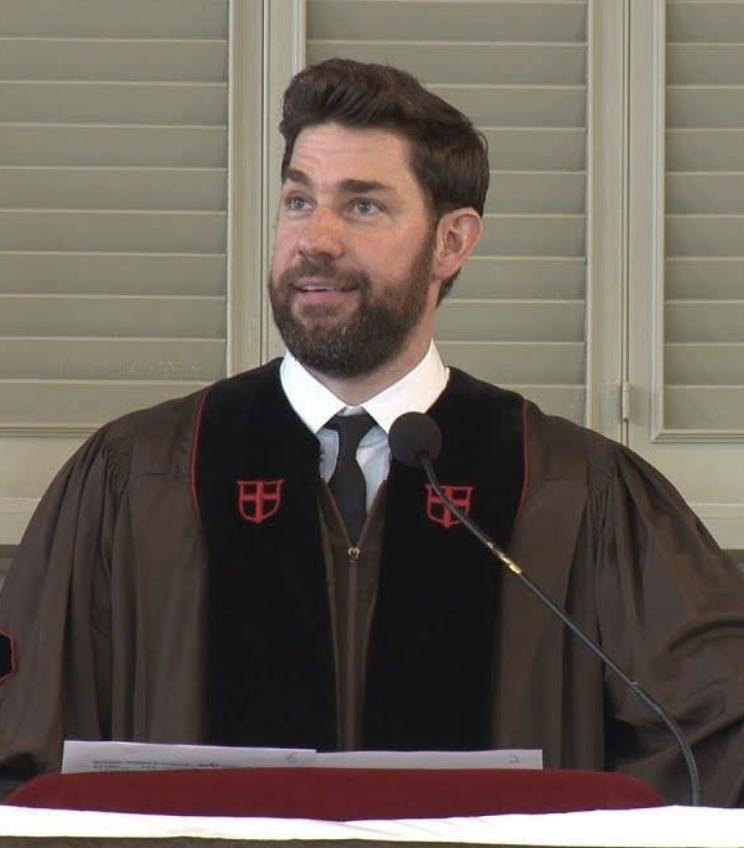
Meanwhile, many colleges and universities hire show-business and sports figures (and professional sports are part of show biz) much more than, say, scholars to give commencement addresses. I suppose this is to get more publicity to the schools, but it diverts attention from what you’d think would be the institutions’ main mission – the rigorous creation and teaching of knowledge.
My undergraduate alma mater, Dartmouth College, in Hanover, N.H., is a prime example of this obsession with celebrity culture. It has had the likes of Shonda Rhimes, Connie Britton, Conan O’Brien, Jake Tapper, and sainted tennis legend Roger Federer as recent commencement speakers. This year it will be Sandra Oh, who is, I am told, a famous Canadian-American actress but a mystery to me. But then, our MAGA Master owes his political success to being a “reality TV” star on the absurd but very popular-in-the-Heartland TV show The Apprentice.
One thinks yet again of Neil Postman’s classic book Amusing Ourselves to Death: Public Discourse in the Age of Show Business.
The commencement speakers used to be mostly the likes of foreign or U.S. government leaders, diplomats, academics, including celebrated scholars and college presidents, statesmanlike corporate leaders, and philanthropists. Consider that the speaker in 1970, when I got my degree, was the classicist William Arrowsmith, who very briefly mentioned Vietnam. But higher culture doesn’t pack ‘em in.

I was recently in Washington, D.C., where I’ve worked for short stretches over 55 years and have relatives. The city had that fresh greenness it has for a few weeks before its oppressively hot and humid summer. I talked to quite a few people. The mood was anxious and pessimistic, mostly because of the Musk-Trump regime’s slashing of government programs and the regime’s extreme unpredictability, seasoned with nihilism.
It was a far cry from my most memorable time in D.C. -- the late summer of 1974, right after another corrupt president, Richard Nixon, was forced to resign. I was editing articles at The Wall Street Journal’s offices in the National Press Building.
The mood in the city was, after the long tension of the Watergate scandal, upbeat, though the economy was in recession. The new president, Gerald Ford, was well-liked and congenial, considered basically honest, and took generally mild right-of-center positions. He also had competent people working for him. Some you could call part of “The Deep State.’’ Sadly, he lost a lot of political capital on Sept. 8, 1974, when he pardoned Nixon for his obvious, but not yet officially prosecuted, crimes. That set a very bad example.
Washington has become a more anxious place since the early ‘90s, and especially, of course, since 9/11, with security checks, etc., much more numerous. Figures associated with the two major political parties are much less likely to do legislative deals with each other, let alone socialize with each other. I trace this back to the rise of very ideological and confrontational forces in the Republican Party in the late ‘80s and the ‘90’s led by the ruthless and corrupt Newt Gingrich, who would become House speaker.
I fondly remember Democratic and Republican legislators schmoozing, sweating and drinking together in the jungle heat at the Washington Hotel’s rooftop bar.
Still Unresolved
The latest little war between Pakistan and India reminds us of how an exhausted Britain’s chaotic exit as the Indian Subcontinent’s colonial power, in 1947, leaving two adversarial nations with an unresolved border in Kashmir, still scarily reverberates. That’s especially because both have nuclear weapons. While our eyes have been on the Mideast and Ukraine, dangerous situations can crop up elsewhere without warning.
The Israel/Palestine situation is another unresolved matter, going back many decades, and apparently with less hope than ever of being fixed. And the future of Northern Ireland remains uncertain.
Speaking of nukes, Ukraine has deeply regretted giving up its nuclear weapons, inherited from the former Soviet Union, in the 1994 Budapest Memorandum, in exchange for security guarantees from the U.S., U.K. and Russia. So much for such guarantees! Ukraine now knows how worthless are promises from aggressive dictatorships and, maybe from quasi-democracies such as America.
Once they have nukes, nations are more unlikely than ever to give them up.
xxx
Like many of my generation, who provided most of the American manpower for the U.S. part of the Vietnam War –- the too-often-forgotten French part came first -- I’ve been thinking lately about May 1975, the ignominious end to our role in the conflict and the role of luck. I escaped service via a 361 draft number. That meant that, except for nuclear war with the Soviets, in which case most of us would be incinerated anyway, it was nearly impossible that I would be ordered to put on a uniform.
But my friend Steve Perry, with #7, was drafted out of college, and sent to Vietnam, where he was killed in action near Danang only three weeks after arriving.
Contingency, contingency!