


Whitcomb: Those Foreign Students; Deconstructing Energy Sectors; Great New England Artist
Robert Whitcomb, Columnist
Whitcomb: Those Foreign Students; Deconstructing Energy Sectors; Great New England Artist
“And sure as shootin' spring
Is getting springier
So on this fine spring morning
My heart’s resigned made up my mind
To spend every fine spring morning with you.’’
-- From the song “A Fine Spring Morning,’’ by Bob Haymes (1923-1989)
Hit this link for a rendition of the song:
“I was born at a very early age. Before I had time to regret it, I was four and a half years old.’’
-- Julius Henry “Groucho” Marx (1890-1977), American comedian and actor
"He {George III} has obstructed the administration of justice, by refusing his assent to laws for establishing judiciary powers.
He has made judges dependent on his will alone, for the tenure of their offices, and the amount and payment of their salaries.
He has erected a multitude of new offices, and sent hither swarms of officers to harass our people, and eat out their substance.''
-- From the U.S. Declaration of Independence
Ignore my promise last week not to refer to You-Know-Who, but I won’t mention him by name. Meanwhile, if you feel that you might drown under the Niagara of lies in the public square these days, turn to:
xxx

Meanwhile, it’s maddening that birdsong, at its most musical at this time of year, is so often drowned out by leaf blowers. But then some people want human noise all the time. For example, they like the loud banal music in stores, locker rooms and elsewhere. You get the impression that silence scares them because it makes room for scary existential thoughts.
xxx
Complaining about what’s coming out of Washington with petition-signings, social-media comments, letters to the editor and so on aren’t enough. Millions will have to hit the streets.
Yesterday was the 250th Anniversary of the start of The American Revolution, with the battles up the road in Concord and Lexington. “The shot heard round the world.’’
"We must all hang together, or assuredly we shall all hang separately.’’
-- Benjamin Franklin (1706-1790) to Thomas Jefferson (1743-1826), shortly before the Declaration of Independence was adopted, on July 4, 1776

Do American colleges and universities, particularly the “elite” ones, recruit too many foreign students, partly in an effort to seem more glamorous and important – call it a species of snob appeal? Some probably do.
And yet, consider the benefits to the U.S. Just to be foreign students suggests the sort of very American-style risk-taking initiative that they’d need if they decide to try to become U.S. citizens, an increasingly onerous task. Consider that so many foreign students who try to become Americans may be poised to make big contributions here in science, medicine and other fields.
And even many students who opt, or are forced, to return to their home nations can still do America good by expanding our “soft power’’ by forging international links that strengthen the U.S. economically and culturally over the long run. That is if the current regime doesn’t make them too bitter.
Some may be better able to explain America to their compatriots than Americans can to theirs.
In this era of regime-promoted xenophobia, many higher education institutions will have to cut back on the number of foreign students, at least for a while. This will make it easier for American students to be admitted to “elite” colleges, which would be good PR for this increasingly besieged sector. Fancy colleges for too long have hyped the difficulty of getting in as a marketing tool, aided and abetted by the corrosive U.S. News & World Report ranking system.
Thank God that America has many private colleges and universities educating millions of students (mostly American!) and churning out research for the benefit of the country. They’re not as vulnerable to corrupt and dictatorial politicians’ threats as are public institutions. These days they must push back as best they can against our budding police state. The more that they can do it together the more strongly they can defend themselves.
Facts Behind Fossil Fuel, Nuclear, Renewables
"They want to mine. One thing I learned about the coal miners, that's what they want to do. You could give them a penthouse on 5th Avenue and a different kind of a job and they'd be unhappy.’’
-- MAGA Monarch the other day
The Conversation has a very useful article about the comparative costs and efficiencies of various sources. One of its many timely points is:
“Coal is one of the more expensive technologies for utilities today, making it less competitive compared with solar, wind and natural gas, by Lazard’s calculations. Only nuclear, offshore wind and ‘peaker’ plants, which are used only during periods of high electricity demand, are more expensive.’’
I quote this in particular because the regime in Washington wants to promote climate-heating and dangerous-to-extract coal, in large part because of the “Redness” of the states where coal is mined.
Hit this link for the article:
Health-Care Atomization
Here’s something else that’s undermining the availability of primary-care physicians: The rise of concierge medicine. In this, doctors charge patients a monthly or annual fee in return for limiting the number of their patients. That means that the patients they do have get faster access to their services and longer and more personalized appointments. But at the same time, patients must continue paying insurance premiums, co-pays, and deductibles.
In other words, concierge medicine serves the affluent and reduces the pool of physicians available to serve everybody.
Well, there are always nurse practitioners….
xxx
So good luck to legislation in the Rhode Island General Assembly that would prohibit such covenants. The bill, sponsored by Rep. Edith Ajello, of Providence, recalls the public’s irritation about the former Eastside Marketplace, on the city’s East Side, shuttered last year. The owner, Dutch-Belgian company Ahold, which owns Stop & Shop, has apparently wanted to force customers to its other stores in the area.
Smaller Steps, Such as No Steps
Because of the relative lack of support by the Feds, rail-passenger service in America may never get the investments required to have the sort of very high-speed train service long available in Europe and East Asia. But Amtrak service can be much improved by more modest improvements such as building train platforms higher to speed passengers in and out of trains without them having to use steps, which obviously require more time to move people in and out, and further electrification to replace diesel locomotives. Electric-powered trains accelerate faster than diesel ones.
The states most dependent on train service will have to chip in more to help finance these improvements. The autocracy based in the White House is run by people who have little interest in public transportation – favoring private jets, helicopters and chauffeur-driven limos for themselves.
Eroding the Planning Process
Even as we need it more and more, a relatively new but enthusiastically embraced tool for predicting coastal erosion has disappeared from the Federal Emergency Management Agency website. Did the real estate agents and developers complain about it?
Such tools, of course, are particularly useful for planning responses to the fast-erosion of such “soft” glacial-moraine shorelines as those of South County, R.I., Cape Cod, Nantucket and Martha’s Vineyard.
I suppose that one huge storm of the intensity of 1938’s “Great New England Hurricane” will encourage some agonizing reappraisals of coastline building and regulations.
xxx
Here’s one Canadian’s real-life tale of tariff times on the U.S. border:
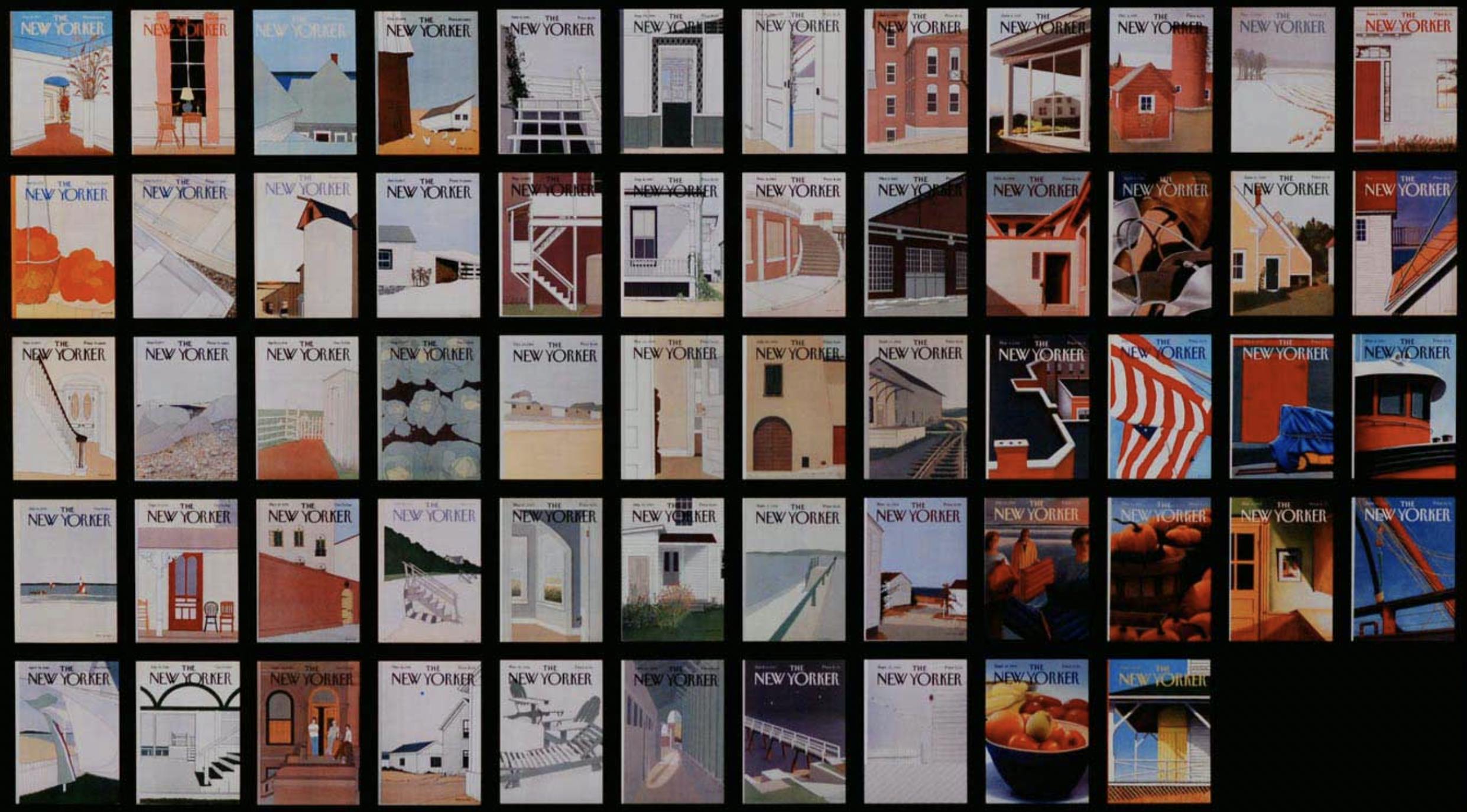
Rhode Island-based Gretchen Dow Simpson, who died April 11, painted a wide variety of settings in her long career. (She was also a distinguished photographer.) But this tall, elegant, and very direct Yankee will be most remembered for her New England-based and often highly architectural paintings, many of which graced the covers of The New Yorker magazine. People weren’t in her pictures very often but you could sense them (lurking?) nearby, if out of sight.
In any event, there was a powerful sense of our regional culture in her images.
Her fame originated from her New Yorker covers, but Gretchen (I’ll use her first name because she was an old friend) was a tad ambivalent about it. She noted that magazine illustration work was in some ways “limiting.’’
Hit this link to see her big retrospectives show last year at the WaterFire Arts Center:
xxx
As I’ve written before, I love magazines and have always preferred them to newspapers, though far more journalistic jobs were available in the latter in my time. I mourn that the magazines’ golden age is gone. For that matter, I mourn the loss of so much of the print-on-paper world, though probably mostly for the aesthetics.
National magazines’ engaging (if sometimes too arch or mannered) writing, often brilliant art direction, within easy-to-use book-like structures, including vivid colored photography and illustrations on slick paper that showed them to their best advantage, led millions of readers to eagerly anticipate their weekly or monthly arrivals and to happily browse at those now disappearing dinosaurs called newsstands.
And boy, were the big news magazines fun to work for, as I did a bit as a freelancer, mostly in New York, where most of the major ones were based. You never knew how much of your writing would be rewritten by their many editors, and those rewrites could sometimes be aggravating. Still, these staffs included many very smart and often funny people.
And those glorious expense accounts, which covered for too many staffers an excessive number of drinks.
I’ve been thinking about all this lately while reading about former Vanity Fair editor Carter Graydon’s memoir, When the Going Was Good: An Editor’s Adventures During the Last Golden Age of Magazines.