


Woody Allen Movie Reopens RI Film Tax Credit Debate
Kate Nagle, GoLocal Contributor
Woody Allen Movie Reopens RI Film Tax Credit Debate

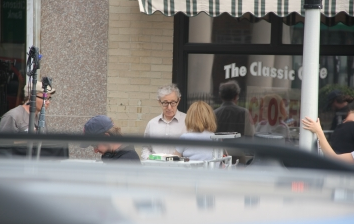
The prolific film director has shot with high profile actors Joaquin Phoenix and Emma Stone at such locations as Fastnet in Newport and Loie Fuller's in Providence, and supporters of the industry tout the ancillary effects that filming brings to the state, from hotel and dining to transportation, to various uses of the state's businesses.
SLIDES: See 25 Movies Filmed in RI HERE
GET THE LATEST BREAKING NEWS HERE -- SIGN UP FOR GOLOCAL FREE DAILY EBLAST"It's not controversial," said Steve Feinberg with the RI Film and TV Office, of the state's motion picture tax credit. "Climate change is controversial, some say it doesn't exist, some do. As far as this goes, Dr. [Edward] Mazze did a comprehensive analysis, and showed that for every $1 we give in movie tax credits, it creates $8 in economic activity for the state. That's not controversial."
However, some critics -- including Mike Stenhouse with the RI Center for Freedom and Prosperity, who cited the movie tax credits as "non-essential" in its Spotlight on Spending report, question the value -- and validity -- of the tax credit program.
"Claiming an economic impact is a false argument. If there was a true positive effect of special interest spending like this, then RI, as the king of crony spending, should have one of the best economies in the nation," said Stenhouse. "Obviously we do not, proving that such schemes have been a failure for our state."
Economic Impact Debated
Mazze, who is URI's Distinguished Professor of Business, has long been a strong proponent of the film tax credit as an economic driver for the state.
"The tax credit is given for documented/audited expenditures in Rhode Island. Critics of the program want to see an immediate return from this investment [if we give you a dollar today we would like a dollar and fifty cents tomorrow]. They do not understand the purpose of tax credits, which is to support and build economic strength in a sector of the Rhode Island economy that has some strong assets with potential to grow. The purpose of the tax credit was to build a film and television sector in Rhode Island," said Mazze.

Feinberg said that the current cap on the the tax credit program meant that he has seen productions interested in Rhode Island go to other states -- as well as those in the industry moving out to follow the jobs.
"[Rhode Island] was always on the forefront back in 2005," said Feinberg. "We were visionary, and then other states emulated us -- and they were a little more liberal. We didn't have a cap, and once we put one in, the cap has impacted production, as well as supporting businesses. Take Massachusetts, who has a 25% tax credit, but unlike here, they don't have a cap -- they also have the offer the option of a transferable tax credit, or a 90% rebate."
Feinberg noted he was recently approached about a particular project -- which he said "people would have loved" -- that opted to shoot elsewhere, due to a more attractive credit.
"The first question asked by someone who's interested always is, "Creatively -- can it meet our needs? Then, how does it compare financially with other options?" said Feinberg. "They said we love Rhode Island, we want to come here -- I thought we had it, we met their needs. But if you're a big project, you're not going to walk away from $3, $4 million on the table for you elsewhere."
Opponents, however, question the role of the governement in promoting the industry.
"Tax credits are just another term for subsidies. Choosing which industries to subsidize by risking our limited resources, whether it's through loans, subsidies or tax credits, is not government's role. We've seen how well that has worked with 38 Studios. Tax credits have a very limited impact. Just like with federal stimulus money, what happens when it dries up? The jobs are gone, so either taxpayers keep funding them or lose the business," said Pam Gencarella with OSTPA, which bills itself as the "voice for taxpayers in Rhode Island. "OSTPA cannot stress enough, that it's government's role to create an overall economic climate where all businesses can thrive and that's through a predictable and reasonable tax structure. The problem in RI is there is no objective, analytical modeling performed to determine whether or not credits have produced a net benefit or not and, more importantly, what the 'opportunity cost' was - could that money have been better spent to produce more of the desired result?"
"Tax credits can carry a serious 'opportunity cost'. According to a US News and World Report done last year, most states are finding that there is no net benefit for film credits. Reportedly, when Massachusetts did the math, after providing $44 million in tax credits, they produced only $39 million in state economic activity. That's a net loss," said Gencarella. "When North Carolina did the math, they determined that with the $30 million in film credits they gave out, if they had simply reduced taxes across the board, they would have increased the number of jobs created more than 6 fold".
Looking Ahead
"Steve Feinberg does an excellent job promoting the motion picture industry in Rhode Island and managing the motion picture tax credit program," said Sasse. "However, granting preferential tax treatment to an industry must be based on hard evidence that the tax credits are producing a real return on investment for Rhode Island taxpayers. This includes the number and type of permanent jobs the tax credit produces, the level of private investments attributable to the credits and whether the credits produce new tax revenue to offset the revenues foregone by providing the credit."
Sasse continued, "Simply providing a motion picture tax credit because other states do so is irrelevant if the credit does not produce a positive return. I believe lower tax rates are a more effective competitiveness strategy than government using tax credits to pick winners. I am not a fan of crony capitalism. Therefore, I have reservation when proposals are made to enhance the motion picture tax credits and would urge a comprehensive independent assessment of the costs and benefits of the existing program."
With this year's General Assembly season wrapped up -- and an election season ahead -- the new Speaker of the House expressed his support for the program where it's currently at -- and that he might be open to considering an expansion in the future.
"Speaker Mattiello does support the film tax credit program. He believes the state’s current investment is appropriate, but would be open to considering an expansion of the program in the future. Until a clearer picture develops on the money that is available in the state budget next year, it is difficult to speculate further," said Larry Berman, Director of Communications for the Speaker.
While there are those calling for a financial impact study, Kathryn Farrington with Discover Newport said that there were benefits that just couldn't be measured.
"Being in marketing here in Newport, I have the best job in the world. It's all about the brand," said Farrington. "Like others that have filmed in Rhode Island, this new Woody Allen is going to be shown around the country, and around the world. Folks will see it -- and everything Newport, and Rhode Island. You can't put a price on the branding, or the number of eyes on it."
25 Movies Filmed in Rhode Island

Moonrise Kingdom
2012
Director: Wes Anderson
Cast: Bruce Willis, Edward Norton, Bill Murray Frances McDormand
This Oscar nominated film features many local landmarks including Fort Wetherill State Park, Bayfield Farm, and the Conanicut Lighthouse.

Mr. North
1988
Director: Danny Huston
Cast: Anthony Edwards, Robert Mitchum, Lauren Bacall
Shot in Newport, this comedy-drama features Anthony Edwards as a con man attempting to break into the 1920s Newport social scene.

There's Something About Mary
1998
Directors: Peter and Bobby Farrelly
Cast: Cameron Diaz, Matt Dillon, Ben Stiller
Filmed partly in Providence, this movie was the highest-grossing comedy in 1998.

Federal Hill
1994
Director: Michael Corrente
Cast: Nicholas Turturro, Anthony DeSando, Libby Langdon
Set in Providence's Federal Hill neighborhood, the movie marks the directorial debut of Pawtucket native Michael Corrente.

Age of Innocence
1993
Director: Martin Scorsese
Cast: Daniel Day-Lewis, Michelle Pfeiffer, Winona Ryder
This Oscar winning drama was partly filmed in Portsmouth.

True Lies
1994
Director: James Cameron
Cast: Arnold Schwarzenegger, Jamie Lee Curtis, Tom Arnold
The ballroom scenes in the movie were filmed at the Rosecliff Mansion in Newport.

High Society
1956
Director: Charles Walters
Cast: Bing Crosby, Grace Kelly, Frank Sinatra
Nominated for two Academy Awards, the movie's opening shot features a flyover of Newport’s oceanfront mansions.

Thirteen Days
2000
Director: Roger Donaldson
Cast: Kevin Costner, Bruce Greenwood, Steven Culp
This docudrama about the Cuban Missile Crisis was partly shot in Newport.

Little Children
2006
Director: Todd Field
Cast: Kate Winslet, Patrick Wilson, Jennifer Connelly, Jackie Earle Haley
Shot partly in Providence, this critically acclaimed drama received three Academy Award nominations, including a Best Lead Actress nod for Kate Winslet.
RIPD
2013
Director: Peter M. Lenkov
Cast: Ryan Reynolds, Jeff Bridges, Kevin Bacon
A car chase for this action-comedy was filmed in downtown Providence.

Amistad
1997
Director: Steven Spielberg
Cast: Morgan Freeman, Anthony Hopkins, Dijimon Hounsou, Matthew McConaughey
Shot at the Rosecliff Mansion in Newport and the State House in Providence, this drama received four Academy Award nominations in 1998.

Outside Providence
1999
Director: Michael Corrente
Cast: Shawn Hatosy, Amy Smart, Alec Baldwin
Filmed in multiple locations throughout Rhode Island, this movie is an adaptation of Peter Farrelly's 1988 novel of the same name.
Me, Myself & Irene
2000
Directors: Peter and Bobby Farrelly
Cast: Jim Carrey, Renée Zellweger. Chris Cooper, Robert Forster, Richard Jenkins
Filmed in Newport, Narragansett, Jamestown, and Galilee, this comedy centers on a Rhode Island State Trooper played by Jim Carrey.

Evening
2007
Director: Lajos Koltai
Cast: Vanessa Redgrave, Claire Danes, Toni Collette, Meryl Streep
The film was primarily set in Newport and included large portions shot at Gooseberry Beach.

The Great Gatsby
1974
Director: Jack Clayton
Cast: Robert Redford, Mia Farrow, Sam Waterston, Bruce Dern
This Academy Award-winning drama was filmed in Newport at the Rosecliff Mansion on Bellevue Ave.

Self Storage
2013
Director: Tom DeNucci
Cast: Eric Roberts, Jonathan Silverman, Michael Berryman, Tom DeNucci
Filmed in a self storage facility in East Greenwich, this horror-comedy marks the directorial debut of Cranston native Tom DeNucci.

27 Dresses
2008
Director: Anne Fletcher
Cast: Katherine Heigl, James Marsden, Malin Åkerman, Ed Burns
Shot throughout Rhode Island, locations included the Rosecliff and Marble House mansions in Newport and a beach in Charlestown.

Dan in Real Life
2007
Director: Anne Fletcher
Cast: Steve Carell, Juliette Binoche, Dane Cook, Alison Pill
Filmed primarily in Jamestown, the movie also features the Point Judith Lighthouse in Narragansett.

Hachi: A Dog's Tale
2009
Director: Lasse Hallström
Cast: Richard Gere, Joan Allen, Jason Alexander
Filmed primarily in Bristol and Woonsocket, other locations included the Columbus Theater in Providence and the University of Rhode Island in Kingston.

The Education of Charlie Banks
2007
Director: Fred Durst
Cast: Jesse Eisenberg, Jason Ritter, Eva Amurri
Shot partially in Brown University in Providence, the movie marks the directorial debut of Limp Bizkit frontman Fred Durst.

Meet Joe Black
1998
Director: Martin Brest
Cast: Brad Pitt, Anthony Hopkins, Claire Forlani
Warwick's Aldrich Mansion served as the residence of Anthony Hopkins' character in the film.

Reversal of Fortune
1990
Director: Barbet Schroeder
Cast: Jeremy Irons, Glenn Close, Ron Silver
Jeremy Irons took home the Oscar for Best Actor for this drama, which was partly shot in Newport.

Underdog
2007
Director: Frederik Du Chau
Cast: Jason Lee, Peter Dinklage, Patrick Warburton, Amy Adams
Shot entirely in Rhode Island, filming locations included Hope High School on the East Side of Providence.

Tanner Hall
2009
Directors: Francesca Gregorini, Tatiana von Furstenberg
Cast: Rooney Mara, Georgia King, Brie Larson
Shot in Providence and Newport, the film marks the the directorial debut of Brown University graduates Francesca Gregorini and Tatiana von Furstenberg.

Dumb and Dumber
1994
Directors: Peter and Bobby Farrelly
Cast: Jim Carrey, Jeff Daniels, Lauren Holly
Scenes from the beginning of this comedy were filmed on location in Providence, including a shot of the Big Blue Bug.


