


Judge Rules on Gender Discrimination Case Against Former RI State Police Boss O’Donnell and YMCA
GoLocalProv News Team
Judge Rules on Gender Discrimination Case Against Former RI State Police Boss O’Donnell and YMCA

The YMCA and O'Donnell had filed for summary judgment asking the court to throw the lawsuits out.
Laplante ruled that three of four claims can go to trial. The judge outlines in his ruling the court found that the claims of gender discrimination and humiliation of the two women by the YMCA and specifically O'Donnell had merit to move forward.
GET THE LATEST BREAKING NEWS HERE -- SIGN UP FOR GOLOCAL FREE DAILY EBLAST“Plaintiffs Karen Cooper and Linda Dykeman allege that the Greater Providence Young Men’s Christian Association and their former supervisor, Steven O’Donnell, subjected them to a hostile work environment based on their gender and retaliated against them when they complained of this discrimination, in violation of federal and state law,” claim the Cooper and Dykeman in the lawsuit.
David Cass, attorney for Dykeman and Cooper in their suit against the YMCA and O’Donnell told GoLocal in a phone interview, “Outside of the decision of the court, I'm not at liberty to speak. Three parts survived -- one didn't -- the defamation [claim]. The next step is if the parties can't reach an agreement -- it will move to trial.”
The case was moved to New Hampshire courts due to Rhode Island federal court judge Will Smith being a personal friend of O'Donnell and serving on the YMCA's board. Laplante was appointed to the federal court in 2007 by President George W. Bush.
O'Donnell did not respond to a request for comment for this article.
READ THE FULL DECISION BELOW
Dykeman served as the chief financial officer for the organization and Cooper was hired to serve as the chief marketing officer. O’Donnell joined the organization after he was dismissed by Governor Gina Raimondo as head of the Rhode Island State Police.
He had a controversial tenure including questions raised about the 38 Studios investigation that O'Donnell personally oversaw and the handling of the physical incident between Trooper Jamie Donnelly-Taylor and a detainee Lionel Monsanto and allegations of a cover-up.
A range of incidents took place between O’Donnell and Dykeman and Cooper that were characterized in the court’s writing as being potentially discriminatory.
According to the Judge’s writings, “After [a YMCA meeting that O’Donnell did not attend] the meeting concluded, Dykeman found that O’Donnell was in his office, and asked why he failed to attend the meeting downstairs. Dykeman testified that O’Donnell lied to her and told her that he did not know about it. O’Donnell was polishing his shoes, and asked Dykeman for an article of clothing from her bag to use in shining his shoes. Dykeman had to leave to attend a holiday party at her social club. O’Donnell told her to go have some drinks and relax. In Dykeman’s observation, O’Donnell did not miss meetings with the male members of the SLT [Senior leadership team], and she is not aware of O’Donnell asking anyone else for clothing with which to shine his shoes.”
“The following day, Dykeman entered CEO O’Donnell’s office to provide some documents when Cooper was present. O’Donnell brought up the prior evening’s discussion and repeatedly referenced Dykeman having drinks to cope. Dykeman repeatedly asked O’Donnell if they could discuss the issue at another time, but O’Donnell continued to discuss it in front of the newly hired Cooper.”
“On one occasion, CEO O’Donnell became belligerent towards Dykeman, in front of Brown and Hannagan, for discussing GPYMCA financials with Board Chair Corrigan. Corrigan reports that in meetings O’Donnell called Dykeman the “grim reaper” and referred to her being inebriated. When Corrigan raised the shoe-shining incident with O’Donnell, he responded that Dykeman was too tightly wound and just needed a few drinks. O’Donnell also called Corrigan to complain about Dykeman. At meetings, Corrigan observed that O’Donnell’s body language expressed disinterest when Dykeman spoke. Board and executive committee member Adam Phillips observed that Dykeman appeared uncomfortable around O’Donnell, and Dykeman advised Corrigan that she felt uncomfortable sharing a car with O’Donnell,” continue the ruling.
“After a meeting on January 5th, 2017, where the grant writer was mentioned, O’Donnell called Cooper and, by her account, unleashed a tirade against her for hiring the grant writer without his explicit consent. Cooper testified that she was afraid of O’Donnell and apologized to him to stop him from yelling and screaming at her,” according to claims.
Gayle Corrigan, who had served as chair of the board of the YMCA when O’Donnell was hired told GoLocal, "All that I know there were for claims for summary judgment - the judge dismissed one and let the other 3 others move forward.”
O’Donnell after being hired by Corrigan moved to successfully remove her as board chair.
Corrigan, Dykeman, and Cooper had filed a complaint with the Rhode Island Commission for Human Rights against the YMCA and O’Donnell in 2017.
“I was just a witness in this case. [O'Donnell] sold us a bill of goods -- we believed it. He told us he was someone he wasn’t,” Corrigan told GoLocal.
“And I was definitely there --and it was a horrific time,” Corrigan added.
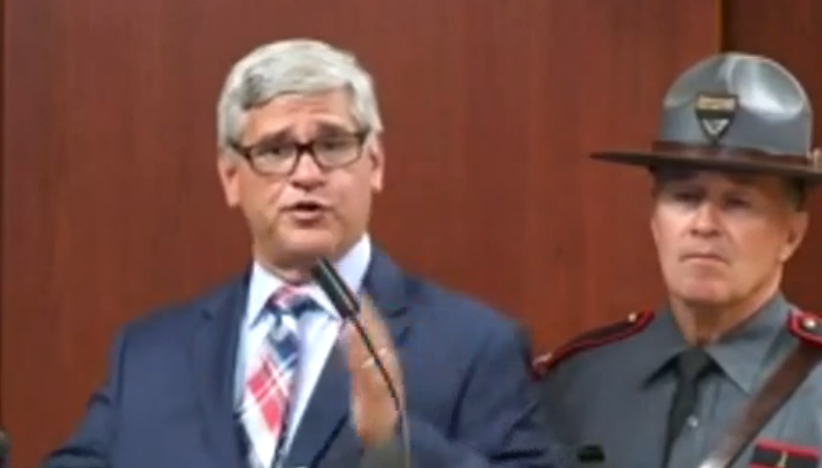
The YMCA and O'Donnell argued that the career-long law enforcement officer was not discriminatory against women, but a tough boss.
“The defendants [YMCA and O’Donnell] first argue that none of the alleged incidents involve an express reference to gender or the use of derogatory terms associated with women. Even if this is accurate, the lack of overt reference to gender is not dispositive. See id. They also describe several areas of evidence that they argue show that CEO O’Donnell did not discriminate based on gender:
• O’Donnell placed the same work restrictions on all the members of the SLT, male and female;
• the male members of the SLT had similar concerns regarding O’Donnell’s management style;
• the investigator, Dwyer, found alternative reasons, unrelated to gender, for any heightened conflict between O’Donnell and the plaintiffs; and
• O’Donnell’s positive treatment of other female employees demonstrates that his conflicts with the plaintiffs were not based on gender.
"These are potentially sound, even persuasive, arguments to make at trial. But, viewing all facts and drawing all reasonable inferences in the light most favorable to the plaintiffs, they do not foreclose a reasonable factfinder from finding discrimination based on gender,” Laplante wrote.
Laplante continued, “Other evidence could also reasonably implicate gender. The shoe-shining incident with Dykeman arguably suggests gender-based assumptions and prejudices. Former Board Chair Corrigan and others testified that O’Donnell used terms for the plaintiffs and other women that were not explicitly sexist, but in context arguably reflected gender-bias.”
According to the court, “The defendants contend that the record only shows that CEO O’Donnell was a demanding manager who engaged in close oversight of the SLT, including Cooper and Dykeman. It is true that ‘a supervisor’s unprofessional managerial approach and accompany efforts to assert her authority are not the focus of the discrimination laws.’”
"But, viewing the facts in the light most favorable to the plaintiffs, a reasonable factfinder could determine that Cooper and Dykeman were subject to more than merely distressing management techniques, but to severe or pervasive “intimidation, ridicule, and insult ...create[ing] an abusive working environment.”

"Humiliated Them"
The judge in deciding to move the case forward found that there was merit in the claim that O'Donnell humiliated Dykeman and Cooper.
"The plaintiffs have presented evidence that O’Donnell, not only their supervisor but the leader of their organization, regularly humiliated them, deprived them of any discretion to perform their roles, and focused his ire on them because of their gender," he wrote."
"The defendants contend that the plaintiffs cannot show that a reasonable person in Cooper or Dykeman’s shoes would have felt compelled to resign. But, taking the facts in the light most favorable to the plaintiffs, a reasonable factfinder could find that, despite CEO O’Donnell’s formal words of reconciliation, his practices and the GPYMCA board’s handling of the investigation left Cooper and Dykeman so professionally powerless and exposed to discrimination and retaliation that their positions were “intolerable.” Id. Given evidence indicating that O’Donnell advocated for the defendants to be put on administrative leave prior to any investigation and later recommended that they be fired for cause if they did not resign, a reasonable factfinder might even find that the plaintiffs were subjected to “a calculated effort to pressure [them] into resignation through the imposition of unreasonably harsh conditions, in excess of those faced by [their] co-workers,” a core concern of constructive discharge," wrote Laplante.
In conclusion, Laplante wrote, "The summary judgment record can be reasonably interpreted in multiple ways. It may reflect only personality conflicts between a demanding boss attempting to reorient a troubled organization and employees with different work styles. Or it may suggest that these disputes were driven, at least in part, by board-level machinations. But viewing the facts and drawing all reasonable inferences in the plaintiffs’ favor, as Rule 56 requires, the summary judgment record can be read to show gender-based discrimination and retaliation. Genuine disputes of material fact remain as to the plaintiffs’ discrimination and retaliation claims. The plaintiffs no longer press their defamation claims against O’Donnell. Defendants’ motions for summary judgment against Cooper and Dykeman are thus granted as to the defamation claims against O’Donnell but otherwise denied."
READ THE FULL DECISION BELOW
Laplante Decision on YMCA and O'Donnell Lawsuit - November, 2019


