


UPDATED: Report Says “Middle East & Palestinian Studies Fuel Antisemitism” at Brown University
GoLocalProv News Team
UPDATED: Report Says “Middle East & Palestinian Studies Fuel Antisemitism” at Brown University
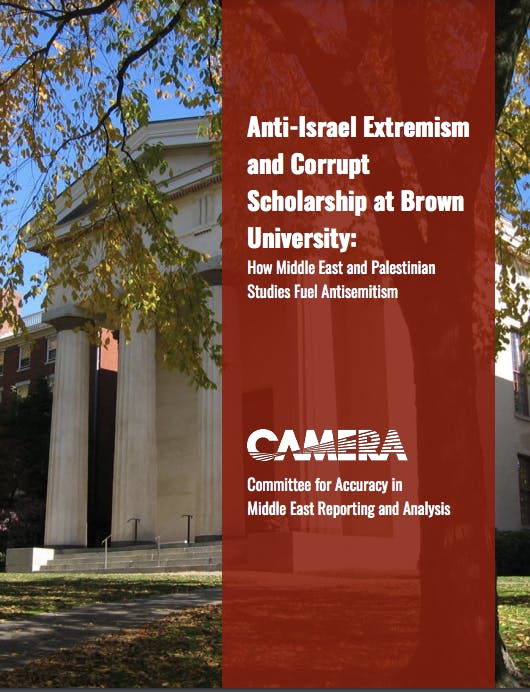
The Committee for Accuracy in Middle East Reporting and Analysis (CAMERA) said the original aim of the 37-page report released this week was to “highlight the disturbing way in which Palestinian Studies, nestled underneath the university’s Middle East Studies department, has worked to indoctrinate students in bigoted and extremist worldviews, rather than educate critical thinkers well versed in the facts, issues and events facing Palestinians, Israelis, and the broader Middle East.”
GET THE LATEST BREAKING NEWS HERE -- SIGN UP FOR GOLOCAL FREE DAILY EBLAST“There is no greater evidence of this failure than the morally obscene reaction of far too many Brown University faculty members and students to the 10/7 massacre,” stated CAMERA. “The hope is that this report will serve as a call to action not just for Brown University leadership, in light of their Title VI obligations to protect Jewish and Israeli students. But the lessons of this report extend beyond Providence, Rhode Island. Those behind the radicalization at Brown University openly declare their intention to spread this particularly radical concept of Palestinian studies to other academic institutions.”
CAMERA has attracted strong support and criticism for its reports in the past.
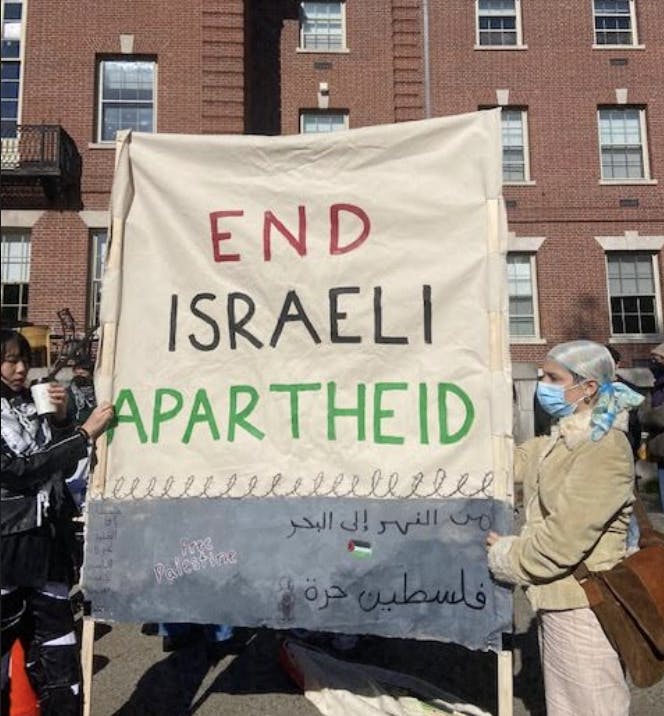
Since the Hamas attacks on Israel on October 7, 2023, and the Israel invasion of Gaza, student protesters at Brown have called the U.S. and Israel “complicit in [Palestinian] genocide.”
In December, GoLocal first reported that students at Brown who are active in the Jewish community had their apartment broken into and, according to Providence Police, were targeted with an anti-Semitic note.
Brown University officials sent an internal email notice to faculty and staff identifying the incident not as an act of “anti-Semitism” — but, Brown called the incident “bias-related.” Previously, Brown had referred to anti-Semitic” incidents as acts of “anti-Semitism.”
According to CAMERA, it was founded in Washington, DC in 1982 by Winifred Meiselman, a teacher and social worker. “Mrs. Meiselman formed CAMERA to respond to the Washington Post’s coverage of Israel’s Lebanon incursion, and to the paper’s general anti-Israel bias,” states the organization.
The new report released Wednesday is divided into several sections — and begins with a review of what happened at Birzeit University while Beshara Doumani, the founding director of Brown’s Center for Middle East Studies and the Mahmoud Darwish Professor in Palestinian Studies, served as president for two years.
In November, an exclusive review by GoLocalProv found that Brown has received millions in funding from sources in “Palestinian Territories,” according to a review of federal data — and none from Israel.
“The professor who those gifts supported is Beshara B Doumani, the Mahmoud Darwish Professor of Palestinian Studies at Brown. He also simultaneously has served as the President of Birzeit University from 2021 to 2023, located in the Palestinian West Bank territory,” wrote GoLocal. “His Brown University bio does not mention his role heading the Palestinian University, but his Birzeit bio features his role at Brown.”
When Doumani was named to the Presidency at Birzeit, the American conservation publication the American Spectator wrote, "Palestine’s ‘Terrorist University’ Picks Ivy League Prof as New President."
“The environment at Birzeit under his tenure serves to illustrate the extremism Doumani not only tolerated but helped foster. Indeed, we have already seen the same brand of extremism found at Birzeit University begin to manifest at Brown University,” wrote CAMERA in its report.
“While the available course material provides important information about the direction of the courses, the rhetoric used in the classes themselves, behind closed doors, is unavailable for the public,” wrote CAMERA. “Based on the materials reviewed, there is little doubt that the associated commentary by instructors/professors, who have elsewhere expressed extremist anti-Israel views, are amplifying the themes outlined.”
“Brown University has a long, proud history as one of the United States’ finest universities. This is what makes it all the more concerning what is emanating from its Middle East and Palestinian Studies programs. Were Doumani to succeed in spreading his model for Palestinian Studies beyond just Providence, Rhode Island, the danger of these rigid, ideological, extremist and often antisemitic messages – much of which is completely at odds with what academia is supposed to be about – would only multiply,” writes CAMERA.
“The danger of indoctrinating young minds with bigoted messages, and glorifying political violence, is obvious, and we are already seeing some of the consequences after the 10/7 Massacre in Israel. Between the ideological uniformity of the faculty and curriculum, and the absence of any meaningful counter-perspectives from Israelis and Zionists, Middle East Studies students at Brown are being at best left uninformed and at worst being actively disinformed about the perspectives of the Jews and Israelis they hear so much about,” according to CAMERA.
“The rigorous study of both the Israeli and Palestinian peoples is crucial not just from a policy perspective, but from the perspective of desiring a peaceful solution to the long-running Israeli-Palestinian conflict. There is nothing inherently wrong with the presentation of Palestinian perspectives, or Israeli perspectives for that matter,” the report concludes. “They should both be studied and considered in an intellectually honest and academically rigorous way.”
Brown Responds
Brown spokesperson Briak Clark issued the following statement on Wednesday evening following publication of the article.
"Universities like Brown can and must be places for contentious discussion and debate around difficult issues, including the Israeli-Palestinian conflict. While external actors attempt to mischaracterize the work of Brown’s Center for Middle East Studies through a narrow lens, CMES confronts a range of issues in the Middle East through its research, scholarship and thought leadership as a convener of leading scholars from across the country and around the world.
Recent events have brought to the forefront deeply held and often conflicting views, but the University remains unwavering in managing challenging discussions and diverging viewpoints in a way that remains true to the foundational principles of academic freedom and freedom of expression, while also maintaining a teaching and learning community where all individuals are respected and valued.
CMES is among the 16 centers, initiatives and programs of the Watson Institute for International and Public Affairs, which has hosted a wide range of events related to the Israel-Gaza conflict, including exploration of Israel-Palestine lands and peoples; the role of international law; competing historical and contemporary narratives about the war; questions of genocide; catastrophic implications for Jewish and Muslim cultures; the question of whether Anti-Zionism is antisemitic; and the failed quest for a two-state solution, among many other topics.
CMES recently has elevated important discussions about issues of geopolitics, religion and culture, war and violent conflict, and law and justice in Afghanistan, Iran, Turkey, and across the Arab diaspora, as well as the current Israeli-Palestinian conflict. Course offerings offer diverse perspectives, including “Ethics and Politics of Intimacy in the Middle East,” with a focus on Iran; “Issues in Contemporary Israel Society,” an exploration of current issues in contemporary Israeli society, politics and culture; “Israel-Palestine: Lands and Peoples,” exploring the two traumatic events of the Holocaust and the Nakba; and “History of the State of Israel: 1948 to the Present,” among a range of other courses.
In keeping with the bedrock principles of academic freedom — which is essential for challenging and testing ideas to promote new paths of learning and discovery — scholars shape their own fields of study and course instruction at Brown. This is the case for CMES, along with all academic centers and programs. And aligned with Brown’s mission, all programs are expected to uphold the highest standards of scholarship and teaching.
CMES continues to be recognized nationally and internationally for its academic excellence. The center’s faculty includes several leading scholars in the field of Middle East Studies, drawn from a range of departments and disciplines across the university, including history, anthropology, comparative literature, religious studies, media and communication studies, and art and architecture, among others."
Article first published Wednesday, January 10, 2024 12:02 PM
Updated Thursday January 11, 2024 7:07 AM