


Raimondo Receives up to $500,000 Payment from Pt. Judith Firm
Stephen Beale, GoLocalProv News Contributor
Raimondo Receives up to $500,000 Payment from Pt. Judith Firm
The exact amount of her earnings has not been disclosed. Instead, state disclosure forms only ask state officials to specify a range, which for Raimondo was between $201,000 and $500,000 in capital gains, meaning she earned at least double her salary. Some of those earnings could stem from the more than $4 million in pension funds the state invested in her former firm, Point Judith Capital, before Raimondo was elected. But the form does not require that level of detail for financial interests that were put into a blind trust after her election in November 2010.
GET THE LATEST BREAKING NEWS HERE -- SIGN UP FOR GOLOCAL FREE DAILY EBLAST

“It sickens me and I’m sure it sickens them,” Downey said.
Union leader: conflict of interest is unavoidable
A spokeswoman for Raimondo yesterday pointed to the March 8, 2011 Ethics Commission ruling that she had “taken appropriate and sufficient steps to avoid conflicts of interest” by placing the assets she had earned at Point Judith in a blind trust. The commission stipulated that Raimondo must also recuse herself from any matters that “pertain to the investment or involve her business associates.”
Raimondo also resigned any positions she had at Point Judith after her election. And, she is no longer involved in the management decisions of the firm, spokeswoman Joy Fox said. Because her assets are in a blind trust, it is the trustee who has control over her assets, not Raimondo.
But Downey maintains that Raimondo still faces a conflict of interest. Even though the blind trust means that she no longer controls her assets, Downey wonders how she can make unbiased decisions about the state pension system, knowing that it could affect her personal financial holdings.
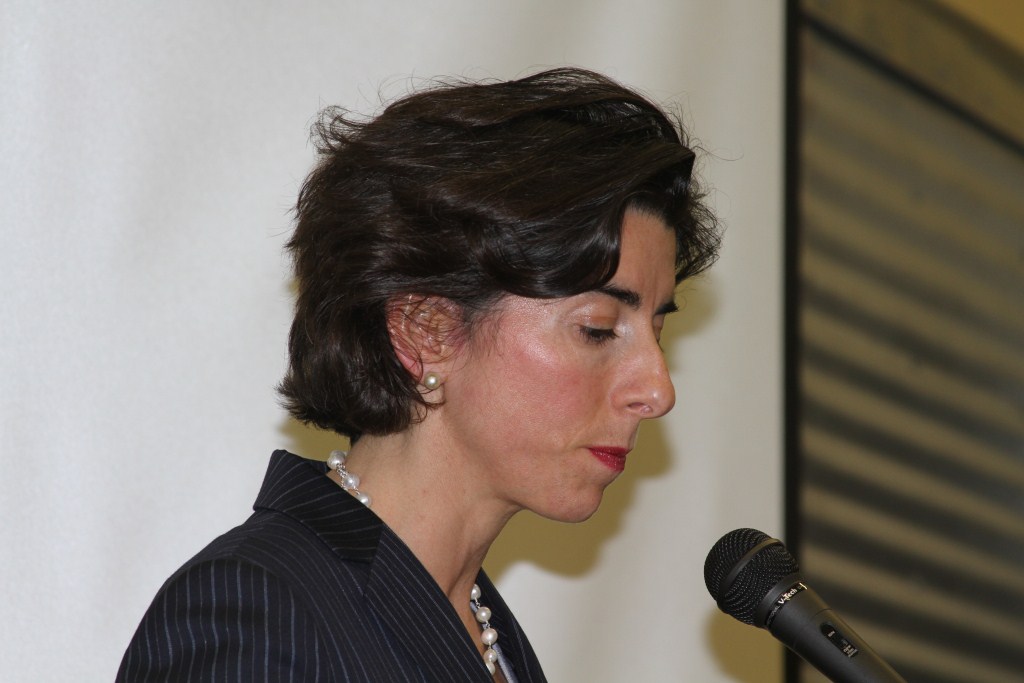
Fox declined to answer questions about exactly how much Raimondo earned from Point Judith and how much of that stemmed from the state’s investment in her firm. At the time of her election, Raimondo had a one-third ownership stake in the firm.
Her investment earnings in 2012 are a noticeable increase from 2011 when Raimondo reported only income from interest that was $1,000 or less. No capital gains were reported for that year. The 2012 capital gains earnings are in the same $201,000 to $500,000 range that Raimondo reported as her salary as an investment manager in 2009 and 2010, before her election.
It’s not clear exactly how much the state made off its investment in Point Judith Capital during the same period, from January to December 2012. When asked what the amount of state earnings was, Fox instead provided the annualized rate of return, which was 10.9 percent as of June 2012. As of March 2013, the state had funded $4,426,630 of its $5 million commitment to Point Judith. At a 10.9 percent rate of return, that would make for a potential $482,502 in earnings for the state in 2012.
Raimondo called to be more transparent
Another statewide labor leader, Service Employees International Union Local 580 President Philip Keefe, said he does not “begrudge” Raimondo any income to which she is entitled. Instead, he objects to the lack of transparency surrounding her holdings in Point Judith, given that Raimondo has been vocal about her commitment to transparency as the state treasurer.
“If that’s her mantra, she should be forthcoming with the state employees and the citizens of Rhode Island,” Keefe said.

Keefe cited the nexus between Point Judith investments, the state pension system, and Raimondo as one example of how different parties connected with the state pension system are too “intertwined” with each other. He pointed to EngageRI—a third party advocate for pension reform whose donors are not public—as another example.
“It’s like a big octopus. Where do the tentacles reach? We’ve got EngageRI. We’ve got blind trusts,” Keefe said. “As far as I can see, it’s getting murkier and murkier.”
If everything done with Raimondo’s investments has been done above board, Keefe wondered why Raimondo wouldn’t disclose more information about her financial holdings, putting an end to public criticism over it.
Raimondo earnings may not play well publicly
When asked if Raimondo should have withdrawn all her assets in Point Judith and invested them elsewhere, Ed Mazze, a noted University of Rhode Island business professor, said her agreement with her partners—a document which is not public—may have prevented such a move.
Mazze said he stood by the decision of the Ethics Commission—that Raimondo had taken the appropriate steps to avoid any conflict of interest. “I really don’t think that anything was done that was wrong,” Mazze said.

“That’s pretty much the standard operating procedure,” said veteran pollster and political scientist Victor Profughi, referring to blind trusts. “As far as I know, that approach is usually looked at as the thing to do.”
But how the public may perceive Raimondo’s complex financial ties to the state pension system is an all-together different question, Profughi added. Given the deep cynicism and skepticism so many citizens have about their elected officials, he said the reaction could easily be negative.
“If you wanted to make this a campaign issue, it might have some merit as a campaign issue,” Profughi said, adding that the issue would depend upon the broader message of an opponent's campaign. “I think it would just be more wood on the fire,” Profughi added.
Other state officers had outside income, but less
In an interview, Mazze emphasized that the salaries for the state general officers are low compared to what they really should be making. “The salaries are out of whack,” Mazze said.

A review of the other financial disclosure forms filed last week show that indeed most of the other state general officers did have outside sources of income while in office, but most, if not all, of the others did not earn more than their salaries.
In addition to a state salary between $101,000 and $250,000, Chafee reported few other significant income streams in 2012: he made less than $1,000 in interest from two banks, drew less than $1,000 in dividends from Hasbro, and had a state income tax refund between $25,001 and $50,000.
Other than small dividend payments, Lt. Governor Elizabeth Roberts reported earnings between $50,001 and $100,000 from a Union Land & Management, a Herndon, VA-based company that is described as the family business in her financial disclosure report. That is close to, but still less than, her salary, which stood at $108,808 in July 2011, the latest available figure in time for publication.
Attorney General Peter Kilmartin did not report any outside business income, but he does continue to draw two pensions—one from the state and one from the City of Pawtucket. Each pension is between $50,001 and $100,000.
Only Secretary of State Ralph Mollis appears to have had no other sources of income besides his official state salary, which he said fell within the $50,001 and $100,000 range.
Stephen Beale can be reached at [email protected]. Follow him on Twitter @bealenews
EXCERPT: 2012 and 2011 Financial Disclosure Reports