


Rhode Island Delta Variant by the Numbers: Warning Signs
Nick Landekic, Guest MINDSETTER™
Rhode Island Delta Variant by the Numbers: Warning Signs
Vaccination
GET THE LATEST BREAKING NEWS HERE -- SIGN UP FOR GOLOCAL FREE DAILY EBLASTRhode Island is doing well with vaccinations, with 61.9% of eligible residents now fully vaccinated, placing us fifth in the country.
Credit must be given to those who made this happen, with sincere thanks to the heroic efforts of the National Guard and front-line healthcare providers for transforming a calamitous start to the vaccination program into a clear success. Without their valiant labors, it would have been so much worse and many more Rhode Islanders would have become ill, and died. We literally owe them our lives.
Unfortunately, a high vaccination rate alone does not guarantee success. It only matters if it works to bring down cases, infection rates, and deaths. It’s become excruciatingly obvious that it will take more than just vaccinations to succeed against the pandemic.
Cases
New COVID cases in the U.S. are up about 119% in the past 14 days and 800% over the past month. Rhode Island’s increase is about double that, at 221% up over the past 14 days and a staggering approximately 1,200% over the past 30 days. Rhode Island’s 14-day increase is the 5th highest in the U.S..
Since the start of the pandemic, Rhode Island has had the second-highest per capita number of cases of any state, behind only North Dakota and just ahead of South Dakota.
Officially 14.7% of all Rhode Islanders have become infected since the pandemic started. The actual number is certainly much higher than that. This compares with Vermont at 4%, and Maine at 5.2%. Per capita, triple the number of Rhode Islanders have become infected compared with states that have prioritized preservation of life and health over short-term money.
The growth of COVID cases in Rhode Island is a stark contrast to that in Vermont and Maine, two states that have consistently done a much better job of protecting their people. Obviously, RI is more urban than Vermont or Maine, but many other factors make the states comparable. The following graph compares per capita infection rates since June between the three states (Rhode Island in blue):

There have been times, such as the summer of 2020, and even just this past June, where the per capita daily cases have been similar in Rhode Island, Vermont, and Maine. However, surges have been tempered by Vermont’s and Maine’s policies while they have increased in Rhode Island.
Infection Rate
The infection rate is an important forward-looking indicator because it is a measure of how many other people each infected person infects. A number less than 1 means pandemic conditions are contracting, and a number greater than 1 means infections are growing because each person infects more than 1 other person. The infection rate can be a good measure of how fast infections are spreading and a predictor of what is coming.
This is considered Critically High and is a level not seen in Rhode Island since April of last year. Even during the dire days of December and January, new infections were not increasing as fast as they are now. This predicts rapid growth of new infections.
Hospitalizations
Hospitalization is a trailing indicator, generally increasing a couple of weeks after cases surge. With a relatively high vaccination rate it is hoped that hospitalizations won’t soar back to the dark days of last December when there were over 500 people hospitalized daily, physicians and nurses were overwhelmed and crying for help, and hospital ICUs were beyond capacity. Fortunately, that is what has been seen to date, with hospitalizations actually down in the past week.
Rhode Island has a total of 2,456 hospital beds and 158 ICU beds. 120 (79%) of our ICU beds are currently filled. This does not leave much capacity if there is a flood of new COVID cases needing hospitalization.
"The number of intensive-care beds needed during this Delta surge could be higher than any time we've seen", said Dr. Michael Osterholm, Director of the Center for Infectious Disease Research and Policy at the University of Minnesota.
Deaths
Death is also a trailing indicator. It can take a few weeks or even longer after being infected before death occurs. The current surge driven by the Delta variant has been going on for about a month, and fortunately, deaths have not increased. There have been fluctuations of small numbers, but generally, the death rate has been about constant for the past several months.
With almost 40% of Rhode Islanders still not vaccinated, and the terrible virulence of the Delta variant, it is likely deaths will increase once again in the coming weeks and months. Overall since the start of the pandemic, Rhode Island has the fourth-highest overall death rate per capita in the U.S..
Our death rate of 259 Rhode Islanders killed by COVID out of every 100,000 population compares with 42 in Vermont and 67 in Maine. Relatively speaking, about five times more Rhode Islanders have died since the start of the pandemic than if we had followed the policies of Vermont and Maine.
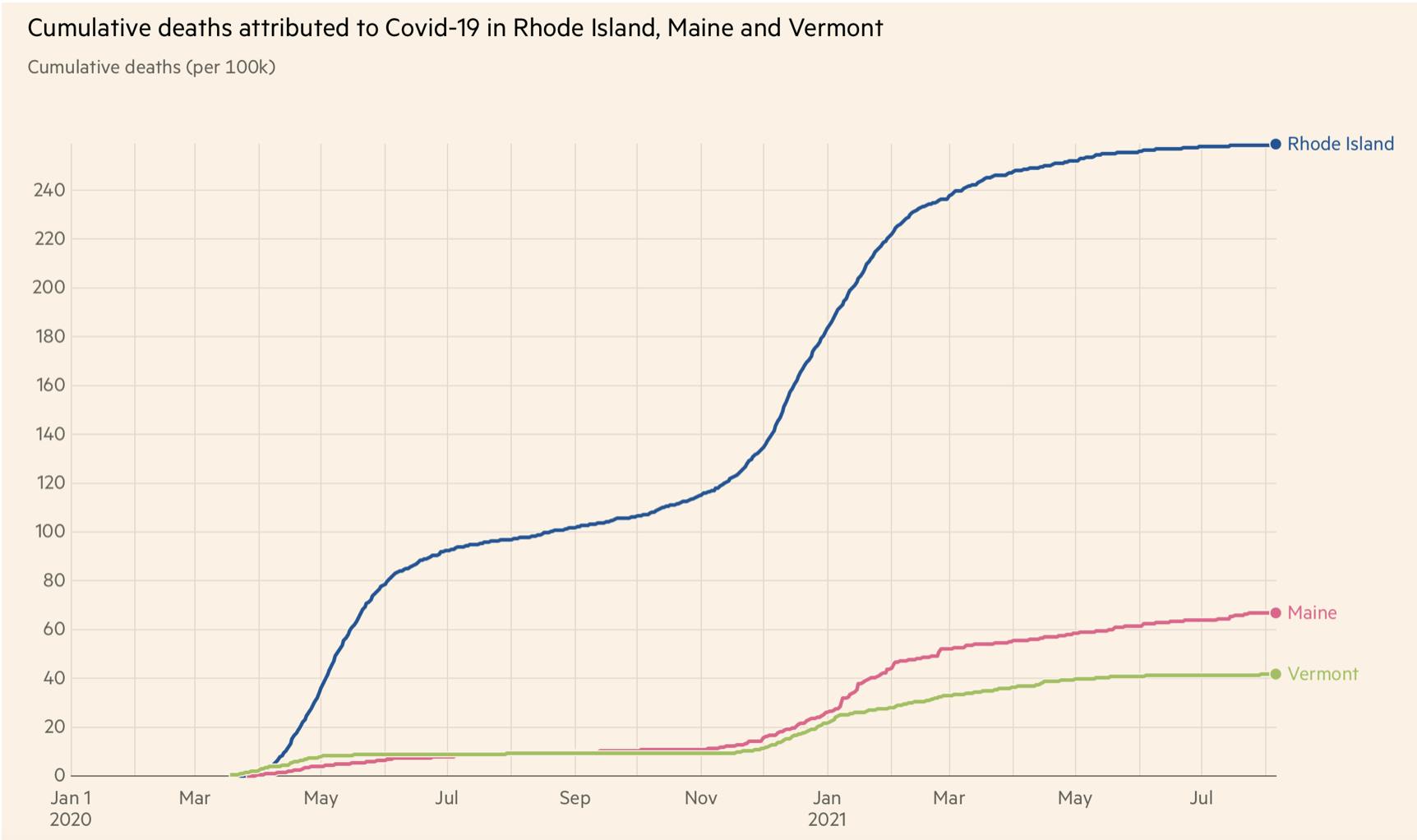
Instead of 2,743 Rhode Islanders killed by COVID, had we followed more prudent, science-based guidelines perhaps only 500 would have been lost. Over 2,000 more people may die than otherwise might have happened because of how Rhode Island had handled the pandemic. Rhode Island is the only state in the top 5 for both deaths and cases.
Economic Impact
A reason often given by Rhode Island’s state leaders is that we cannot afford to protect health and lives against COVID because making money and jobs are more important.
Real-world experience shows that the interests of preserving health and life, and minimizing economic impact, are aligned and not contradictory. The following graph compares unemployment insurance claims between Rhode Island (in orange) with Maine and Vermont. At almost all times since the start of the pandemic, unemployment claims have been substantially higher in Rhode Island than in Vermont or Maine.
People go out and spend money not when they feel safe, but when they actually are safe to go to stores, restaurants, and bars without having to fear for their health and lives. In Rhode Island, neither jobs, nor our health and lives, have been protected.
Businesses understandably want to go forward and continue to make money. But the status quo in Rhode Island isn’t working.
Risk Level
All of the major public health agencies currently rate Rhode Island at either the very highest or second-highest level for risk of infection.
Rhode Island Department of Health: High Transmission
Centers for Disease Control: High Transmission
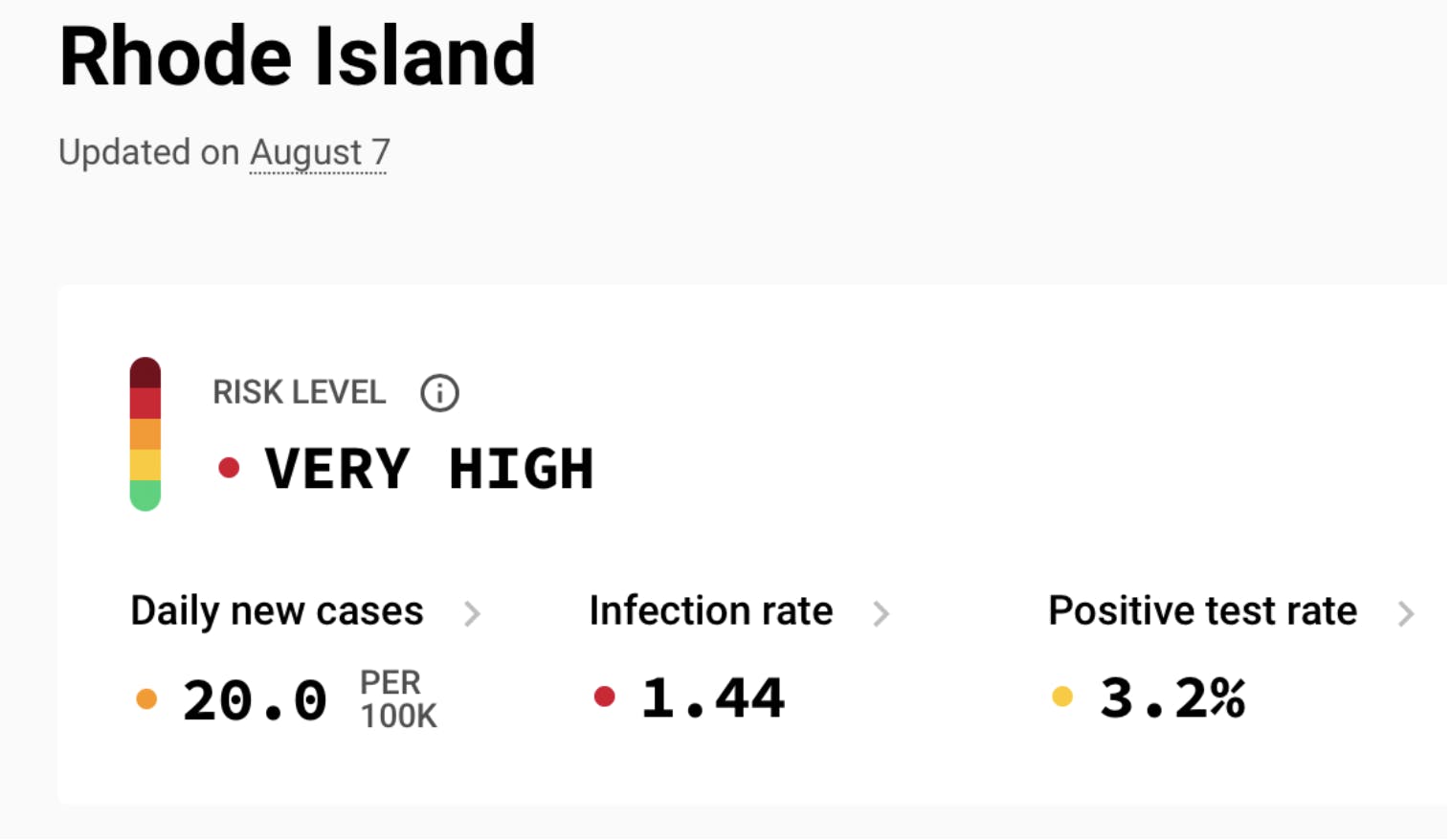
covidactnow.org (a consortium of Harvard Global Health Institute, Stanford University, and Georgetown University): Very High (approaching Critical).
Rhode Island is the only New England state ranked at the highest level of infection risk by the CDC.
Why Is Rhode Island Doing So Poorly?
Prior analysis suggests Rhode Island’s poor pandemic performance is not because of ‘density’, ‘age’, or ‘nursing homes’. There are more densely populated places (New Jersey, and most major metropolitan areas), states with older populations (Vermont, Maine, Connecticut, New Hampshire, and others), and areas with fewer nursing home residents infected (most places), than Rhode Island that have had much lower infection and death rates https://www.golocalprov.com/news/what-went-wrong-in-rhode-island-with-the-covid-19-pandemic
The problem in Rhode Island has been bad management and decision-making by our elected leaders.
Yesterday Rhode Island reported 298 new cases, a 7-day average of 212. This is the same range as April-May of last year during the first surge of the pandemic. At that time numerous public health measures were being implemented to reduce infections and save lives, which worked to bring cases down by summer. The growth in in new cases over the past 30 days has been more than twice as fast as at any other comparable time period since the start of the pandemic.
Yet now nothing is being done by our state leaders, and it’s left to businesses, schools, and individuals to figure things out for themselves.
This hands-off approach by our state leaders is an abrogation and abandonment of responsibility. Following Florida’s example and in Ron DeSantis’s footsteps is not the way to protect our health and lives.
Some people seem to take comfort in saying ‘but all the restaurants and bars are full’. This suggests a willingness to accept high infection and death rates - as long as it’s happening to someone else. The reason we are experiencing the atrocious skyrocketing of new infections is because the restaurants, bars, stores, and other indoor spaces are full of unmasked people, and so many are still unvaccinated. Unfortunately, the Delta variant is so highly contagious and spreading so fast that at this rate, unless significant steps are taken immediately, it is likely everyone will be exposed.
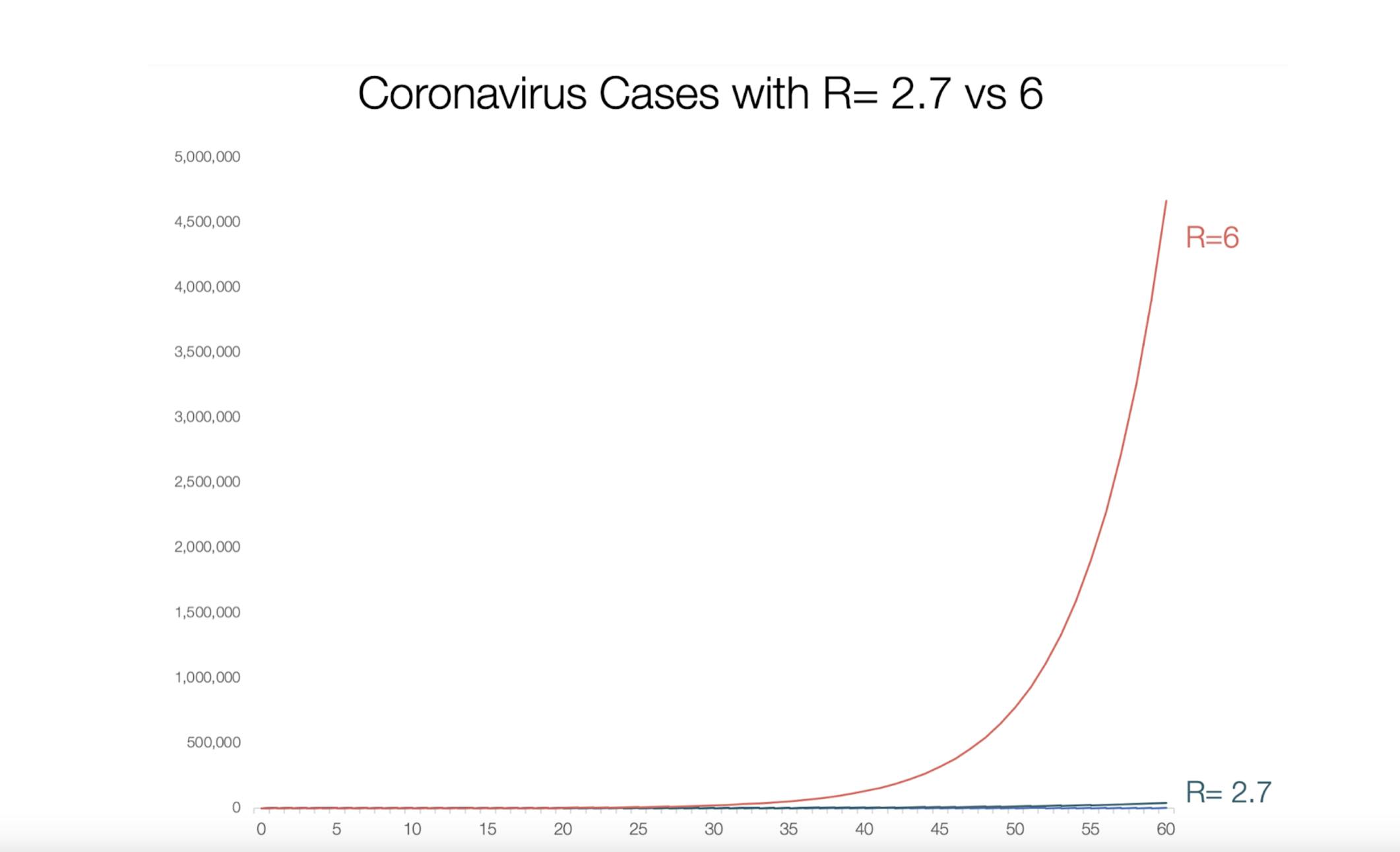
In epidemiology, the R0 (“R naught”) is a measure of how many cases of infection will be generated by one infected person. The R0 for the original SARS-CoV-2 strain is estimated at about 2.3-2.7. That is, each person infected ultimately creates about two and a half cases. If R0 is larger than one, the number of infected people will keep growing exponentially until all susceptible people have either died or recovered and ‘herd immunity’ is reached.
The situation is very different with the Delta variant. It is so much more contagious the R0 is estimated at somewhere between 5 and 9. The following graph projects the differences in infection growth between the original coronavirus strain and the Delta variant:
Governor McKee seems to think we are ‘doing OK’, and that we are ‘not going to take a step back’ https://turnto10.com/news/local/mckee-likely-to-address-high-transmission-of-coronavirus-in-rhode-island.
If having one of the highest COVID death rates, infection rates, and increases in new infections is ‘doing OK’, I would hate to see what doing badly looks like. We may be doing OK at the moment with hospitalizations and deaths, but with new COVID cases soaring, the warning signs are clear for what lies ahead. This kind of leadership may lead us all into a hospital, or a graveyard.
If you don’t want to be a subject in an experiment to see what the Delta variant - and the even more serious variants coming after it – might do to you, the time to take action is now before infection rates are again as wildly out of control as they were this past winter. We cannot wait until every hospital bed is filled and we are once again on the brink of collapse.
There are no simple, easy answers to winning this war. Governor Raimondo seemed to think the solution was to do lots of testing. While testing is crucial, not doing anything with the information didn’t solve anything, and we ended up in a mess. Now Governor McKee appears to be placing all hopes on vaccination, even though it’s painfully clear that vaccination alone is not enough, especially against the Delta variant.
In the meantime, there are steps we can each take on our own to improve our chances. Get vaccinated. Wear masks indoors where other people are around. Get tested regularly whether you feel symptoms or not. Think carefully if you really need to travel right now.
Nick Landekic is a retired scientist and biotechnology executive with over 35 years of experience in the pharmaceutical industry.