State Budget: 'Double Killer' for Schools
Stephen Beale, GoLocalProv News Editor
State Budget: 'Double Killer' for Schools

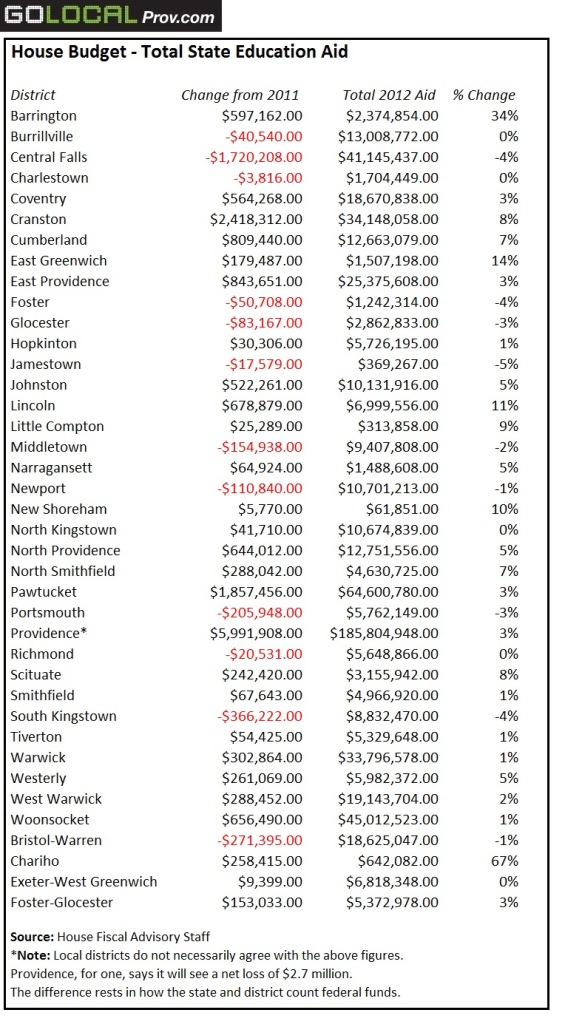
The House version of the budget—which makes some significant changes to what Governor Lincoln Chafee proposed—was released just one week ago, leaving little time for districts to make course corrections with the new fiscal year just a week away, said John Pini, executive director of the Rhode Island School Superintendents Association.
“It’s very difficult to make adjustments at this time of year,” Pini said.
GET THE LATEST BREAKING NEWS HERE -- SIGN UP FOR GOLOCAL FREE DAILY EBLASTState and local education officials pointed to the implementation of the new school funding formula and what is technically an across-the-board cutback in state aid as two driving forces in the school budget crunch. “If [the school districts] took anything but an ultra-conservative approach to their budget, this thing is a double-killer,” Pini told GoLocalProv.
Under new funding formula, even the winners lose
The upcoming school year makes the first time that the state is following a funding formula that is based on student enrollment and the poverty level of a district. “With the funding formula, they’re winners and losers,” said Frank Flynn, president of the state chapter of the American Federation of Teachers. “I think it’s tough to adjust the budget. [School districts] are looking at it as a cut.”

The formula may be fair, but the timing is not, said Cranston Schools Superintendent Peter Nero.
He said the losing districts are taking the hits at a time when the state is still in the throes of a recession—even though the cuts are phased in over a decade. As for the winning districts, such as his, the increased state funding is trickling in over seven years—too slow to help.
“Had the funding formula been done four to five years ago, right now we’d be doing well,” Nero said. “But it’s going to take too long to satisfy our needs.”
In Cranston, the elementary school enrollment has gone up by about 400 students and the number of schools classified as having at least 40 percent of their students coming from low-income households has more than doubled, from four to 11, according to Nero.

Debate over federal funds
Another sticking point for districts is federal education jobs funding. The House budget takes the amount each district is receiving for both 2011 and 2012 and subtracts that amount from how much the state will give to the district.
In theory, it should come out even. But the House “assumes that districts will carry forward their FY 2011 allocation for use in FY 2012,” according to an official summary. If districts failed to save those federal jobs funds, Flynn said they could indeed face a “double hit” in their budgets next year: a reduction in state aid and an absence of federal funds to make up the difference.
Berman rejected talk of a double hit.
“It’s not a double hit,” Berman told GoLocalProv. “When the Governor proposed his budget to the General Assembly in March, he took note of that fact that the school districts received $32 million in federal stimulus dollars, so he reduced the state aid that they would be getting by that amount. Their budgets still stayed the same; it’s just that we used federal dollars instead of state dollars.”
But the state’s largest school district is counting that as a net cut.

O’Reilly said the district was already expecting a net loss of $2.5 million under Governor Lincoln Chafee’s budget. “So it is a little bit of an additional hit, but certainly we were braced for cuts,” O’Reilly said. “It would be premature to say where the additional [money] would come from, but in the scheme of things it’s not an enormous amount.”
Union president: School budgets down to the bone

As a result, he said districts are being forced to eliminate music and sports programs along with programs for gifted students. “They’re expendable because they’re not mandated,” Flynn said. Another consequence of budget reductions: larger class sizes and schools where teachers have to spend their own money to buy supplies, according to Flynn.
One district that has been making cut after cut is Bristol-Warren.
“It’s constant,” said Pauline A. Silva, the Director of Administration and Finance. “I’m constantly looking for ways to make the district more effective, more efficient, and to have the least impact on children.”
In the current year, the district has trimmed its staff by 19 positions, with 3.5 more positions on the chopping block for next year. Changes to health insurance plans have lowered costs by 38 percent and increased co-shares have saved $140,000. Apparently few stones have been left unturned: A change in bus routes eliminated one bus that would have cost $52,000 and a renegotiated contract with the company that services the district’s copy machines netted another $36,000.
“The district is committed to having the least impact on children,” Silva said. “Yes, it is ugly for adults. Yes, it’s going to get uglier for adults.”
If you valued this article, please LIKE GoLocalProv.com on Facebook by clicking HERE.