


Tom Sgouros: Occupy Movement is on Right Track
Tom Sgouros, GoLocalProv MINDSETTER™
Tom Sgouros: Occupy Movement is on Right Track
I went down to Kennedy Plaza in Providence on Saturday, to see the Occupy Providence protest, march, and encampment. It was a pretty exciting scene, with well over 1300 people marching (see below). My favorite signs: "I'm here for my grandchildren"; "End anti-intellectualism"; and "We did not spend our way here -- We were robbed." The march left Burnside Park in Kennedy Plaza and toured all over downtown -- making stops at Textron, Bank of America, and the state house, before returning to the park.
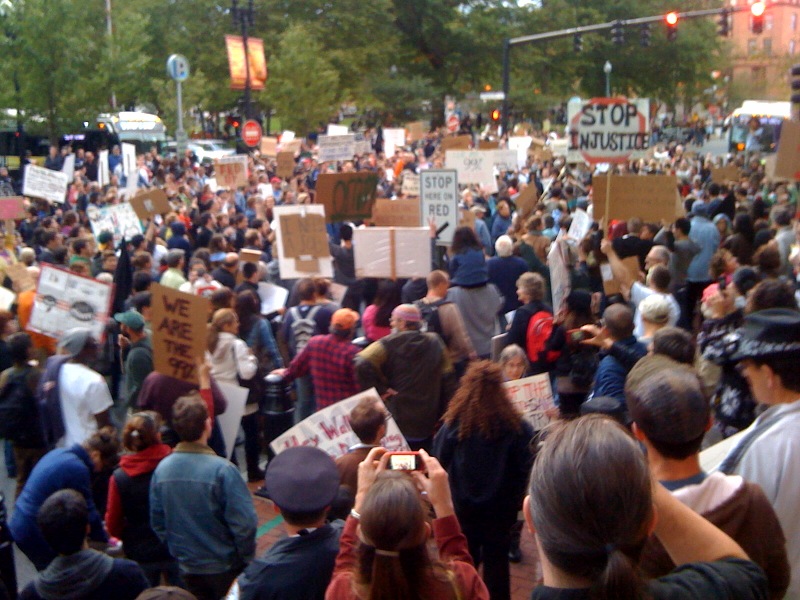
The crowd was large and exhilirating in a variety of ways, and it's great to be in the company of people so united, but it's not for the sake of idle fun that people come out like this. These protests have a legitimate set of grievances that neither of our great political parties is doing much to address. The power of corporations over our public life and the misidentification of those corporate interests with the interests of our democracy is a big part. The failure of our economy to provide opportunities for earning a living to many of our citizens, and the failure of our political class to respond effectively is another. The contrast between these and the skyrocketing salaries for CEOs, bankers, and Wall Street money managers only makes the failures cut deeper.
Other protests
You'll hear bad comparisons between these protests and the Tea Party protests. There are important parallels between them: both are fueled by people who (accurately) see their horizons needlessly blocked and who (accurately) see expenses rising and know that life in a rich country need not be so straitened. I think it's important to see that both groups are part of the "99%" referred to in the Occupy protests.
GET THE LATEST BREAKING NEWS HERE -- SIGN UP FOR GOLOCAL FREE DAILY EBLASTThe big difference I see is that the Tea Party leaders -- the organizers, corporate funders, and Fox News hosts who did so much to drive turnout to the early events -- see government as the only possible source of oppression and see salvation in the private sector, while the Occupy movement sees oppression -- and salvation -- in both the private and public sectors.
A simple call for spending less on government can feel good, but how does it help defend us against the depredations of our financial industry? During the financial crisis of 2008, Lloyd Blankfein, then CEO of Goldman Sachs, stood up in a meeting room at the New York Fed on one of those Sunday emergency meetings that fall and essentially threatened to bring down the entire American insurance industry, apparently for no other reason than that it was a useful hostage to use to extort even more money from the US Treasury. He was quite correct in thinking that a bailout by the Treasury would be much more profitable to Goldman than a workout of AIG's debts in a more orderly fashion. No one doubted he'd do it even though Goldman was going to do fine either way. In a despicable way, perhaps it's appropriate that so much of that bailout money went straight into colossal bonuses for Blankfein and his pals. How, exactly, does a simple call for less government prevent bankers from amassing and abusing that kind of power again?
But in many policy areas, our government is far too weak: I want a strictly regulated financial market because I don't ever want to lose my savings or my insurance coverage to operators as unscrupulous as Blankfein. I want more careful oversight of Monsanto and other ag giants because I don't think their profit interests are well aligned with my interests in the health of our planet. I want more intervention in the health insurance market because I don't trust that the CEOs of Rhode Island Hospital, United Health, Pfizer, Glaxo Wellcome, and all the rest have my family's best interests at heart.
Why are we so weak?
The weakness of our government in defending my interests is mostly due to the wealth of the lobbies interested in weakening it. The obvious manifestation is campaign donations to politicians interested in preventing good regulation. The less obvious way is support for groups that splinter the unity of people whose lives would be helped by more effective government. Compare Rick Santelli's famous tea-party-founding rant about not wanting to pay his neighbor's mortgage to the Occupy movement's insistence that "We are the 99%."
There is a lot to be unhappy about with the state of politics in America today. The only way forward is to recognize all of our common interests in building a world where hard work is rewarded and a decent and dignified living is possible for all of our citizens. What we need in our country not just more democracy, but also the acknowledgment that our divisions often prevent the achievement of that democracy. The Occupy movement seems on the right -- inclusive -- track to me. See you around the park.
Note 1: To support the Occupy Providence effort, stop by and talk with them some time. Or check out occupyprovidence.com where you'll find ways to help that might not involving sleeping out in the park.
Note 2: I was pleased the march decided to go down Westminster Street at one point. Why? Because Westminster Street is a narrow street, so the march strung out, and could be counted. I timed how long it took the march to go past me, and during that 4 minutes and 37 seconds, I counted the number of people who passed the lamppost across the street every 10 seconds. Getting a good number is hard to do, but I enlisted the aid of a few people and after a few trials, the four of us agreed that it was at least 40 people. This makes 240 people per minute or about 1,108 people who passed while I was timing. I started a minute or so from the front of the parade so that's another couple of hundred or so, so there you have my estimate: 1,300 people, minimum. I'd also add that the crowd seemed to swell as we marched further, though I didn't find another chance to count.
Note 3: One last pleasant note is that I owe a compliment to the police on their good humor and patience on Saturday. Here's hoping they can make it last.
Tom Sgouros is the editor of the Rhode Island Policy Reporter, at whatcheer.net and the author of "Ten Things You Don't Know About Rhode Island." Contact him at [email protected].
If you valued this article, please LIKE GoLocalProv.com on Facebook by clicking HERE.