


Violent Political Rhetoric and Political Violence - Mackubin Owens
Mackubin Owens, MINDSETTER™
Violent Political Rhetoric and Political Violence - Mackubin Owens

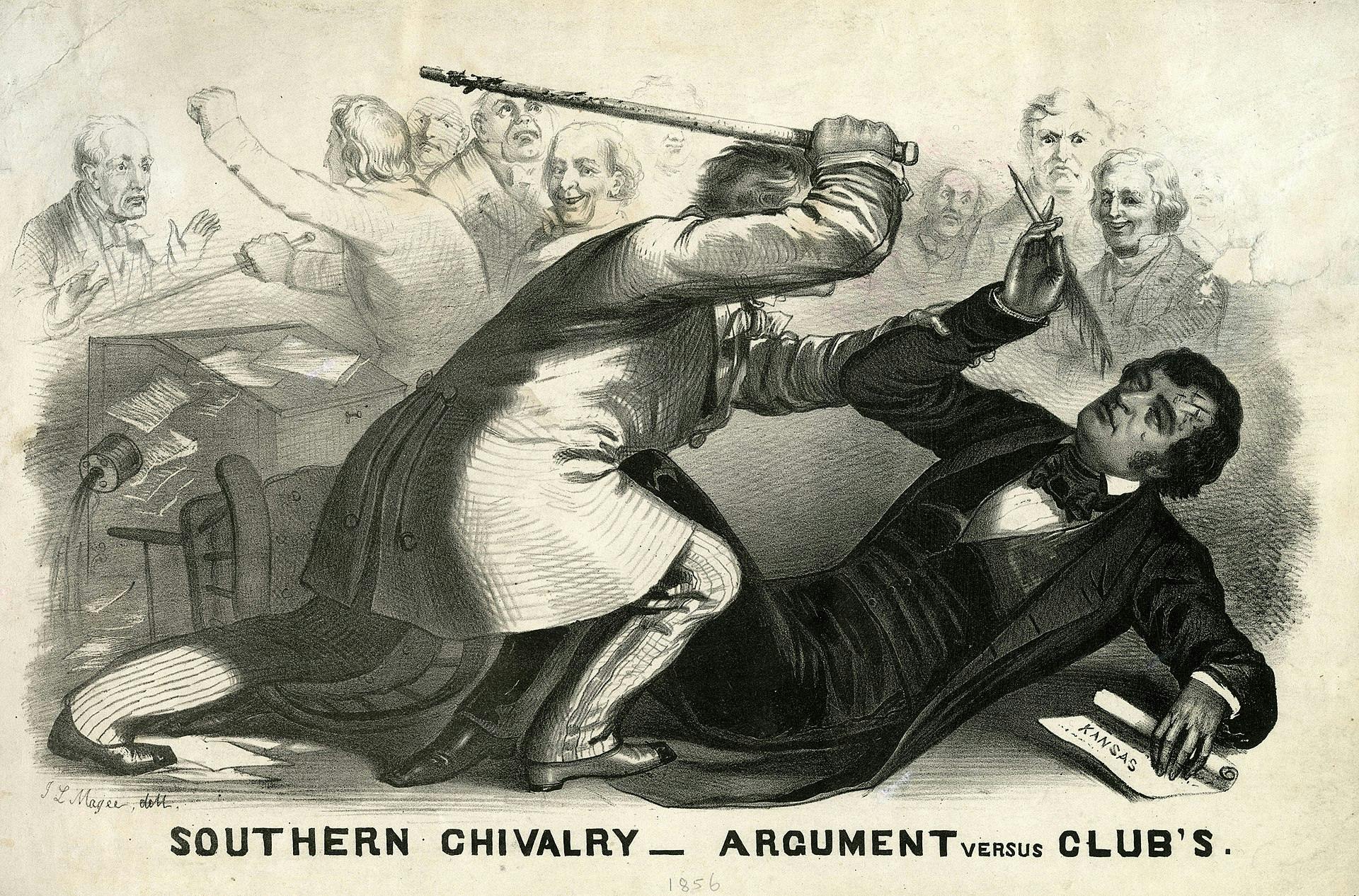
Brooks’ attack of course represented a microcosm of the passions that were dividing the country at the time. Five years later, the country would descend into four years of bloodletting, pitting Americans, who were no longer fellow citizens, against each other.
GET THE LATEST BREAKING NEWS HERE -- SIGN UP FOR GOLOCAL FREE DAILY EBLAST
Politics and rhetoric are inextricably linked. Aristotle wrote treatises on both, observing that the purpose of rhetoric is to persuade others. He, like the American Founders, understood that good rhetoric, which appeals to the reason, not the passions, of fellow citizens, is a necessary condition of republican government. One thinks of Washington’s Farewell Address or Lincoln’s Second Inaugural. But the slavery debate had unleashed the passions. And the country would pay the price in a terrible civil war.
Although today, some speak of a “cold civil war,” we have not reached the level of political polarization that prevailed during the run up to the Fort Sumter--yet. Nonetheless, intemperate speech is increasingly a part of today’s political landscape, and as the attempted assassination of former President Donald Trump may suggest, such speech can have serious consequences.
Many blame Donald Trump for today’s incivility and intemperate speech, but these problems predate his presidency. While Trump has not hesitated to mercilessly mock his political opponents, to my knowledge he has not attacked Democratic voters in the way Democrats have attacked Trump voters, most notably dropping what my friend and former colleague, Steve Hayward, calls the “F-bomb”: the claim that Trump and his supporters are “fascists.” We can harken back to President Biden’s Philadelphia speech in September of 2022, when he labeled “MAGA Republicans” as extremists and enemies of democracy who “embrace anger…thrive on chaos… [and] live not in the light of truth, but in the shadow of lies.” In an earlier address, he had claimed that “It’s not just Trump, it’s the entire philosophy that underpins [MAGA]— I’m going to say something, it’s like semi-fascism.”
As I have argued before, “fascism” has become a mere epithet, a slur directed at the political opponents of the Democratic Party. But the term has both a real meaning and a history. The intellectual father of fascism is the Italian, Giovanni Gentile. Born in 1875, Gentile was one of Europe’s most influential philosophers during the first half of the twentieth century.
In keeping with the mainstream view of European continental political philosophers such as Hegel, Gentile believed that the modern state represented the culmination of history. Gentile contended that all private action should be oriented to serve society; for him, there was no distinction between private and public interests. Indeed, correctly understood, the two are identical. Since the state administers all aspects of society, to submit to society is to submit to the state in all matters.
Of course, it was Gentile’s philosophic disciple, Benito Mussolini, a former socialist, who actualized Gentile’s words. In his Dottrina del Fascismo, one of the doctrinal statements of early fascism, Mussolini wrote, “All is in the state and nothing human exists or has value outside the state.” German fascists, who called themselves “national socialists,” contracted to “Nazi,” followed a similar path. But the idea that the state should dominate society is completely foreign to any Republicans that I know.
But the demonization continues. Trump supporters are fascists and Trump is Hitler. And if we believe that our opponents are not just wrong, but evil, violence against them is an acceptable response. Intemperate language inflames the passions, the enemy of a republican government. As Hosea warned, those who sow the wind will reap the whirlwind.