


What RI's New Education Commissioner Infante-Green Needs to Do to Turn RI's Schools Around
GoLocalProv News Team and Kate Nagle
What RI's New Education Commissioner Infante-Green Needs to Do to Turn RI's Schools Around
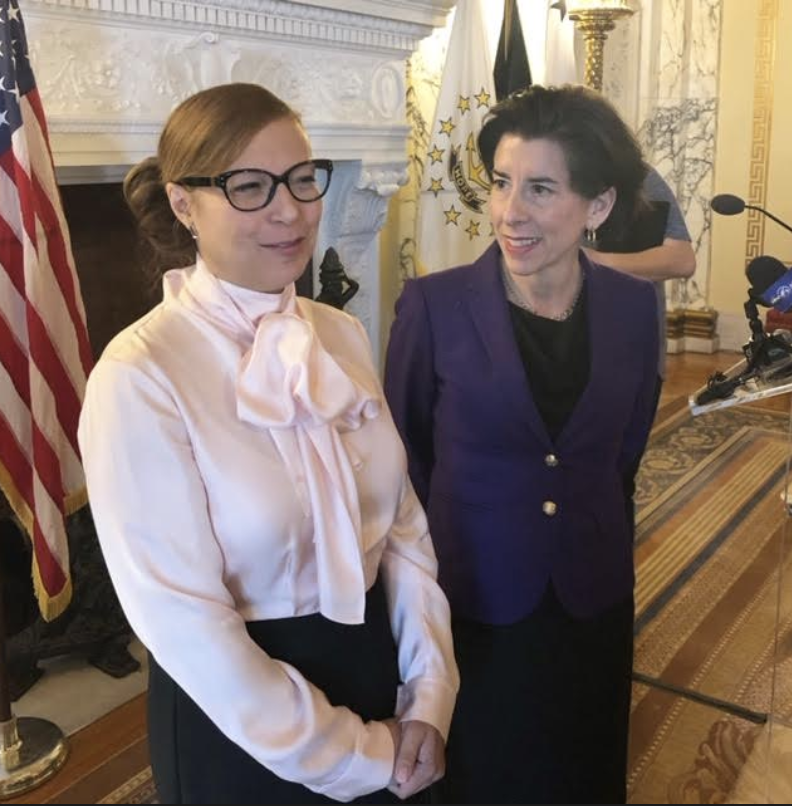
How can Infante-Green turn Rhode Island’s education system — and performance — around? In December, two top Rhode Island leaders said there is a need for emergency action to reform Rhode Island’s underperforming schools.
GoLocalProv.com reached out to a range of educators and opinion leaders for their thoughts and advice for Infante-Green, who succeeds Commissioner Ken Wagner who will be stepping down at the end of the month.
GET THE LATEST BREAKING NEWS HERE -- SIGN UP FOR GOLOCAL FREE DAILY EBLASTSEE WHAT EXPERTS SAY BELOW
From addressing achievement gaps, to the role of public charter schools in the state, to whether or not Rhode Island needs a constitutional right to an education — which the Rhode Island House Committee on Health, Education, and Welfare will consider next week — Infante-Green faces a wide range of challenges — and opportunities.
Jennifer Wood with the Rhode Island Center for Justice was part of the group that filed a federal lawsuit last December for a constitutional right to an adequate education.
“Rhode Island's new education commissioner will take on her role at a time when students, families, policymakers and elected officials are truly alarmed at how student success in Rhode Island is lagging behind that in our neighboring states. This presents her with a real opportunity to mobilize all of us for meaningful change,” said Wood. “The R.I. Center for Justice, along with other attorneys, has filed suit in federal court on behalf of a group of students and their families, representing all public school students in Rhode Island, who share this alarm at the lack of support provided in most of Rhode Island's public schools to prepare public school students for full and robust participation in civic institutions like voting, serving on a jury, running for office, and exercising free speech rights, just to name a few.”

“[Infante-Green] can support the School Committee Association’s legislative efforts to make education a Constitutional Right for all children. Massachusetts recognized this as a right in 1993, and since then they have turned a mediocre school system into one that is recognized as the best in the nation," said Tim Duffy with the Rhode Island Association of School Committees. "In 1995 our Supreme Court found 'there was no requirement that public education be provided at all in this state.'”
Infante-Green, who is the first Latina and the first woman of color to lead the Rhode Island Department of Education, said the following at her confirmation by the Council of Elementary and Secondary Education in March.
“I am honored, humbled, and excited to be joining the team in Rhode Island, and I want to thank Governor Raimondo and the entire Board of Education for their support. I look forward to their continued partnership as we move forward,” said Infante-Green. “We have significant challenges ahead, but I know that if we work together and engage our communities in this critical work, we can move forward on a strong, unified, long-term strategy to improve outcomes for our kids. All school can – and must – improve, and I am ready to hit the ground running on this statewide effort.”
What RI's New Education Commissioner Can Do to Turn RI Around - APRIL 2019

Gina Raimondo
Rhode Island Governor
Investing in high-quality curricula and supporting schools in their adoption and implementation is one of the most impactful things we can do as a state. Commissioner Infante-Green is eager to capitalize on the foundation that has been laid and plans to scale up that work until every student in the state has access to high-quality curricula.
The Commissioner has a proven record of engaging and mobilizing students, families, and communities, and this will be key to her strategy coming into Rhode Island. When we elevate the voices of parents and students, we create an educational system that is more responsive and sustainable.
Commissioner Infante-Green also has extensive experience working with multilingual learners and differently abled students, and she has been clear that increasing equity for these students, and for all students, will be among her top priorities.

Tim Duffy
Rhode Island Association of School Committees
Support the School Committee Association’s legislative efforts to make education a Constitutional Right for all children. Massachusetts recognized this as a right in 1993, and since then they have turned a mediocre school system into one that is recognized as the best in the nation. In 1995 our Supreme Court found “…there was no requirement that public education be provided at all in this state.”
Examine if school choice is working. For the most part charter schools failed to outperform their counterparts on RICAs. The State and its municipalities should take a closer look at the cost of running parallel school systems. Moodys Investors urged the defeat of charter expansion in Massachusetts as it would prove to be a credit negative for the communities involved. Providence might want to consider getting a Moodys opinion, before letting Achievement First expand or allowing the approval of any new charters. The charter school formula also needs to be addressed. They receive per-pupil funding associated high-cost Special Education but do not accept any of those students. The Governor’s FY 2020 budget has $4.5 million for high-cost special education reimbursement, but Charters will receive less than one-tenth of one percent of those funds.
Take steps to ensure choice programs are not leading to the resegregation of public schools. CTE Pathways programs and many Charter Schools are woefully underrepresented when it comes to minority students and students with IEPs. Students that lack transportation to Career Tech programs offered in outside districts are being left behind.

Maribeth Reynolds-Calabro
Providence Teachers Union
I think one of the first priorities is to address the significant teacher shortage in our state by improving upon our “grow your own programs” like the one at Mt Pleasant High School.” We further need to incentivize our students of color to follow that path, and provide financial assistance for school as well as affordable housing upon graduation. In keeping with that theme we need to engage the Higher Ed partners in graduating market-able educators with degrees in hard to fill areas and elementary teachers with EL certificates and or Spec Education certificates.
In terms of teachers who currently have positions in order to support and educate our ever-changing and diverse population we need to be provided affordable, reasonable opportunities to obtain certifications to teach our multilingual learners as we receive more each day.
Another priority would be to develop a strategic education plan for 3,5 and 10 years so that regardless of who is sitting in the seat the work gets done — and then stick with it- like Massachusetts’s did, let’s look at everything that works there AND what isn’t working and make a plan for RI.
Finally, we need a Board of Ed that actually has educators on it - not just 3 token educators the whole Board and business and industry and political leaders can attend meetings and be on committees in an advisory capacity. Last time I checked no educators sit on the law review board, or the medical review board - why is the expectation different for educators?

Gary Sasse
Former Director of Administration and Founding Director of the Hassenfeld Institute for Public Leadership at Bryan University
Place emphasis on high student performance and outcomes, by adopting non-negotiable targets and measurements of student progress.
Review the school aid formula focusing on improving equity including adequately funding ELL students.
Implement a “Marshall Plan” for improving urban school including making access to an adequate education an enforceable constitutional right.
Establish and enforce a Student Bill of Rights

Karla Vigil
EduLeaders of Color Rhode Island
Advocate for policies and initiatives that support the increased recruitment and retention of educators of color such as proactive hiring and on-boarding processes and Grow Your Own programs.
Establish an active external affairs role/office that focuses on family and community engagement; resource and information dissemination; and strategies and advice to advocate for their students and navigate the education system. Research suggests that strong family and community engagement efforts improve student performance and educational outcomes.
Prioritize supporting school and district leaders in developing teacher capacity and strengthening cultural competence. As schools grow increasingly diverse in terms of race and ethnicity, strong leadership focused on improving the educational outcomes of historically marginalized communities is imperative.
Photo: YouTube

Neil Steinberg
Rhode Island Foundation
We look forward to welcoming Commissioner Infante-Green. Her experience, background and passion appear to be the right combination to lead arguably the most important statewide effort we can focus on – educating our children by taking the public pre-K-12 system to the next level.
We look forward to engaging with her as a member of the long-term education planning committee that we pulled together late last year. By learning from the work that Massachusetts and other states that have higher student achievement levels undertook and committed to and by incorporating their own experience and expertise, the group is having substantive conversations about the challenges in distributing resources equitably, the importance of aligned curriculum, governance, teacher development and early learning. The group is also committed to engaging and empowering educators, parents and students to help shape these experiences.

Elizabeth Burke Bryant
Rhode Island KIDS COUNT
Closing unacceptable, wide and persistent gaps for students of color, low-income students, students with disabilities and Multilingual/ English Language Learnings must be Rhode Island’s most urgent educational priority. Three steps Commissioner Infante-Green can take during her first year to address these gaps are:
Provide school districts resources to choose high-quality, evidence-based curriculum that is aligned to standards and allow districts to stick with it. RIDE began this work by conducting a survey of district Reading and Mathematics curriculum materials used in grades K-8. The survey revealed that math curriculum rated as meeting high-quality expectations is used in 39% of districts in grades K-5 and 5% of districts in grades 6-8; for reading, only 9% of districts use a curriculum rated as high-quality in grades K-5 and 5% of districts for grades 6-8. Take these research findings to the next step by providing resources for districts to choose high-quality curricula that support student learning and teacher instruction.
Support the recruitment and retention of a diverse pool of educators and improve educator cultural competencies. Rhode Island’s student population is increasingly diverse, yet only a small fraction of RI teachers are teachers of color. Data is needed to track the number and percentage of teachers of color. In October 2018, 57% of Rhode Island public school students were non-Hispanic White, 26% were Hispanic, 9% were Black, 3% were Asian/Pacific Islander, 4% were Multi-Racial, and 1% were Native American. Our educators and school leadership should reflect the rich diversity of the children they serve. All educators need training in cultural competencies to reduce significant disparities in suspension rates and decrease barriers between parents, communities and schools. Ensure that the voices of students and parents are at the table and that decisions are made through the lens of equity.
Provide resources and support to districts to adequately address the needs of Multilingual/English Language Learners.
Photo: YouTube

Mike Stenhouse
RI Center for Freedom and Prosperity
While there has been much discussion about the process and the personal qualifications of the commissioner, and while there is great desire for a way out of Rhode Island’s dismal public educational system, there has been far too little discussion on the policies Ms. Infante-Green may actually support.
Our Center would like to know if she is willing to stand up to the teachers unions who have blocked most all meaningful reforms in recent decades. Will the commissioner turn a blind eye to the ongoing assault on charter schools? Or does the commissioner support expanded school choice, such as increasing the corporate tax credit scholarship program and creating publicly funded educational scholarship accounts for students and families who want to escape under-performing schools?
The future and lives of our students – and the well-being of our state - are at stake. Immediate options are needed for families that cannot afford to wait for vague promises of reforms that may take many, many years to materialize. We hope the commissioner will work with our Center in advancing these specific reforms.

Kristine Frech
Teach for America Rhode Island
Teach For America Rhode Island is thrilled to welcome Commissioner Angélica Infante-Green to Rhode Island’s educational community. From her time in the classroom as a member of Teach For America’s New York corps to various district leadership posts, she has been a tireless champion for change in pursuit of educational equity for more than two decades. As Commissioner Infante-Green begins work in the Ocean State, Teach For America would encourage her to consider the following priorities: multi-lingual learners, diversifying the educator workforce and building connections between K-12 and post-secondary education institutions.
Rhode Island’s largest growing student population includes multi-language learners. However, our current educational system is not equipped to holistically meet their specific needs. We need competency based certification programs to prepare educators to lead classrooms of multi-language learners as well as a funding mechanism to support multi-language learner’s educational trajectory.
Study after study proves that all children benefit from learning from diverse teachers. Rhode Island’s teacher workforce is not only suffering from a lack of secondary STEM educators, but also from a lack of leaders of color. Children across Rhode Island deserve the best teachers, which includes educators that share their identity, cultural background and world view. We can and must do more as a state to diversify our teacher workforce.
All children deserve an education that prepares them for the college or career path of their choosing to as they leave high school. Right now, we have a lot of room to grow to create intentional and purposeful relationships between our K-12 and post-secondary learning institutions for programs like dual-credit learning and vocational opportunities.

Robert Whitcomb
GoLocal Columnist and Former Providence Journal Editorial Page Editor
What state has best model for what she needs to do?
What are her views on early childhood education?
Charter schools?
Collaboration with public and private colleges to improve public schools?
Her views of physical upgrades of schools, including equipment?

Jennifer Wood
Rhode Island Center for Justice
Rhode Island's new education commissioner will take on her role at a time when students, families, policymakers and elected officials are truly alarmed at how student success in Rhode Island is lagging behind that in our neighboring states. This presents her with a real opportunity to mobilize all of us for meaningful change.
The R.I. Center for Justice, along with other attorneys, has filed suit in federal court on behalf of a group of students and their families, representing all public school students in Rhode Island, who share this alarm at the lack of support provided in most of Rhode Island's public schools to prepare public school students for full and robust participation in civic institutions like voting, serving on a jury, running for office, and exercising free speech rights, just to name a few.
We welcome the new commissioner, Angélica Infante-Green, who has already publicly expressed her support for expanded programs for English-language learners, students with disabilities and other students who are often not placed at the center of concern and discussion. She is an experienced education leader and no doubt has given careful thought to how the Rhode Island public schools can serve Rhode Island students better. As part of that consideration, we hope she will be taking steps to address (1) the lack of meaningful instruction in civics and civic engagement for ALL students, (2) the pushing of civics, social studies and science to the periphery of the curriculum instead of using these rich content areas to reinforce and develop skills in numeracy, literacy and critical thinking and (3) examination of and solutions for the racial, socio-economic and other disparities and equity gaps for groups of students who are not thriving in our schools.

Rob Horowitz
GoLocal Columnist and Democratic Political Consultant
The most important step is to directly take on Rhode Island's culture of mediocrity in public education and set high expectations and standards, outlining a vision to achieve those standards. In George W Bush's famous words, the new Education Commissioner must reject the 'soft bigotry of low expectations."
Among the top priorities to address immediately is accelerating the recruitment and training of a sufficient number of teachers qualified to teach English Language Learners as well as working to incorporate the number of English Language Learners into the education funding formula to enable school districts to sensibly plan to meet this challenge: improving professional development and training for teachers to boost over-all quality, and emphasizing the recruitment of top-flight principals.


