


Whitcomb: Tourists, or Will They Stay? Take 50 Layoffs and Call Me in the Morning
Robert Whitcomb, Columnist
Whitcomb: Tourists, or Will They Stay? Take 50 Layoffs and Call Me in the Morning

“There is no physic
for the world's ill, nor surgery; it must
(hot smell of tar on wet salt air)
burn in fever forever, an incense pierced
with arrows, whose name is Love and another name
Rebellion (the twinge, the gulf, split seconds,
the very raindrops, render, and instancy
of Love).’’
-- From “Train Ride,’’ by John Wheelwright, (1897-1940), a Boston-based poet and architect. He was killed by a drunk driver at the intersection of Massachusetts Avenue and Beacon Street.
“A pessimist is a person who has had to listen to too many optimists.’’
-- Don Marquis (1878-1937), American columnist and playwright, among other things
“My reaction to porno films is as follows: After the first ten minutes, I want to go home and xxxxx. After the first twenty minutes, I never want to xxxxx again as long as I live.”
― Erica Jong (born 1942), American novelist and poet
Moving Around
A flamingo has been found wading along the shores of Dennis on Cape Cod! Parakeets, which, like flamingos, are mostly tropical and subtropical birds, have long been adapting to coastal southern New England’s climate, which has been warming. But the Cape’s flamingo may be a pioneer, and an entertaining supplement to those plastic flamingos on lawns.
(The parakeets often build thick nests on power lines near the heat of transformers to stay warm. Their adaptability is impressive!)
Presumably, we’ll see more avian and other nonhuman migrants from the south over the next few decades. And we’ll appreciate the birds’ vivid colors and, in the case of parakeets and other parrots, intelligence, even as some of us will be unsettled by what their arrival signifies. (Are the parakeets picking up New England accents?)
I’ll be worried if alligators come to be found in the swamps of New Jersey’s Pine Barrens.
Scarier climate migrants from the South are assorted insects carrying diseases, not to mention such venomous snakes as water moccasins. Watch where you step! Change is speeding up.
xxx
A strong memory from many decades ago comes up in early June: Literally sweating through final exams and papers because almost no schools or homes in New England had air-conditioning, and many shut for the summer later than they do now. All this was tinctured with a bit of unexpected melancholy that comes with important endings, even if not entirely pleasant experiences, such as the school year.
Going Private
Can/will states ban private equity ownership of something as essential to public health as hospitals? I assume not. Private equity operations saddle hospitals with huge debt and ferocious cost-cutting to achieve sky-high short-term profits for investors and maximum executive-suite wealth; their finances are often remarkably opaque. But what is clear is that they are often linked to bad patient care.
You might say the strategy of at least some of these private equity investors is to loot and leave. In any case, I’d guess that most patients would prefer not to use a hospital owned by speculators.
Here's a Harvard Medical School article:
A Food and Drug Administration committee has rejected the use of MDMA (aka Ecstasy), a psychedelic drug, to treat post-traumatic stress disorder, saying that the risks outweigh the benefits.
It reminded me of the enthusiasm for LSD and other mind-altering drugs back in the ‘60’s. They were supposed to change everything. Many will remember psychedelics promoter Timothy Leary’s line that if we just “Turn on, tune in, drop out’’ society could become paradisical. The idea that we can fix our thinking and the emotions it causes through chemistry is ancient, of course. The use of alcohol, caffeine, coca, “magic mushrooms,’’ etc., goes back thousands of years.
But the human brain is so complex that manipulating it is often problematic, and can cause problems worse than what chemical treatment was meant to address. Of course, even non-drug treatment, such as cognitive therapy, can change brain chemistry. We’re all chemistry sets. (It sometimes seems that there’s more craziness than ever these days, or maybe the media just makes us more aware of it.)
xxx
Some are pushing the University of Rhode Island to create a medical school to focus on producing primary-care physicians – by far the most needed doctors. What an intriguing idea.

This is an obvious conflict:
As of this writing, Paul Winspeare was not only the full-time human resources director of Providence, a good-sized city, but also the personnel director of little Georgetown, up on the Massachusetts North Shore, where he was reported to be paid $75 an hour to work 10-12 hours a week – at 12 hours a week that’s $46,800 a year.
(GoLocal first reported on this curious situation.)
Given the unpredictable nature of personnel work (worker disputes, hirings, firings, etc.), it strains credulity to say that his Georgetown gig wouldn’t sometimes interrupt his Providence work, mostly via phone and Internet. You might or might not agree that his $132,567.89 salary, plus benefits, is too low for his Providence responsibilities, which must be complex, but having another somewhat similar job at the same time isn’t right.
Many of us have or have had jobs on the side, but generally not those that are likely to often interrupt our main jobs during working hours. (I occasionally did publishing hack work on weekends and at night to help pay my bills while holding down a plus-9-hour-a-day job during the week.)
xxx

Here’s some explanation of what happened:
American politics are primarily based on trying to get through the next election. The winners for an elective executive position must try to get anything important but controversial enacted in the first months of their term, and then hope that voters will forget what they disliked about it.

Another restaurant has closed in Providence, at least in part because of the Washington Bridge closure mess. This time, it’s one of our favorites, Noodles 102, on Ives Street, in Fox Point, where our good friends Mustafa and Lisa Kuscu had been providing always delicious and indeed often exciting Asian food for 17 years, in a highly congenial atmosphere and at modest prices. It was a beloved neighborhood institution.
Restaurants are a tough business, and they can come and go fast. A certain fatalism is needed. Still, their demise can feel like the death of a friend.
xxx
As has long been the case in Europe, more and more restaurants are tacking (10-20 percent) tips (gratuities) onto your bill at restaurants. Some customers complain, accurately, that tips are a way for owners/managers to pay their employees less in wages.
I think that it’s a good idea to give people who have served you a little extra beyond a restaurant’s official gratuity, assuming that they did it well and at least successfully faked friendliness. But do it in cash, not via a credit card, so you know that the server will actually get it, and then ask her or him with a smile: “You report your tips on your tax return, right?’’
I know lots of timid people who tip too much, even after having received poor service, simply to avoid public unpleasantness.
This is summer resort season around here, and lots of young people are in service jobs to help pay for college, etc. Encourage them!
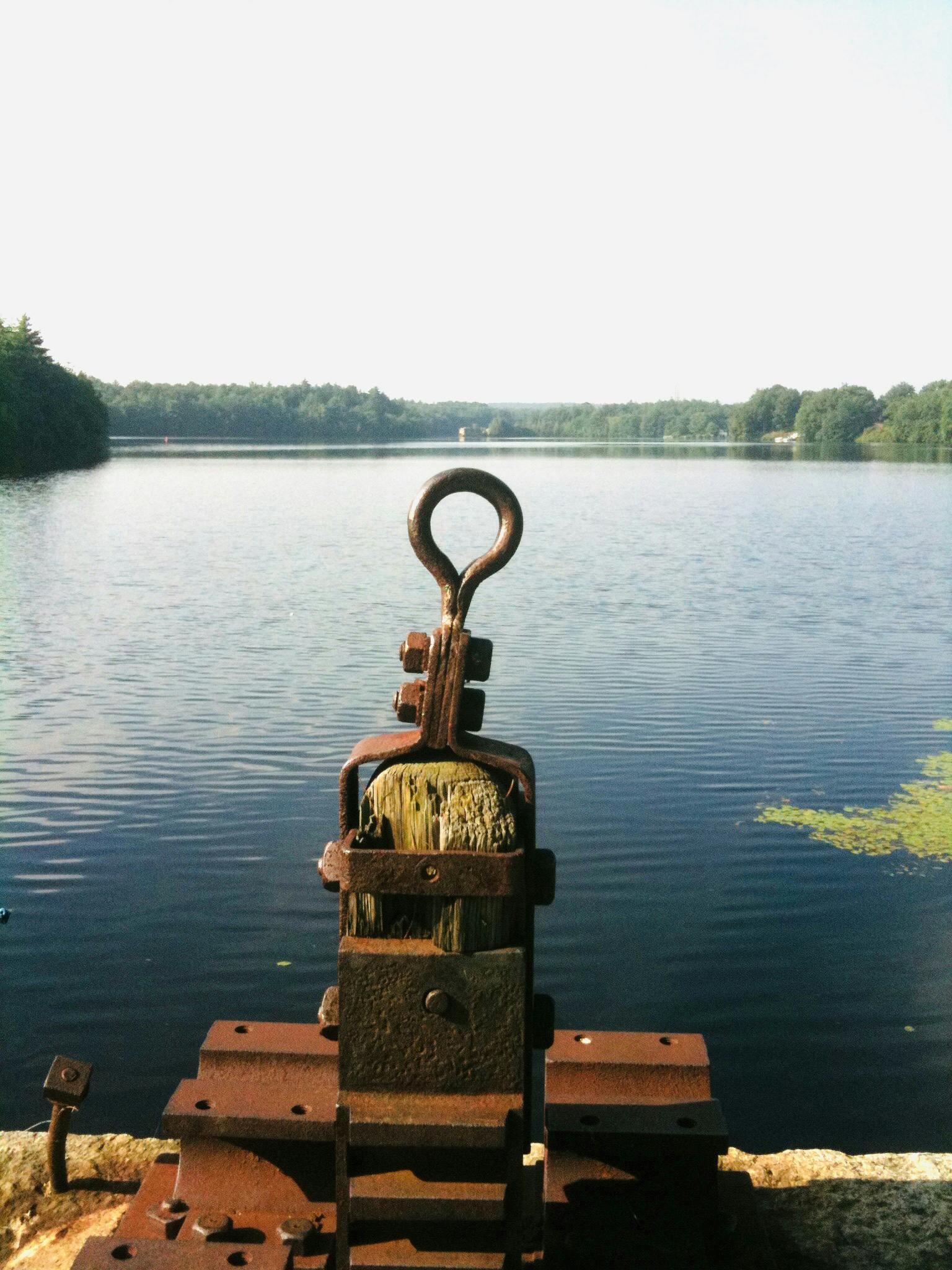
Here’s a quintessentially New England story about a heated debate in the Massachusetts North Shore town of Ipswich over whether to take down the Ipswich Mills Dam and fish ladder. The current dam was built in 1908, but there’s been a dam there since the 17th Century. It’s a reminder of the town’s industrial past. The idea, which seems to be supported by the majority of town residents, is to let the Ipswich River flow freely again, with associated environmental benefits, including better fishing and flood control.
But many love the pond that the dam created -- just to look at it and its waterfall, as well as for the skating and, I suppose, swimming, that it provided.
Lots of dams were built (and rebuilt) from colonial days to the early 20th Century to create waterfalls to power mills in New England towns large and small – at first to mill corn and for sawmills -- and many of us like those historic reminders, though few of the remaining mills serve any practical purpose anymore. But of course letting the rivers flow freely (when beavers allowed it), as they did when Native Americans lived along them, is much more “historic.’’
Clipping the Wings of an Autocrat
It was good news that the party of Hindu right-wing nationalist Prime Minister Narendra Modi did far less well than expected in the recent elections. Modi will remain prime minister, but his Bharatiya Janata Party will have to rule in a coalition. The authoritarian Modi’s wings have been clipped, and so India’s democracy, which Modi’s regime has eroded since he took power in 2014, now looks a bit stronger. This obviously is very important to the world.
Modi’s party is anti-Muslim, consistently promoting discriminatory policies against a religious minority of 200 million people in a nation with a staggering population of 1.4 billion.
The prime minister, a very smart, hard-working and highly successful xenophobic demagogue, has used his government to try to suppress his political foes and has raised piles of cash from anonymous sources doing business with the government. If he had succeeded in furthering cementing his power, many feared that would be the end of democracy in the world’s most populous country.
While Modi’s policies have helped create billionaires, hundreds of millions of Indians still living in poverty feel left behind. That’s another reason that Modi’s party didn’t do nearly as well as expected.
Happily, deep fakes and other AI pathologies don’t seem to have had much impact in the election campaign. Still, who knows what’s coming?
xxx
Armed with billions in investment money from foreign investors, especially the Saudis, Jared Kushner, whose father-in-law you may have heard of, is wandering the world looking to do deals. One that’s getting a lot of attention now is a big real-estate deal in Serbia, whose government is pro-Russian. But nothing so far will be comparable to the conveyor belt of deals he can look forward to if the U.S. presidential election goes his family’s way. Wielding the power of the White House and further family enrichment would become the same operation.
Day In, Day Out
More and more, I think that one of the best ways to understand history is to read the diaries/journals of people close to what movers and shakers, as well as everyday people, were doing. That’s especially true if the diarist is a clear, calm, psychologically astute and emotionally intelligent writer who plans to eventually have them published. And the high-quality gossip certainly can be a lot of fun.
An example is the two volumes of Who’s In Who’s Out, The Journals of Kenneth Rose, the distinguished English newspaper columnist and royal and other biographer. Mr. Rose (1924-2014) may have had the sharpest understanding of, and closest proximity to, the British establishment of any observer of his time. He’s sometimes acerbic but more often sympathetic about the foibles of those he wrote about, and places them in the broad panorama of history.
It's a good thing for historians that Rose did most of his communicating via letters on paper, his journals (which he planned to publish), phone calls and over meals and drinks. If he’d been in our churning text and email world, most of his observations would have been lost.