


10 Things to Know About Primary Day 2018 in RI
Rachel Nunes, Contributor
10 Things to Know About Primary Day 2018 in RI
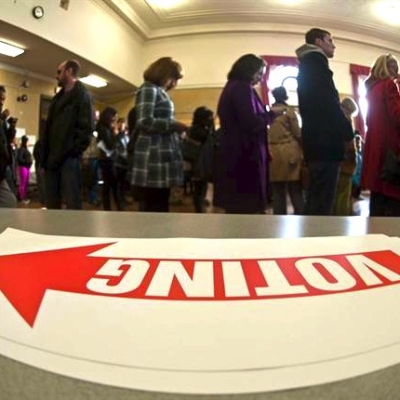
SLIDES: Ten Things to Know Ahead of Primary Day 2018 BELOW
"It's really hard to call what will happen ahead of time -- everything we have is anecdotal," said Kevin Olasanoye, Executive Director of the Rhode Island Democratic Party. "If anyone says for certain what will happen, they should also play the lottery."
Candidates are sprinting from door-to-door and from event-to-event trying to convince last-minute undecided voters.
GET THE LATEST BREAKING NEWS HERE -- SIGN UP FOR GOLOCAL FREE DAILY EBLAST"This campaign has focused on grassroots, in-person campaigning. There's been a lot of door knocking and meeting people," said Olasanoye.
Voting Procedures
The Secretary of State's office encourages all voters to check their voter status prior to going to the polls on Wednesday, which can easily be done on the office's website. Active voter status is required to vote in the primary election.
Those who did not make the August 13 deadline for voter registration can still register to vote in the November 6 general election up until October 7.
While at the polls, voters are entitled to certain rights, which are clearly outlined on the Secretary of State's website. These include provisions ensuring secrecy of ballots and the right to a polling place free of harassment or intimidation, meaning that no campaign materials can be displayed within 50 feet of a polling place.
Any voter who feels their polling place or a candidate has violated these rules can contact the state's Board of Elections.
In addition, those who are in need of assistance while voting can request it at their polling place, according to the Secretary of State's office. The Help America Vote Act requires that all polling places have a handicapped-accessible voting station, with priority given to those who are disabled or over 65 years old for its use.
Those who are physically unable to stand in long lines have the right to move to the front of the line. Additionally, anyone who is blind, disabled, or unable to read can request a bipartisan pair of poll workers to assist them, which requires the signing of an affidavit.
Below are the top ten things to know about Wednesday's primaries.
10 Things to Know About Primary Day 2018

Finding Your Polling Place
There are several ways to find out where to vote. The easiest way is to go to the Secretary of State's website, where voters can put in their address to find out their polling place, as well as view and print a sample ballot.
"We're really encouraging voters to go online ahead of time to see their sample ballot, so they know what to expect," said Joseph Graziano, Communications Coordinator for the Rhode Island Secretary of State's Office.
Voters are allowed to bring materials into the polling place with them and can fill out a sample ballot ahead of time if they choose to.
If internet access is unavailable, voters can also locate their polling place by calling their local Board of Canvassers or the Rhode Island Board of Elections.

What Do I Do If I'm Told I Cannot Vote?
Issues such as forgetting a proper voter ID or not being found on the polling place's list of voters could cause problems when going to vote.
"As long as you're registered to vote in the state, you still have the right to fill out a ballot," Graziano said.
To do so, request a provisional ballot at the polling place.
A provisional ballot is filled out the same way as a regular ballot and is put aside to be verified. The board of canvassers will verify the signature and eligibility on the ballot, and the vote will be counted later.
To be considered valid for voting, photo IDs must meet certain criteria. It must not be expired, though the address listed does not need to be current.
Valid Forms of ID Include (per the Secretary of State's Office):
- RI driver’s license/permit
- U.S. passport
- ID card issued by any federally recognized tribal government
- ID card issued by an educational institution in the U.S.
- U.S. military ID card
- ID card issued by the U.S. government or State of Rhode Island (RIPTA bus pass, etc.)
- Government-issued medical card
- RI Voter ID card
A Rhode Island Voter ID card can be obtained from the Rhode Island Department of State.

Election Results
The age of digital media has created a demand for instant access to information, and the election process is no exception.
"You can find out election results online in real time [after the polls are closed at 8 p.m]," said Dottie McCarthy at the Warwick Board of Canvassers. "New voting machines are wifi-connected and constantly send results to the Board of Elections, which are then posted online. You get the results as fast as we do."
Official election results must be certified by the State Board of Elections, and are made available on the organization's website. The Board of Elections website states that primary night results will be made available starting at 8 p.m. on Wednesday.
If a candidate contests the results of a close election, he or she has the right to request a recount. The candidate must fill out a request, have it notarized, and deliver it to the Board of Elections headquarters on Branch Avenue in Providence, where the recount will take place. The public is welcome to attend recounts, which are conducted in the headquarters' lower level warehouse.
EDITOR'S NOTE: An earlier version of this section was not clear that the real-time reporting began at 8 PM.

Election Security
The Department of Justice and the FBI said in a press release that they are prepared to handle all complaints of election fraud and violations of voter rights.
According to the release, Assistant United States Attorney Terrence Donnelly will be in charge of complaints of voter fraud, and the FBI will have extra agents available on election day. Donnelly can be reached by the public at 401-709-5068.
The organizations will work in tandem to ensure all votes are properly submitted and polling place procedure is followed. Changing votes, stuffing ballot boxes, and marking ballots for voters all violate federal election laws.
Any voter who feels intimated or harassed can file a complaint with the state Board of Elections or contact Donnelly directly. This includes being questioned or challenged at the polling place, as well as being videotaped or photographed.

How Does Weather Impact Voter Turnout?
Traditional political wisdom says inclement weather causes a slump in voter turnout.
"Usually, the research we see surrounding this phenomenon [of bad weather] focuses around the general election over the primary. Primary elections are a whole different animal, so it will be interesting to see if that carries over," said Aaron Ley, Professor of Political Science at the University of Rhode Island. "A lot of times we see larger concentrations of Democratic voters in urban areas, which can make it harder to get out in bad weather. These polling places tend to be more crowded because they're in the city. People are going to be less inclined to wait in a long line if it's raining."
The current forecast from The Weather Channel shows a chance of unsettled weather on election day, with the chance of scattered thunderstorms between 35-50 percent throughout the time polls are open.
The journal Frontiers in Psychology published a study in 2017 that looked at the link between voters turnout and temperature. The study's authors examined voter data from 1960 to 2016, to examine the impacts of both turnout and voter outcome based on temperature.
With each increase of one degree Celcius, voter turnout also increased by 0.14 percent. In addition, the study concluded that temperature-based increases in voters are largely motived by those pushing for political change.

Emergency Ballots
Emergency ballots are available to anyone who requests one, regardless of the nature of the "emergency."
A voter unable to make it to the polling place on election day can apply for an emergency ballot through the day before the election. Emergency ballot requests can be completed at the voter's local city or town hall. Once the application is submitted, the emergency ballot will be distributed and can be filled out the same way as a traditional ballot.
Once completed, the ballot must be placed in an oath envelope and signed. Two witnesses or a notary must be present at the signing.
Emergency ballots must be submitted to the Board of Elections before 8 p.m. on election night. The completed ballot can be left with the city or town clerk, who will submit it. The ballot can also be hand-delivered or mailed to the Board of Elections by the voter.
More information on emergency ballots is available here.

Youth Voter Turnout
Traditionally, young voters are one of the least likely demographics to vote.
According to the Center for Information and Research on Civic Learning and Engagement at Tufts University, approximately 50 percent of eligible voters aged 18 to 29 voted in 2016, despite making up 21 percent of all eligible voters in the United States.
However, younger voter interest has increased in recent years with the rise of Progressive candidates like Bernie Sanders.
"This could be a time when we see an increase in younger voters," URI's Ley said. "This is a midterm election, and we haven't seen this much interest in a while, since 2006. The carryover from Bernie Sanders could have an impact."
Ley added that he has not seen a large amount of interest in the election from his students at the University of Rhode Island.
"There hasn't been a huge outpouring of enthusiasm from my students so far, but that could be impacted by several factors, including that I'm mostly teaching graduate students," Ley said. "You could ask a different professor and get a completely different response."

2018 Primary Race Compared to 2014
"What we're seeing is basically a repeat of the 2014 primary," said Kevin Olasanoye, Executive Director of the Rhode Island Democratic Party. "There was more interest in the governor's race four years ago, and we're looking into the enthusiasm gap. But in terms of numbers of primaries, it's nearly identical."
The 2018 ballot strongly resembles its 2014 counterpart, with Democrat Gina Raimondo and Republican Allan Fung as their parties' endorsed candidates.
In 2014, now-Governor Raimondo decisively defeated her primary opponents with 42.1 percent of the vote, compared to 29.1 percent earned by her closest opponent, Angel Taveras.
Fung, meanwhile, won the Republican primary in 2014 with a strong 54.9 percent of the votes. His opponent, Ken Block, had 45.1 percent of the vote.
The major difference in the 2018 election is the increase of strongly progressive candidates on the Democratic side, both nationally and in Rhode Island.
"What's new in 2018 is the national wave of progressive candidates," Olasanoye said.
"That could have a major impact."
Another major difference in the 2018 gubernatorial race compared to 2014 is the presence of an incumbent governor, which lends an advantage to Governor Raimondo.
According to the Center on the American Governor at Rutgers University, incumbent governors are successful when seeking re-election just over 72 percent of the time.

Watch Secretary of State on GoLocal LIVE
Rhode Island Secretary of State Nellie Gorbea will join GoLocalProv News Editor Kate Nagle in the Navigant Credit Union Broadcast Center on Tuesday afternoon.
Tune in at 4 p.m. for everything you need to know ahead of Wednesday's election and last-minute information for voters.

Watch GoLocal LIVE for Election Night Coverage
GoLocalProv is your election night headquarters.
Watch GoLocal LIVE all night as the latest results come in and to hear input from Rhode Island's leading political minds.
Reporters will be stationed at campaign headquarters around the state, bringing up-to-the-minute information.


