Carol Anne Costa : “Open Sesame” If Only it Was That Easy!
Carol Anne Costa, GoLocalProv MINDSETTER™
Carol Anne Costa : “Open Sesame” If Only it Was That Easy!
Lederberg - a pioneer
I guess you could say “I cut my teeth” on open records in the grand vaults encased within the marbled halls of the Licht Judicial Complex. I was a clerk in the Superior Court and was on the front lines where the public interest and the protection of child molestation cases came to a head-on collision in 1996. In the case folder of The Providence Journal vs. Joseph F. Rodgers, I learned about access and confidentiality from mentor clerks including Pat Picano (we will get back to that in a bit) and others who defaulted to the public’s right to review, inspect, and copy records, with the exception of the child molestation cases which contained detailed information about the underage victims. These case files were, for all intents and purposes, hands off, taboo, and only pulled for hearing or trial. The travel of the Journal vs. Rodgers case ended up in the RI Supreme Court. Settled by a ruling in 1998, written by Rhode Island Supreme Court Associate Justice Victoria Lederberg. Lederberg was a pioneer in interpreting this complicated challenge and she and the Weisberger Court’s ruling lives on today. The court found that these protected case files which were the subject of an appeal from the Providence Journal confronted a standing order of the Presiding Justice of the Superior Court, at the time Joseph F. Rodgers, regarding public access to child molestation cases kept within the Superior Court. The order of the Presiding Justice was clear:
GET THE LATEST BREAKING NEWS HERE -- SIGN UP FOR GOLOCAL FREE DAILY EBLAST“The Presiding Justice has interpreted §11-37-8.5 as mandating that all court records and documents, which concern the identity of a victim of child molestation or sexual assault, shall be confidential and shall not be made public and the Presiding Justice has advised the Chief Clerks of the Superior Court of that interpretation and said clerks, in reliance on said advice, have adopted as a policy of the court that all files pertaining to the indictments, prosecution, and/or conviction of persons charged with first and second degree molestation of children are to remain sealed and not available for public inspection.”
Lederberg ruled in the interest of the public and designed a bifurcated record keeping system which allows access while at the same time protecting the victims. From my firsthand experience, these balances can be struck. She begins her opinion with this: "The public's interest in knowing about its government is protected by the guarantee of a Free Press, but the protection is indirect. The Constitution itself is neither a Freedom of Information Act nor an Official Secrets Act." Her opinion and quote reveal the true nature of the balancing test that occurs often in the keeping and disseminating of “public records.”
Real experience is worth a thousand words
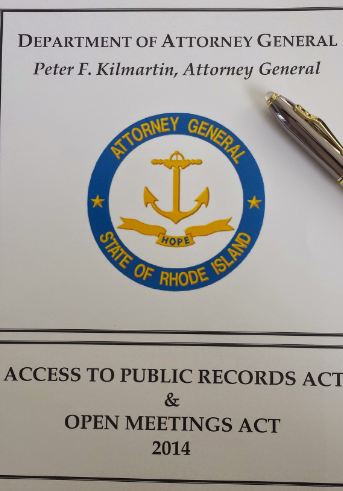
That is why I was so very pleased with the comprehensive summit hosted by Attorney General Peter Kilmartin. His cracker jack staff put together the 16th Annual Open Government Summit and the 650+ people who were in attendance were presented thoughtful, lucid and very easy to follow tutorials on both of these important acts. I am not going to fib, the thought of an open meetings gathering on a nice August Friday was... let me say, “really?” But, as it turns out, spending a summer day on the East Bay learning about quorums, rolling quorums, notice, balancing tests and statutory requirements, and Assistant Attorney General Mike Field’s Dodgeball clip proved enlightening, empowering and yes, Mike- funny! The presentations- thorough research and interpretations of real cases- reminded me again of the obligations and duties to the public and the media as it relates to access and relationship building.
A fruitful panel discussion
Kilmartin and his staff put together a stellar panel to present their experiences and field questions for the attendees. The fantastic panelists present at the summit were Providence Journal columnist Ed Fitzpatrick, WJAR-TV I-Team Investigative reporter Katie Davis, Pawtucket City Clerk and President of the Rhode Island Town Clerks Association Richard Goldstein, and Johnston City Solicitor William Conley, Esq. These panelists talked freely about the “knee jerk NO” relationship building and the evolving OMA and APRA laws that often leave clerks paralyzed for fear of committing an unlawful act. Goldstein offered straight away that trust and relationships matter as well. I agree with him, as a simple query to a clerk may result in a quick and painless retrieval of a document. But Bill Conley pointed out that the evolving laws have sometimes left public servants with more questions than answers as they man the front lines. Conley’s proffer resonated with me, “The first instinct should be these belong to the public.” But, is was Ed Fitzpatrick of the Providence Journal who hit the homerun when he quoted a mentor of mine and a genuine gift to the public, the late and great Pasco Pat Picano, with his effervescent “I know the law and I know the score.” Ed made me smile and remember what we, as public officials, are there for ...THE PUBLIC. I was so thrilled that Ed allowed me the fabulous memory of Pat and our many searches undertaken and successful retrievals of public records.
This summit is a resource that must be shared with boards, committees, subcommittees, commissioners, et al as it is crucial that a greater understanding of OMA and APRA blossom to shine that light from above…”Open Sesame”.
The summit is available online in a video through Clerkbase archives, so more interested citizens and public employees can join in a better understanding of the acts. Assistant Attorney General Michael W. Field, chief of the Open Government Unit, and Special Assistant Attorney General Lisa Pinsonneault are second to none in explaining and enforcing the OMA and APRA acts. On behalf all those who desire more open government practices, “Thank you.”