


RI’s Affordable Housing Strategy Needs More Innovation, Including Modular Homes - McMahon
Robert McMahon, Columnist
RI’s Affordable Housing Strategy Needs More Innovation, Including Modular Homes - McMahon

The median asking price of a single-family home in May was $525,000.
About 150,000 households in RI—about one-third of all households in the state—are cost-burdened (spending more than 30% of their income on housing). The median rent in Providence in 2023 was $2002/month. The rate of production of new housing units in RI is one of the lowest in the nation. Permits for housing units in RI in 2023 were about one-fifth of what they were in 1986.
GET THE LATEST BREAKING NEWS HERE -- SIGN UP FOR GOLOCAL FREE DAILY EBLASTMore needs to be done, and innovation needs to be encouraged. One potential solution is modular homes.
The General Assembly and Governor McKee have dedicated hundreds of millions of dollars of federal COVID funds — earmarked for affordable housing projects across the state. There is now one state agency, Rhode Island Housing, that is centralizing state efforts to address housing affordability in the state. More state funds are being allocated for affordable housing in the form of grants, loans, tax credits. Reform of local land use regulations is still a work in progress. This fall, voters will be able to vote on a $120 million state bond issue that will provide significant funding for affordable housing projects.
The state's response is a little disrupted with the announcement that Housing Secretary Stefan Pryor has resigned. Prior served less than 18 months.
A few communities, such as Providence, also have housing trust funds that are used by community development organizations to supplement state and federal funding streams to construct affordable housing.
All the current housing projects in the pipeline and those to be funded by the 2024 state bond (if it gets voter approval)—while significant when compared to housing production in the last ten years—will result in only 4,000 to 5,000 units. Most recent studies of affordable housing in RI from the RI Foundation and Housing Network of RI suggest that the current deficit of affordable housing is approximately 24,000 units.
If we are to continue to grow as a state, we need to think bolder and more creatively to address the growing affordable housing shortage in RI. In this column, I will plead the case for a key initiative: locally-based modular housing construction. Other initiatives will follow next week and the week after.
Modular Multifamily Construction Today in Rhode Island
Your view of modular home construction may be limited, like mine was for several years, to the hundreds of small and inexpensive single-family homes that were built in Rhode Island in the 1950’s and 1960’s. A double-wide “trailer park” unit would be dropped off on an already constructed basement on a vacant lot, “stitched together,’ a gabled roof added, and new siding attached to make it look a small single-family home.
Single-family modular constructed homes have advanced since then. Many being built in the US look like they were designed by architects.
To alleviate Rhode Island’s housing affordability crisis, single-family homes are not the immediate answer. We need to build hundreds of new multi-family buildings in the next 5-10 years that will result in thousands of affordable housing units. Modular construction is well-suited to multifamily housing construction, even three and four-story construction.
While there are several builders in RI who have installed modular homes, there is only one company In Rhode Island today that is significantly involved in modular housing construction, Coastal Modular Homes of RI based in South Kingstown. They do not, however, actually manufacture modular housing. They receive modular units from out-of-state vendors and coordinate the installation on-site, and perform the completion of the roof, siding, site work, etc, of the unit. Some of the cost savings of modular construction are eaten up by the transportation costs to get the modular units to RI sites.
There are only three companies in New England actively manufacturing modular multi-family housing: KBS Builders of Maine, Preferred Building Systems of New Hampshire, and Huntington Homes of Vermont.
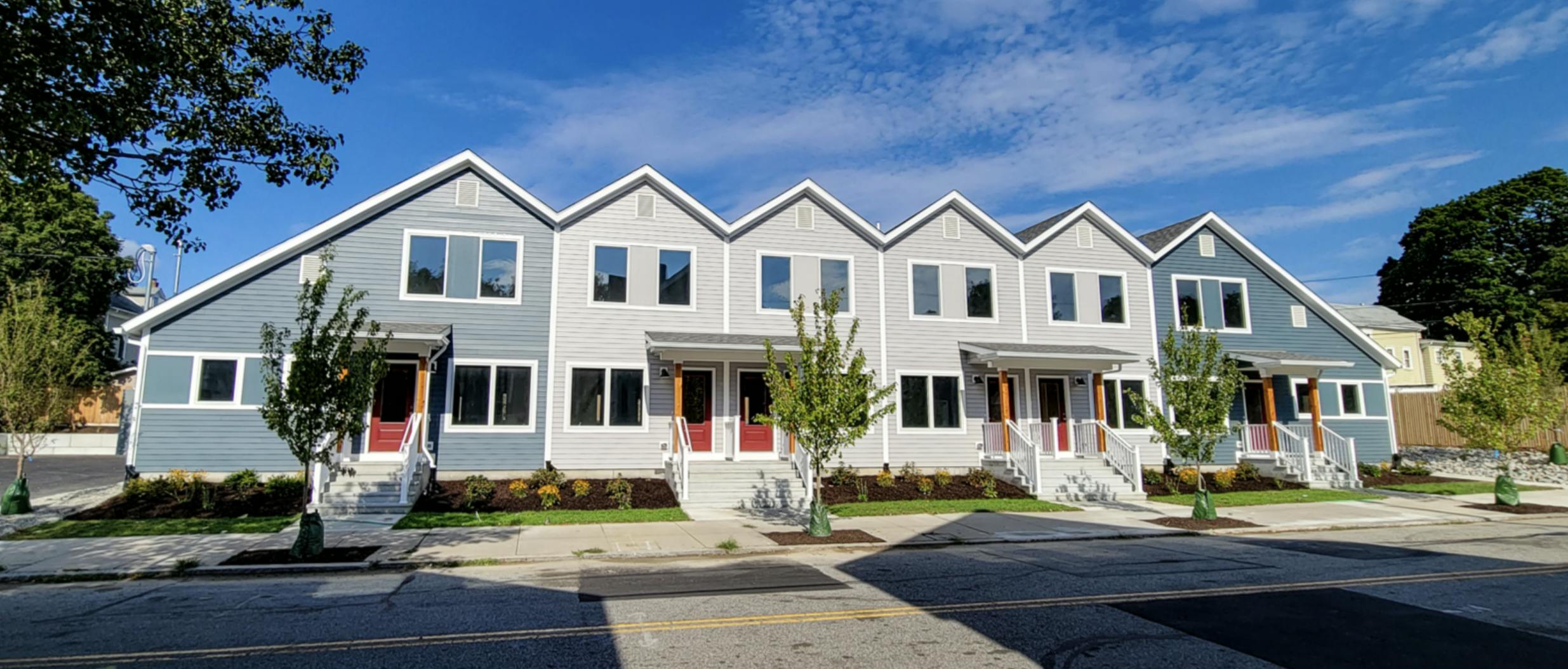
Case Study: Modular Multi-Family Construction in Olneyville
In 2018 a fatal fire destroyed several blighted multifamily homes on Bowdoin Street in Olneyville displacing 22 individuals. The land sat vacant until ONE Neighborhood Builders (ONE NB), a nonprofit community development organization of Olneyville, acquired the property and began to plan for new affordable housing. Row housing was designed by Truth Box architects to maximize the number of units that could be built on the site.
Construction began in late 2021 on a multifamily complex that would include six two-bedroom apartments and two one-bedroom apartments. Start to finish occurred in just a few months as ONE NB and its innovative Executive Director, Jennifer Hawkins, employed a new concept for RI affordable housing, modular housing fabrication. The units were built by Champion Modular Homes of Pennsylvania in a factory over a two-month period starting in December 2021, shipped to Bowdoin Street in February 2022 over a 10-day period, installed by Coastal Modular Homes of RI, and were ready for occupancy three months later.
The construction costs for the project were almost 20% lower than conventional stick-built construction at the time. The construction cost savings would have been another 2-3% if the units didn’t have to be shipped by truck almost 400 miles from Liverpool, PA, to Rhode Island.
Modular Constructed Affordable Multifamily Housing Should be Built in Rhode Island
Why modular construction for Rhode Island multifamily affordable units:
- Cost: Construction costs can be 20-25% less costly than conventional stick-built units;
- Speed: Construction time can be shortened by 40-50%;
- Year-round construction: With most of the units and utilities installed in a factory, winter weather in Rhode Island will not hinder construction schedules.
Rhode Island Housing should team up with the Quonset Development Park to recruit one of the existing New England-based modular housing companies or one of the scores of Pennsylvania companies to build a modular housing fabrication factory at Quonset Point. A variety of incentives can be used to attract one of these firms, such as low-cost or no-cost land at Quonset Point, low-cost loans for factory construction, and training grants to local RI unions to train a modular construction workforce.
Such a facility would not only speed up the quantity of affordable multifamily housing in RI, but would be a vital new form of economic development for RI, providing year-round union jobs in a variety of trades, to meet the demand for affordable multifamily housing in RI, Massachusetts, and Connecticut.
EDITOR'S NOTE: Robert McMahon served on the board of ONE Neighborhood Builders until 2022.