


Whitcomb: Our Future Fuel? Housing Help in Newport; Rewilding Suburbia; Go Aluminum
Robert Whitcomb, Columnist
Whitcomb: Our Future Fuel? Housing Help in Newport; Rewilding Suburbia; Go Aluminum

Christmas Eve, and twelve of the clock.
‘‘Now they are all on their knees,’’
An elder said as we sat in a flock
By the embers in hearthside ease.
We pictured the meek mild creatures where
They dwelt in their strawy pen,
Nor did it occur to one of us there
To doubt they were kneeling then.
So fair a fancy few would weave
In these years! Yet, I feel,
If someone said on Christmas Eve,
‘’Come; see the oxen kneel,
‘‘In the lonely barton by yonder coomb
Our childhood used to know,’’
I should go with him in the gloom,
Hoping it might be so.
---“The Oxen,’’ by Thomas Hardy (1840-1928), English poet and novelist. A “barton’’ is a farm building and “coomb’’ a valley.
“Early to bed and early to rise --- till you get enough money to do otherwise.’’
-- Laurence J. Peter (1919-1990), Canadian-American educator, psychologist and writer
“Xxxx (expletive verb) regulators. They make everything worse.”
-- Sam Bankman-Fried, leader of the collapsed FTX cryptocurrency exchange, to Vox News in November, before his indictment last week on fraud and other charges. I’d guess that many thousands of his customers/victims might have friendlier ideas about financial regulation these days. The crypto sector has been unregulated. “SBF” made millions in political donations to Democratic and Republican politicians. Most of the money to the latter, he says, was given via “dark money” groups that don’t have to disclose their donors. His aim was to keep pesky regulations out of the crypto swamp.

There was lots of excitement last week – most of it premature -- with news of the first nuclear-fusion reaction, in a federal laboratory in California, that produced more energy than it took to start the reaction. As well there would be. It might be a world/historical development.
While much, much more work needs to be done, and many more billions of dollars spent on research and development, the breakthrough could lead to gigantic changes in our energy economy, with endless amounts of clean energy to generate electricity and thus speed us off our increasingly disastrous dependence on fossil fuels. That dependence is not only heating the Earth at an accelerating rate, it also props up tyrannical and kleptocratic petrostates, such as Russia and Saudi Arabia.
I hope that the breakthrough boosts public- and private-sector research in fusion energy to the Manhattan Project’s intensity in World War II. Meanwhile, we must press ahead with other, increasingly affordable renewable-energy technology to reduce our unavoidable fossil-fuel dependence as much as possible in the next few years. And we’ll have to maintain current nuclear-fission plants as long as safety permits. For fusion to become a major part of our energy complex, if it ever does, may require decades of work.
Ah, those dreams, which go back to the ‘50s, of unlimited, virtually free electricity from nuclear power! A reactor in the basement! “Our friend the atom!”
(It was happy news that Venterra Group, a London-based wind-power services company, is opening its U.S.-based office in Providence’s Jewelry District, mostly because of what most of us hope will soon be major offshore wind-turbine operations off southern New England.)
Last week’s fusion announcement spurred more interest in such companies as Cambridge-based Commonwealth Fusion Systems and other companies in the Greater Boston technological complex working on fusion-related projects.
The breakthrough is a reminder of the tremendous inventive capacity of American science as a result of Federal tax money, public and private support of our great research universities and corporate research and development. They’re the key parts of our technological-innovation infrastructure, which supports much of our prosperity.
Indeed, no nation is such a hotbed of invention as America.
But in many sectors, we lag behind other developed nations in applying our inventions and maintaining the systems based on them. For instance, our electrical grid is decayed and fragile, our healthcare “system” is fragmented, alarmingly costly and inefficient, and our transportation systems lag far behind many other nations’.
(And parts of our health systems are deeply corrupted by extreme greed. See dubious, bait-and-switch Medicare Advantage plans and crooked hospice-care operations.)

Consider that the MBTA’s Green Line Extension was first proposed in 1991 but only opened last week, or that extending commuter rail to Dulles International Airport from downtown Washington, D.C., was proposed in the ’60s but that extension only opened last week!
(Those who oppose spending tax money on creating or improving commuter rail and subway lines should look at the huge taxpaying development that occurs along them. Yes, millions of people want to get out of their cars and use mass transit if it’s close to them and provides frequent and reliable service.)
We could take many lessons from the likes of Western Europe and Japan on how to apply and maintain systems created in part or wholly because of American inventions. In the past few decades, America’s reputation as a place for completing big projects using these inventions has slipped, to no small degree because of too many layers of regulation, too many selfish and politically powerful special interests and runaway litigiousness. Let’s hope that the vast promise of fusion energy helps turn that around.
The invention of the likes of Facebook and Twitter doesn’t seem to have advanced America. But you can join the Metaverse and Cryptoworld, where nothing is real!
xxx
Speaking of high-tech, I spent around 35 minutes last week inside an MRI machine in order to have doctors identify a probably relatively minor problem. MRI machines, as I’m sure many readers know from experience, make lots of weird clanking and whirring noises and can be very claustrophobic for some people, but I rather enjoyed the experience; it weirdly reminded me of being in an airplane.
The only thing that bothered me a little was that the machine’s noise sometimes made it difficult to hear the music being sent into the earphones I was given to wear.
An American, natch, was the inventor of MRI technology -- Raymond Damadian (1936-2022), a New York physician and medical technologist.
While American healthcare technology is impressive, the healthcare system in which it’s used is clogged with wasteful documentation duplications compared to other advanced nations. Different parts of the system don’t talk to each other. A tiny example: I was asked to answer a list of questions before my MRI adventure and then asked the exact same questions by somebody else again the next day. In other medical adventures, I have been asked to respond to the same questions up to five times. More paper, and more layers add to administrative costs.

Newport has adopted a new two-tier residential tax system that may cut taxes for many homeowners. The people who would get the break include owners of single-family homes who prove that they’re residents of the City by the Sea for more than seven months a year as well as owners of residential rental properties of three or fewer units whose renters’ leases run for at least a year.
The tax rate will remain higher for non-owner-occupied housing.
Earlier this year, Rhode Island state Sen. Dawn Euer said of the state legislation authorizing the change:
“As we know, our whole state and Newport especially are deep in an affordable housing crisis, and residential property tax relief is one tool to help address affordability…. Vacation rentals and short-term rentals take away from year-round housing, and while they do provide revenue, they contribute to our city’s housing crisis. Making a distinction between them will give residents the tax relief they need, and encourage property owners to create and maintain the permanent housing we desperately need.”
This arrangement should help stabilize housing in the city, which has long been destabilized by the high number of financially alluring (for property owners) expensive short-term warm-weather or even weekend rentals. But it’s hard to know what the effect on total property-tax revenue for the city might be. It will probably take a year to find out.
In any event, some lessons for other communities will come out of the Newport program, especially those in coastal resort areas.
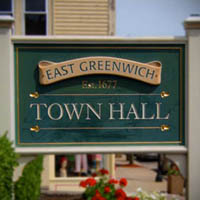
The recent report by the Rhode Island Public Expenditure Council on the state’s communities spending more than others across America for police and fire can be explained by a number of things. These include the power of public-employee unions in the state and the failure to consolidate more public-safety functions into multi-community operations. Indeed, it seems a tad absurd -- or at least impressively inefficient-- for a state as tiny as Rhode Island to have 39 cities and towns. More sharing of services, please.
And does the large number of old wooden houses in the Ocean State require more fire protection than elsewhere?
More Parental Planning Needed
It’s hard to oppose the proposed renewal of the federal child tax credit expansion, part of pandemic relief, that expired at the end of last year. But, as politically incorrect as it sounds, wouldn’t it be nice if more people thought more carefully about whether they could afford having children before having them? And wouldn’t it be nice if federal and state policies encouraged marriage and pressed sperm donors (aka “fathers”) to take more responsibility for supporting the children they helped create?
There’s a lot of social pathology associated with the irresponsibility of fathers in the past few decades, and single-parent households with young children tend to be very stressed.
Modest Suburban Rewilding
I love this story.
A Columbia, Md., couple replaced the ecological wasteland of the typical American turf lawn soaked with chemicals with native plants to attract bees and other insects – many of them pollinators -- as well as birds and other wildlife. Their homeowners' association threatened the couple with fines and worse if they didn’t tear up their little park and recreate the lawn. Humans need pollinators for food crops!
But the couple fought back in a legal battle that ended up with a new state law that, says The New York Times, forbids “homeowner associations from banning pollinator plants or rain gardens, or from requiring property owners to plant turf grass.’’
As The Times noted, “Insect, bird and wildlife populations are plummeting as a result of human activity, pollution and habitat destruction, prompting scientists to predict mounting mass extinctions in the coming years.’’ And those lawn chemicals to kill “weeds” and insects end up in streams, lakes and the ocean.
Encouraging homeowners to reduce their toxic, chemically dependent lawns and replace a lot of that space with native plants, including trees, is a small but still significant way to slow the ecological ruination that has accompanied too much of American suburbanization.
Anti-Free Speech, Anti-Free Enterprise
Thuggish and cynical Florida Gov. Ron DeSantis and allies in some other Red states always claim to be pro-business and pro-free speech, but are increasingly trying to penalize companies financially, and thus their executives, whose opinions and investment decisions they don’t like (either sincerely or for demagogic reasons).
Companies are being targeted, for example, for favoring renewable energy or for taking stands on social issues, such as gay rights. (Fossil-fuel companies give many millions to Red state politicians.)
Florida U.S. District Judge Mark Walker mused: “Normally, the First Amendment bars the state from burdening speech, while private actors may burden speech freely. But in Florida, the First Amendment apparently bars private actors from burdening speech, while the state may burden speech freely.”
Hit these links:
xxx
How much of “diversity training” actually makes people more open to those different from them, be it race, ethnicity, sexual identity, and so on, and how much does it do the opposite, with its preachiness, assumptions, and condescension? And does it intensify identity politics?
xxx
It’s astonishing how much water a recently cut Christmas tree requires to keep most of its needles from falling off before New Year’s! You’d think it was still alive. Maybe next year, we’ll take the environmentally responsible approach and buy an aluminum one. That would go with the metallic look of the outdoors at this time of year.
Those Christmas cards from people we haven’t seen in 20 years! Research needed. And a year’s worth of parties in a week and a half! And the feeling that this might be the last of such festivities.