


Whitcomb: Sending Schools Back to School; Vote Yes on #1; Eateries; Housing Nimby’s vs. the Economy
Robert Whitcomb, Columnist
Whitcomb: Sending Schools Back to School; Vote Yes on #1; Eateries; Housing Nimby’s vs. the Economy

“Miniver scorned the gold he sought,
GET THE LATEST BREAKING NEWS HERE -- SIGN UP FOR GOLOCAL FREE DAILY EBLASTBut sore annoyed was he without it;
Miniver thought, and thought, and thought,
And thought about it.
“Miniver Cheevy, born too late,
Scratched his head and kept on thinking;
Miniver coughed, and called it fate,
And kept on drinking.’’
-- From “Miniver Cheevy,’’ by Edward Arlington Robinson (1869-1935), a native of the Maine Coast who won three Pulitzer Prizes for Poetry and was nominated for the Nobel Prize for Literature
“The road to hell is paved with adverbs.’’
-- Novelist Stephen King (born 1947), another Maine writer
“The oldest and strongest emotion of mankind is fear, and the oldest and strongest kind of fear is fear of the unknown.”
— H.P. Lovecraft (1890-1937), a writer of science, fantasy and horror fiction who lived most of his life in Providence. The virulent racist’s work is adored by many; I find it boring. Try Providence writer Jonathan Thomas instead. Happy Halloween, in any case.
xxx

You might be tempted these days to pick up a rotting apple on the ground in an orchard and taste it, and you have to admire a Norway maple that hasn’t yet dropped its leaves as mild weather seems to last later and later in the fall. You notice the beautiful patterns on bark, painted with lichen, more than you had a couple of months ago, when you were distracted by the vivid colors of many growing plants.
November is also prime time for gatherings of crows, those highly intelligent and social birds that seem to take over as we head closer to winter. You often see them on streets feasting on dead squirrels killed by cars as they try to collect acorns. But they’re also adept at splatting your car with revolting off-white poop. Do they do it on purpose?

The recently reported sliding test scores in public schools across America can, of course, in part be blamed on COVID-19’s disruptions (and now we also have to contend with other respiratory-disease epidemics). But test scores have been bad for many years, and bespeak an ominous decline in the country’s social and economic potential.
Did schools overdo their cancellations of in-person learning during the pandemic? Yes, but COVID was a new disease, and health and school officials and politicians were operating mostly in the dark for months about how best to respond to a global pandemic.
It’s not surprising that Maine and Rhode Island have the worst test scores in New England since they’re the poorest states in the region. If you want to see higher test scores, you should generally go to the richest states.
Hit these links:
https://www.cnbc.com/2019/10/03/rich-students-get-better-sat-scores-heres-why.html
https://worldpopulationreview.com/state-rankings/public-school-rankings-by-state
Move away from the reliance on local property taxes to fund education. This dependence limits many school departments’ efforts to maintain, let alone improve, standards. Public schools’ decline has exacerbated income inequality as the wealthy increasingly send their kids to private schools that have the resources to maintain high standards and give these students even greater advantages in life than they already have.
Get the unions out of the public schools and make teaching positions more meritocratic while making sure that teachers have full civil service protections.
Stop demanding of public schools that they be social workers, compelled to address an endless list of cultural issues, especially around ethnic and sexual identity. These demands drain time, energy and money from basic education.
Colleges can help by demanding that all applicants take SAT or ACT tests. Too many colleges have dropped that requirement, thus lessening academic discipline in high school.
But the toughest problem is familial. The collapse of the two-parent family has been a socio-economic disaster, causing chaos at home that has undermined students’ ability to learn. Single parents, usually the mothers, often don’t have the time or energy, or even interest, to nurture their children’s learning. And would more fathers please report for duty?
Meanwhile, right-wing politicians make matters worse by demagogically asserting that “parental rights’’ trump everything else when it comes to schools. No, schools have crucial community/societal obligations. Society needs educated people, with professional teachers trained to do much of the teaching. (And democracy declines with lack of education in civics and history.) No, the much misunderstood “Critical Race Theory’’ isn’t taught in the public schools.
Many parents are ill-educated, bad role models and exhausted as they try to preside over chaotic homes. Giving them veto power over public education would be a disaster. And now leaders of the GOPQ are trying to weaponize parents as a distraction from a central political goal – the care and feeding of the plutocracy/oligarchy. The depressing student-absentee rate at many schools demonstrates the parental problem. Of course, at some schools, teacher absenteeism is also an outrage. That’s another reason why I dislike teachers' unions.
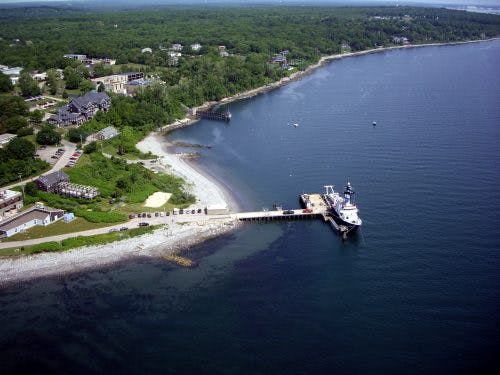
Please vote for this because it speaks to what is, or at least should be, a comparative advantage for a place that calls itself “The Ocean State.’’
The University of Rhode Island is campaigning hard for citizens to approve Question 1 on the Nov. 8 ballot. Approval would provide $100 million in bonds for much needed and far-too-long-delayed improvements to the Narragansett Bay Campus of URI’s internationally respected Graduate School of Oceanography, a center of Rhode Island’s ocean (‘’blue”) economy.
xxx
Also, at URI, congrats to Jessica Alber, an assistant professor of biomedical and pharmaceutical sciences, for getting a five-year, $10.3 million grant from the National Institutes of Health to look into changing how physicians diagnose Alzheimer’s disease, which could create new possibilities for treatment.
URI says that the project, “Longitudinal validation of retinal biomarkers against cerebral imaging in preclinical Alzheimer’s disease” (whew!), could help provide a low-cost, minimally invasive screening technique to detect Alzheimer’s disease before symptoms appear.
With an aging population, few things are more important than finding new ways to diagnose and treat dementias.

Somebody asked me the other week what I thought Rhode Island GOPQ gubernatorial candidate Ashley Kalus would be like in office. I answered that the relentless, smart, strident Ms. Kalus would be very entertaining, to a point, at which she might become exhausting. (I wish she wouldn’t use one of her young boys as a prop in a very harsh campaign TV commercial, but, I guess, as writer Finley Peter Dunne (1867-1936) noted, “Politics ain’t beanbag.”)
Is she a crook? Too early to know, although unsettling and confusing stuff is coming out about her intriguing and enigmatic business career.
We’d probably know a lot more if this resident of -- three states? -- released her joint tax returns with her businessman/physician husband, which she has so far refused to do. The general idea, of course, behind asking candidates to release all their tax returns is to let the voting public know if there might be big conflicts of interest of certain types. Of course, you can understand why most of us, in or out of politics, don’t want to display our finances, even if we’re honest.
Is her Democratic opponent, incumbent Dan McKee, some sort of crook, as Ms. Kalus implies? Probably not. He’s been around in Rhode Island and so has been available to be watched for his whole life. But he does have plenty of conflicts of interest. Are any truly toxic? So far, the biggest impediment to his election may simply be that he comes across as boring, if amiable and earnest.
xxx
Every time that people in Providence or elsewhere talk up “reparations” for people some of whose ancestors were slaves or otherwise brutalized by the White (if shrinking) majority, the angry White-based, bogus-conspiracy-driven GOPQ gains more election votes from its bitter base.
Yes, address some of the socio-economic effects of racism through expanded job training, healthcare and housing, but calling for racial “reparations’’ makes many people angry since they didn’t have anything to do with these sins of history, which is a litany of woes around the world. There’s still some slavery in Africa, by the way.
In particular, many Whites, especially those struggling economically, are anxious that the world they grew up in is no more and that all those people who don’t look or sound like them have moved in. I, too, am not that pleased with American society these days, but because of its increasing barbaric crudeness, widening socio-economic class divisions and lack of a sense of civic obligation. And some of those tattoos just don’t work.

Just how hard it is to build more housing (except for mansions and McMansions) in New England can be seen in Rockport, Mass., the affluent North Shore town. There, a bunch of Nimbys seek to block a state plan to put multi-family housing near the town’s train station. The project is aimed at slowing soaring housing costs by increasing supply and getting more people out of their cars and into environmentally friendly public transit.
Rockport, with its famous ‘’quaint’’ harbor (“Motif #1, beloved by Sunday painters!), is a major tourist destination but the people who work in its restaurants, inns and bars increasingly can’t afford to live there. This has helped to cause severe labor problems in the local and heavily taxpaying hospitality sector – leading to shortened hours and outright closures.
This sort of opposition has cropped up in other rich towns, such as Newton. The Rockport project is driven by the new rules of the administration of outgoing Republican Gov. Charlie Baker aimed at increasing multi-family housing, especially for low-income people, in the 175 cities and towns served by the MBTA.
I hope that the commonwealth continues to enforce these rules. If not, Massachusetts, like the other New England states, will lose many more jobs to the South and West where more, and more affordable, housing is available. It’s a social and economic imperative for our region to build much more housing.
‘Pieces of Narragansett History’
I wrote in last week’s column that I had come across this cairn while walking on the lawn at the Roger Williams National Memorial, in downtown Providence, and asked – in a too-jokey way -- what it is. Here’s the answer from the National Park Service, via my friend Ken Williamson, who lives in Hawaii.
“This cairn, or stone pile, depicts pieces of Narragansett history from pre-contact through today. Built by Narragansett artists associated with the Tomaquag Museum {in Exeter, R.I.} it expresses the fact that WE ARE STILL HERE. The cairn is at the center with 4 raised stones around it representing the Four Directions. It is a meditative circle, representing Narragansett lives, history, and future which brings us full circle. Sit down and reflect on your own past, present and future and its intersection with the Narragansett people.
“The Narragansett Tribal Nation has lived on these lands since time immemorial. Their ancestors respected all living things and gave thanks to the Creator for the gifts bestowed on them, as do Narragansett people of today. Lynsea Montanari & Robin Spears III, both Narragansett, served as summer arts interns at the memorial for this project. They incorporated their own cultural knowledge with teachings by tribal elders regarding first contact with European settlers, genocide, displacement, assimilative practices, enslavement, continuation of language, ceremony, and other cultural practices. The artists chose to create a cairn as it is a part of the history of all indigenous peoples. There are many historic cairns in the Narragansett landscape.’’
My strongest memory of Native American cairns comes from driving with my wife in the forests along the northern side of gorgeous Georgian Bay in Ontario. You can’t go far there without seeing a cairn or other stone sculpture on a slope above the road.
The Way We Live Now, Cont.
There’s an attractive shopping strip (yes, there are a few) on one side of a street near our house in Providence. On this less than one-block stretch are three restaurants. One, a café/takeout/deli/caterer, is a locally owned one-off and has been a fixture of the neighborhood for many years. The other two are parts of small chains – a sit-down and takeout doughnut establishment, which arrived a very few years ago, and a sit-down and takeout place selling “Mediterranean’’ stuff that arrived a few weeks ago.
All three places seem to be doing pretty good business, especially now that COVID has declined (for the time being). But are they, er, cannibalizing the neighborhood restaurant sector?
(I myself stick with the deli/restaurant out of loyalty as well as liking its food and staff.)
I see people who claim to be nearly broke patronizing these places, although it’s much cheaper to eat at home. People urgently want to get out of their house or apartment and avoid food prep and cleanup. They also, of course, like to see people they know in ‘’a third place,’’ which is often less psychologically challenging than seeing them where we live. And then, more and more people live alone or with only one or two others, which seems to them to make at-home food less cost-effective. Having to buy in small quantities in grocery stores can be expensive.
I run into a lot of people I know in the café/deli. They’re usually pleasant, but a few glower at me, and may mutter “Are you the S.O.B who wrote that thing about….?’’ Then they may give me a rictus smile. Others say conspiratorially, “There’s something I want to tell you about.’’ Calling me by name can be pleasant or ominous.
In these harried times, no wonder so many people are willing to pay a premium to avoid feeding themselves and others at home.
An attraction is that it’s usually less awkward to get up and leave a restaurant where you’ve been eating with someone than to get up and leave someone’s home where you’ve just been fed. But do they really want you to stick around and yak some more? And in an eatery, you avoid the anxiety of trying to politely hint to meal guests in your home that as much as you like them, it’s time for them to leave.
As restaurants fill up these retail strips, small local clothing stores disappear. Too bad! For that matter the selection of clothes in such establishments as big department stores continues to shrink as people turn more and more to the World Wide Web. Check out Macy’s in Providence. Some empty racks. I’ve pretty much given up buying clothes there because I can’t find anything in my un-American size.
Left and Far-Right United in Appeasement
After a bit of a firestorm, 30 “Progressive’’ Democrats have withdrawn an appeasement-soaked letter urging President Biden to negotiate directly with Russia to end the war in Ukraine. Hey, it’s the Ukrainians’ country, not ours or Putin’s, and trying to force their partial surrender would be a green light for further aggression in Europe by the killer in the Kremlin.
The left and the right sometimes support similar positions. Consider the pro-Putin GOPQ members of Congress who have demanded that we utterly abandon Ukraine to the tyrant.
xxx
I had a European history teacher in high school, the chain-smoking Walter Foley, like most of the figures he talked about now a dead white male, who always called World War I and World War II the same war split into two pieces by a two-decade “armistice’’. So I now think of the Cold War (which sometimes gets hot) as divided into two parts -- 1946-1991, and then from about 2007 to now. It's still mostly a war between liberal democracy and kleptocratic tyranny. The latter has been the default government system through history. Democracies (and quasi-democracies like the U.S., which is often under minority rule) are usually on the endangered list.
xxx
“Happy families are all alike; every unhappy family is unhappy in its own way.”
-- Famous opening line of Leo Tolstoy’s (1828-1910) 1878 novel Anna Karenina. I’ve never quite understood the first part of the quote.
It would be fun if the banal line in many obits, usually stuck in by funeral homes -- “the most important thing in his/her life was her/his family’’ -- was more honest and replaced by, say, “the most important thing in his/her life was her/his job or his/her friends or her/his cat or dog or boat.’’
Kindness as Rx
In Accidental Kindness, primary-care physician, public-health expert and novelist Michael Stein (who lives in Providence) discusses with impressive openness -- including a sometimes self-lacerating honesty -- the often complex and sometimes contradictory goals of patients and doctors. He uses memorable anecdotes of his encounters with his own patients to present an engaging, if sometimes very sad, picture of our dysfunctional healthcare “system’’ at ground level. Almost all of us have been patients and many will learn a great deal from this sweet book, in which forgiveness, a key part of kindness, plays a big role.