


Battle Heats Up Over Providence Streetcar Proposal
Kate Nagle, GoLocal Contributor
Battle Heats Up Over Providence Streetcar Proposal
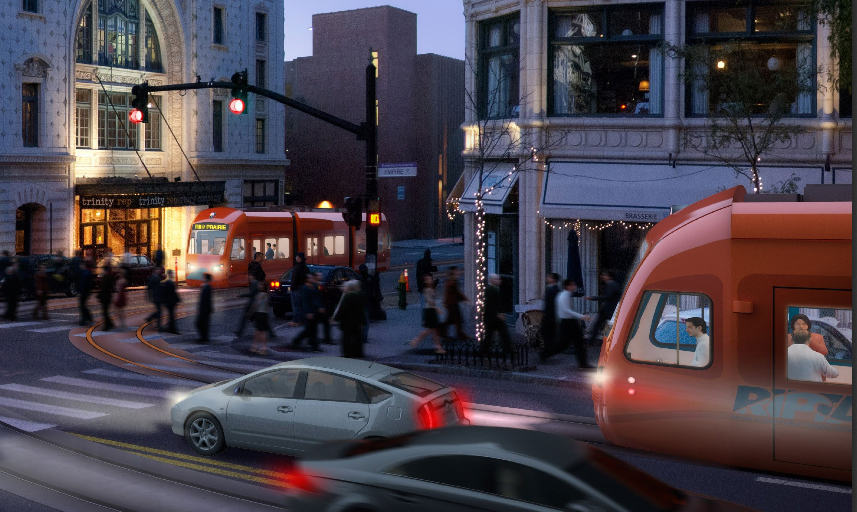
On Wednesday, the City Council Bond Study Commission will review an ask for $58 million in new bonding authority for the streetcar -- and on Thursday, the Council Finance Committee will review the city's proposal which they say would create 6,000 new jobs in twenty years.
"While I am intrigued by the project's potential benefits and increasing public transit options for our residents, I am cautious about the timing and risk associated with a proposed streetcar," said Councilman David Salvatore in a message to constituents. "In a time when our schools and roads are in desperate need of infrastructure upgrades, it would be irresponsible for our City to add additional borrowing costs to the City's budget without a guaranteed return on investment."
GET THE LATEST BREAKING NEWS HERE -- SIGN UP FOR GOLOCAL FREE DAILY EBLASTProvidence Mayor Jorge Elorza has been on the record in support of the project. In a questionnaire for the Greater Providence Chamber of Commerce during the campaign, Elorza said he supported a tax increment financing (TIF) district to fund the city's portion of the project.
"If federal TIGER grant funds are awarded to support the streetcar initiative, I will support the creation of a TIF district to provide the City’s portion of financial support for the project," wrote Elorza in the questionnaire, prior to the city being awarded a $13 million grant by the U.S. Department of Transportation. "As the project gets underway and proves successful, I will direct my administration to further develop the strategy to expand the streetcar lines to connect more neighborhoods."
While the current Mayor has expressed his support, a former Mayor -- and real estate developer -- is continuing his stuanch opposition.
"It's ill advised, and ill-timed," said former Mayor Joseph Paolino on Tuesday. "Quite frankly, I'm surprised that it got this far. It's too expensive for the city. Would it be a nice amenity? If we were flush, perhaps. People think there's just one meeting this week on it [on Thursday], but there's two -- and I'll be at tomorrow's bond study commission hearing."
Nuts and Bolts
"This week and next is to review all the possible bond financing projects in the hopper," said Councilman Sam Zurier. "In additions to streetcars, the commission will be reviewing possible bonds for streets, sidewalks and schools will on the the 20th."
Zurier noted that the commission was tasked with looking at both pending bonds -- and future bonds -- as part of a "larger picture."
"My questions will be about how does TIF work, how is the model constructed? That's certainly something we need to look at," said Zurier. "Just to be clear, the bond study commission is not necessarily going to have a detailed evaluation of every bond finance project. Our goal is to have the menu in one place, to see what all the choices are -- do we want this, or do we want to save more money for that -- that type of analysis."
Salvatore explained the TIF structure -- and costs associated with the project.
"What is tax increment financing (TIF)? TIF is a mechanism commonly used by municipalities to pay for large projects from the proceeds of revenue bonds. The new or incremental taxes that are generated from development and increased property value in the designated district help finance the project," wrote Salvatore. "In the case of the proposed streetcar ordinance, the City's administration and some City Council members are asking us to authorize nearly $58 million in new debt service. In other words, the City would borrow $57.7 million to pay for the streetcar's upfront costs and will not be subject to taxpayer approval, unlike general obligation bonds."
Paolino on TIF
Paolino noted that the Providence Foundation, of which he is a board member, voted not to take a position on the project.
"The Providence Foundation did not take a position - normally they come out and endorse proposals, but the they stayed away from it," said Paolino. "There was a heated debate and there was a decision made not to endorse.
"I did the city's first TIF in [1986] for Corliss Landing," said Paolino. "It was an empty factory building paying $30,000 a year in taxes. By turning it into residential and commercial condos we could get $300,000. The developer said that the surrounding streets were a disaster and needed better sidewalks, a path to the water, and that's why we did the TIF. And now that area is thriving. We floated a 2.1 million bond that's been paid off. We knew that development was taking place, and we did the TIF in anticipation of those tax dollars."
The city however is touting the economic impact of the project
According to the city's streetcar website. "The City’s investment in the permanency of fixed-rail infrastructure will spur development and growth in the core of our city and increase transit use in Providence. Phase 1 of Providence Streetcar is expected to spur 3.6 million square feet in new development, equating to nearly $1.1 billion in additional property value and over 6,000 permanent jobs over 20 years."
The status of exsisting -- and proposed -- streetcar projects was the subject of a recent look by the New York Times' Eugene Meyer, who in March wrote, "Streetcar Revival is Wavering in Some Cities."
"First, suburban Arlington, Va., abandoned long-laid plans last fall to build a streetcar line its leaders hoped would help revitalize a neglected corridor, wrote Meyer in his introduction. "Now, across the Potomac, the District of Columbia is rethinking the whole idea, after spending $160 million to bring the trolleys back to the nation’s capital, after more than half a century."
City Council President Luis Aponte noted this week's hearings were just one stop in the process in whether to determine to mover forward.
"Thursday's a public hearing," said Aponte. "The [committee] will reconvene next week or following to go over presentations. As part of the Federal grant process, there has to local contribution, the bond proceeds if passed would be that local contribution."
The Ten Most Politically Powerful in Providence

10.
Buff Chace - Developer
Regardless of who is the Mayor, the Downcity developer flexes his economic muscle and constantly wins superior tax agreements.
The visionary developer transformed Westminster Street from a blighted dead zone to a tony-neighborhood.
He has realized tens of millions in benefits in tax breaks from the City over the past two decades and will be back again this year. He still has open issues on a range of properties and is the likely candidate to take control of the Providence Journal’s building on Fountain Street.

9.
Myrth York - Politico
The former State Senator from the East Side and three-time failed candidate for Governor has become a major power in Democratic circles both in the city and statewide. She went all in for both Gina Raimondo and Jorge Elorza and she won big.
Recently, she scored an appointment to the Beacon Insurance Board as a part of a Chafee-Raimondo agreement.
York has been the Chair of the Zoning Board during the tenure of Providence Mayor Angel Taveras. The changes to zoning on Federal Hill under the York leadership of the Zoning Board have been widely scrutinized.
York is seen as a major mentor and supporter to Brett Smiley, the City of Providence’s newly appointed Chief Operating Officer.

8.
Buddy Cianci - Former Mayor, Radio Talk Show Host
He lost the election, but make no mistake about it -- the two-time convicted felon and talk show radio host still casts a big shadow. He came within a couple thousand votes of winning the Mayor’s office again.
Cianci still talks to every player in the City nearly every day. He strategically uses his radio show to set the agenda.
The new Council leadership has a number of Cianci supporters among their ranks.

7.
House Majority Leader John DeSimone
With the resignation of Gordon Fox in 2014, the City of Providence’s influence in the legislature took a big hit losing the Speaker’s office. DeSimone rose to majority leader as part of the Speaker Nick Mattiello leadership team.
DeSimone will be the key to the City of Providence’s financial well-being. Elorza and Smiley will need to quickly build a strong relationship with DeSimone.
With the State of Rhode Island facing a $200 million budget deficit as well as a potential further hit due to the loss of gaming revenue with Massachusetts facilities coming online, the appeals of the City of Providence for financial support will be difficult.

6.
Joe Paolino - Former Mayor and Developer
The former Mayor of Providence upped his investment in the City of Providence with a $60 million deal in January of 2014 to purchase three major buildings in the financial district.
That investment further extended the Paolino empire in Providence. He continues to be a national player in Democratic politics and fundraising, but his economic interests are embedded in Providence.

5.
Sabina Matos, Council President Pro Tempe
Matos, who will be formally elected President Pro Tempe of the Providence City Council, has firmly established herself as the most influential Latina in the City of Providence.
Her savvy strategy to team with Aponte creates a trifecta of Hispanic power in the City of Providence - the three most powerful positions are all lead by Hispanics.
The Rhode Island College grad who represents the 15th Ward - the Olneyville and Silver Lake neighborhoods,-- is emerging as Providence’s most influential woman.

4.
Tony Simon, Chief of Staff
The Chief of Staff for Mayor Elorza comes to the City from Sheldon Whitehouse’s office. He served as Rhode Island Deputy State Director for the junior senator and his transition to City politics should be smooth.
He is knowledgeable about the City’s politics and obviously well-connected with the Congressional delegation and the State House.
His challenge may be will he -- or Smilley -- have the Elorza’s ear.

3.
Brett Smiley - Chief Operating Officer
The former political fundraiser, then candidate for Mayor, and now the City of Providence’s Chief Operating Officer knows a lot about politics, but has no experience in running a city.
Smiley and Elorza’s relationship will be critical to the the new Mayor having a productive agenda.
Smiley has to be careful to serve the Mayor and foster Elorza’s agenda. As a consultant he had many masters. As a candidate he had many plans, now he has to be staff.

2.
Luis Aponte - City Council President
Aponte was first elected to the Providence City Council in 1998. He is one of the first Latino candidates ever elected in Rhode Island and the true trailblazer in Providence when he was elected as Providence’s first Latino member of the City Council.
Aponte is seen as thoughtful and progressive. During the course of his tenure he has often been the bridge between the neighborhoods and downtown.
With nine votes on the Council, Aponte can at a minimum share with Elorza setting the City’s agenda.

1.
Jorge Elorza - Mayor of Providence
The former RWU Law Professor and Housing Court Judge is facing a tremendous number of difficult and complex problems:
- Budget shortfall
- Poor performing schools
- One of the highest commercial tax rates in the nation
- Concerns about crime
- Decaying city infrastructure
- Unfunded pension liability


